Why Catheter Securement Evidence Cannot Be Treated as One-Size-Fits-All
Hospital procurement committees, clinical engineers, and urology or critical-care nursing teams frequently evaluate urinary catheter securement consumables under a single standardized tender specification. However, randomized controlled trials published between 2024 and 2026 demonstrate that catheter stabilization outcomes vary substantially across clinical settings, fixation mechanisms, comparator arrangements, and patient mobility profiles. In intensive care units (ICUs), structured securement interventions reduced meatal pressure injuries and, in one dual-ICU trial, catheter-associated urinary tract infection (CAUTI) risk estimates (Intensive and Critical Care Nursing, October 2026; Nursing in Critical Care, 2024). By contrast, a June 2026 randomized trial following transurethral resection of the prostate (TURP) found higher Grade I meatal pressure injury rates with external adhesive body-surface fixation than with a specific nonexternal drainage-management arrangement (PLOS One, June 2026).
For hospital buyers and distributor clinical-education teams, these divergent findings carry a clear operational implication: outcome estimates from ICU and post-TURP populations must not be pooled into a single universal securement efficacy figure (Intensive and Critical Care Nursing, October 2026; PLOS One, June 2026; Nursing in Critical Care, 2024). Effective specification requires separating ICU workflows from ambulatory postoperative urology pathways, monitoring adhesive-related skin injury alongside meatal outcomes, and evaluating functional stability without excessive tissue loading (EAUN Guidelines).
Guideline Baseline: Stabilization Recommendations and Historical Evidence Limits
Major infection-prevention and urology nursing guidelines support indwelling catheter stabilization while underscoring historical gaps in comparative trial quality. Under Recommendation II.E of the CDC Prevention of Catheter-Associated Urinary Tract Infections Summary of Recommendations, appropriate stabilization of inserted indwelling urinary catheters is assigned Category IB to limit catheter movement and urethral traction. Similarly, the 2022 acute-care infection-prevention update issued by the Society for Healthcare Epidemiology of America and collaborating organizations recommends stabilization while rating the supporting evidence as low quality.
Urology nursing guidance adds practical mechanical criteria that directly inform device evaluation. The European Association of Urology Nurses (EAUN) guidelines on indwelling catheterisation identify avoidance of tissue tension and appropriate drainage-bag support as important considerations in catheter stabilization. From a hospital procurement perspective, this means buyers should not equate high adhesive tack or rigid mechanical retention with clinical safety. A securement method that holds tubing tightly without accommodating limb movement, tubing slack, or drainage-bag weight can transmit localized pressure or tension to the urethral meatus and surrounding skin. Procurement assessments should therefore focus on functional stability without excessive tissue loading, rather than retention strength alone (EAUN Guidelines).
Intensive Care Trial Evidence: Securement Bands and Adhesive Interventions
October 2026 Male ICU Securement-Band Trial
A randomized controlled trial published in the October 2026 issue of Intensive and Critical Care Nursing evaluated the effect of a urinary catheter securement band on meatal pressure injury in male intensive care patients. The trial enrolled 248 adult male ICU patients, with 124 participants assigned to receive a securement band alongside standard care and 124 assigned to standard care alone. Meatal pressure injury occurred in 6.5% of patients receiving the securement band with standard care, compared with 16.1% of patients receiving standard care alone, representing a statistically significant reduction (p = 0.016) (Intensive and Critical Care Nursing, October 2026).
While these results support considering dedicated securement bands in male ICU care pathways, hospital committees must account for the trial's scope boundaries. Because the study used a single-center design and enrolled an exclusively adult male ICU population, its findings cannot be generalized automatically to female patients, general surgical wards, or ambulatory postoperative settings where catheter duration, anatomy, and movement patterns differ (Intensive and Critical Care Nursing, October 2026).
2024 Dual-ICU Adhesive Securement Trial and Skin-Injury Trade-Offs
Earlier critical-care data highlight both the potential infection-prevention benefits of structured ICU catheter stabilization and the need to monitor skin-contact adverse events. In a 2024 open randomized trial published in Nursing in Critical Care, investigators across two Spanish ICUs analyzed 350 patients to evaluate the effectiveness and safety of an internally developed adhesive securement intervention aimed at preventing CAUTI. Adjusted risk estimates favored the intervention for both CAUTI (RR 0.20; 95% CI 0.05–0.67) and meatal pressure injury (RR 0.31; 95% CI 0.15–0.58) (Nursing in Critical Care, 2024).
Crucially for product evaluation teams, the same trial reported that medical adhesive-related skin injury occurred in 7.1% of the intervention population (Nursing in Critical Care, 2024). Two procurement lessons emerge from this dataset. First, because the study evaluated an internally developed adhesive intervention under an open randomized design in two ICUs, its risk-ratio estimates should not be extrapolated as guaranteed performance metrics for unrelated commercial adhesive devices. Second, reducing urethral meatal injury through adhesive anchoring can introduce skin-integrity trade-offs at the attachment site, making adhesive-related skin injury a mandatory safety metric in ICU product audits (Nursing in Critical Care, 2024).
Post-TURP Evidence: Why Body-Surface Fixation Showed Higher Grade I Meatal Injury
June 2026 Post-TURP Randomized Controlled Trial
In contrast to the ICU trials, a June 2026 randomized controlled trial published in PLOS One questioned the routine value of external body-surface adhesive fixation following transurethral resection of the prostate (TURP). Among 208 analyzed post-TURP patients, Grade I meatal pressure injury occurred in 9 of 105 patients receiving external adhesive fixation compared with 1 of 103 patients receiving nonexternal fixation (p = 0.010). Neither study arm experienced higher-grade meatal pressure injuries (PLOS One, June 2026).
The trial also evaluated secondary clinical endpoints and operational resource use. No statistically significant between-group difference was observed in catheter-associated urinary tract infection or postoperative hematuria (PLOS One, June 2026). Furthermore, the investigators measured consumable costs and nursing intervention frequency, providing unit-level operational data alongside clinical outcomes (PLOS One, June 2026).
Guardrails Against Overgeneralizing the Post-TURP Results
Procurement teams and clinical-governance panels should avoid misreading the June 2026 post-TURP trial as a rationale for eliminating catheter stabilization across hospital departments. Three methodological boundaries govern how these results apply to formulary decisions:
- Specific alternative comparator rather than unmanaged catheters: The nonexternal-fixation group in the post-TURP trial received a specific alternative drainage-management arrangement rather than an absence of catheter management. Consequently, the study findings must not be interpreted as justification for abandoning catheter stabilization in unrelated clinical settings (PLOS One, June 2026; CDC CAUTI Summary; EAUN Guidelines).
- Nonsignificant secondary outcomes do not prove equivalence: Finding no statistically significant difference in CAUTI or postoperative hematuria between post-TURP arms does not establish statistical equivalence, nor does it prove that external fixation is unnecessary for other patient populations (PLOS One, June 2026).
- Local cost data are not universal savings projections: While the post-TURP study's measurement of consumable costs and nursing intervention frequency supports collecting local replacement and workload metrics during hospital product trials, its economic findings should not be generalized into international hospital savings projections (PLOS One, June 2026).
Why ICU and Post-TURP Trial Estimates Must Remain Separate
Reviewing the three randomized trials side by side clarifies why pooled efficacy percentages distort clinical reality (Intensive and Critical Care Nursing, October 2026; PLOS One, June 2026; Nursing in Critical Care, 2024). Each study examined a distinct clinical context defined by different patient populations (adult male ICU patients, a general dual-ICU cohort, and post-TURP urological surgery patients), different fixation methods (a securement band added to standard care, an internally developed adhesive intervention, and external adhesive body-surface fixation), different comparator arrangements (standard care alone versus an alternative drainage-management protocol), and very different patient mobility conditions. Presenting their results separately allows clinical-engineering and nursing committees to match device requirements to actual ward mechanics rather than relying on an artificial average.
These contrasting outcomes also align with the biomechanical perspective emphasized by the EAUN guidelines. In immobile critical-care patients, unstabilized catheters can shift during bed turning and generate sustained urethral traction, whereas structured securement bands or adhesive protocols can absorb external pull when applied carefully. In ambulatory or semi-ambulatory post-TURP patients, however, anchoring the catheter to the body surface via external adhesive fixation may create focal tension or pressure at the meatus relative to an alternative drainage-management arrangement if geometry, slack, or postoperative anatomy increases local tissue loading (PLOS One, June 2026; EAUN Guidelines).
Proposed Hospital Evaluation Framework for Procurement and Clinical Engineering
To translate the 2024–2026 clinical literature into actionable tender and trial criteria, hospital procurement teams can structure product evaluations around care-setting separation and balanced safety auditing. The framework below represents procurement evaluation recommendations derived from the cited clinical evidence rather than universally mandated clinical or regulatory acceptance thresholds (Intensive and Critical Care Nursing, October 2026; PLOS One, June 2026; Nursing in Critical Care, 2024; EAUN Guidelines).
1. Separate ICU and Ambulatory Postoperative Evaluation Tracks
Procurement specifications should avoid forcing critical-care and post-TURP urology units into a single rigid fixation mandate without local validation. ICU evaluations should test how band-based or adhesive securement systems perform during prolonged bedrest, turning, and routine hygiene, tracking both meatal protection and attachment-site skin integrity (Intensive and Critical Care Nursing, October 2026; Nursing in Critical Care, 2024). Postoperative urology evaluations should assess whether external body-surface fixation offers net benefit over the unit's established drainage-management arrangement during early mobilization and post-TURP recovery (PLOS One, June 2026).
2. Audit Six Core Clinical and Workflow Endpoints
During structured pilot evaluations, clinical-engineering and nursing leads should track the following parameters across each target ward:
- Meatal pressure injury (graded): Document Grade I meatal pressure injuries separately from any higher-grade injuries so early tissue loading is captured accurately (PLOS One, June 2026; Intensive and Critical Care Nursing, October 2026).
- Medical adhesive-related skin injury (MARSI): Track skin erythema, blistering, or stripping at the securement site for any adhesive-backed pad or tape protocol (Nursing in Critical Care, 2024).
- Catheter displacement: Record unintended catheter movement or dislodgement to verify that stabilization prevents urethral traction (CDC CAUTI Summary).
- Drainage obstruction and bag support: Inspect tubing routing and drainage-bag support during bed rest and ambulation to verify unobstructed flow without downward pull (EAUN Guidelines).
- Patient comfort: Collect standardized patient-reported discomfort scores, particularly during movement and post-procedure recovery (PLOS One, June 2026).
- Securement replacement requirements and nursing workload: Measure actual unit-level replacement frequency, consumable consumption, and nursing intervention touchpoints rather than relying on external cost assumptions (PLOS One, June 2026).
3. Score Functional Stability Rather Than Retention Strength Alone
Tender rubrics should prioritize functional stability without excessive tissue loading over raw peel adhesion or pull-force numbers (EAUN Guidelines). Evaluating how easily nurses can verify neutral tubing slack, support the drainage bag, and remove or replace the securement interface without skin trauma addresses the primary failure modes observed in both ICU and postoperative trials (Nursing in Critical Care, 2024; PLOS One, June 2026).
Supplier Portfolio Context and Evidence Boundaries
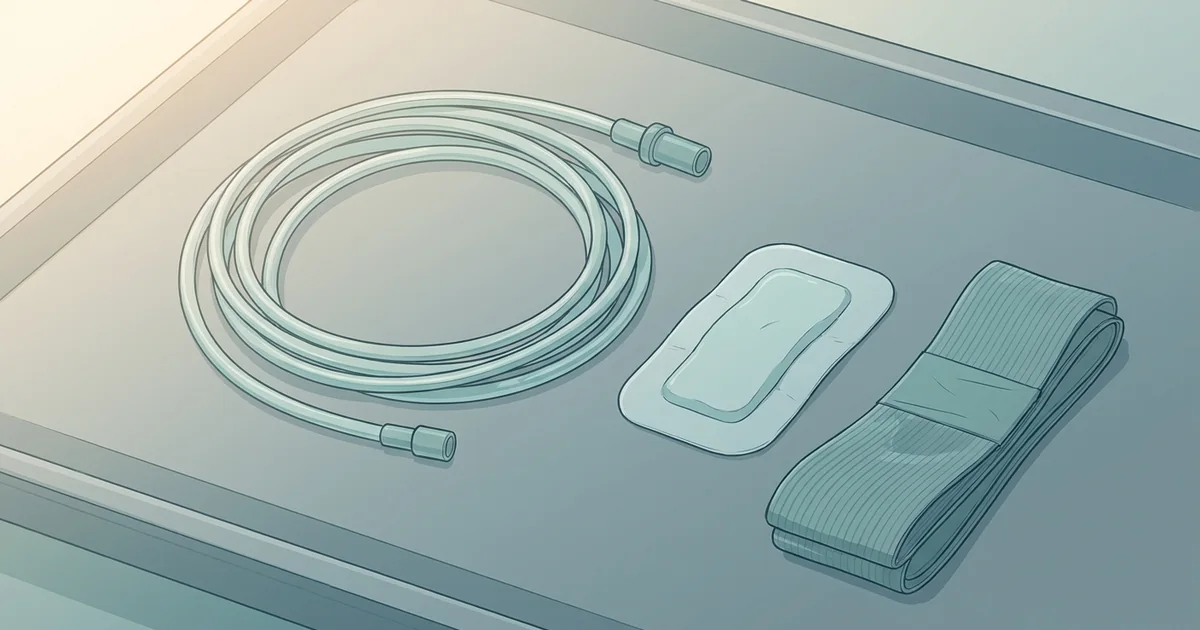
VEMERIX is the international brand of Weihai Medison Medical Equipment Co., Ltd., positioned as a Minimally Invasive Surgery Total Solution Platform serving urology, vascular surgery and perioperative care. Within its urology and perioperative consumables portfolio, VEMERIX publicly lists a Disposable Catheter Securement Set intended for post-procedure catheter stabilization. For hospital buyers and medical-device distributors qualifying single-use perioperative fixation accessories, this listing establishes a direct product inquiry pathway for specification review and sample evaluation.
At the same time, buyers must distinguish general literature on catheter stabilization from product-specific clinical proof. None of the randomized controlled trials reviewed in this article (Intensive and Critical Care Nursing, October 2026; PLOS One, June 2026; Nursing in Critical Care, 2024) evaluated the VEMERIX Disposable Catheter Securement Set, and those trials do not establish product-specific efficacy, infection reduction, pressure-injury prevention, or comparative superiority for the VEMERIX set. Clinical-engineering teams and procurement committees considering any securement consumable should therefore validate performance in their target ICU or postoperative urology workflow using structured local safety and workload audits.