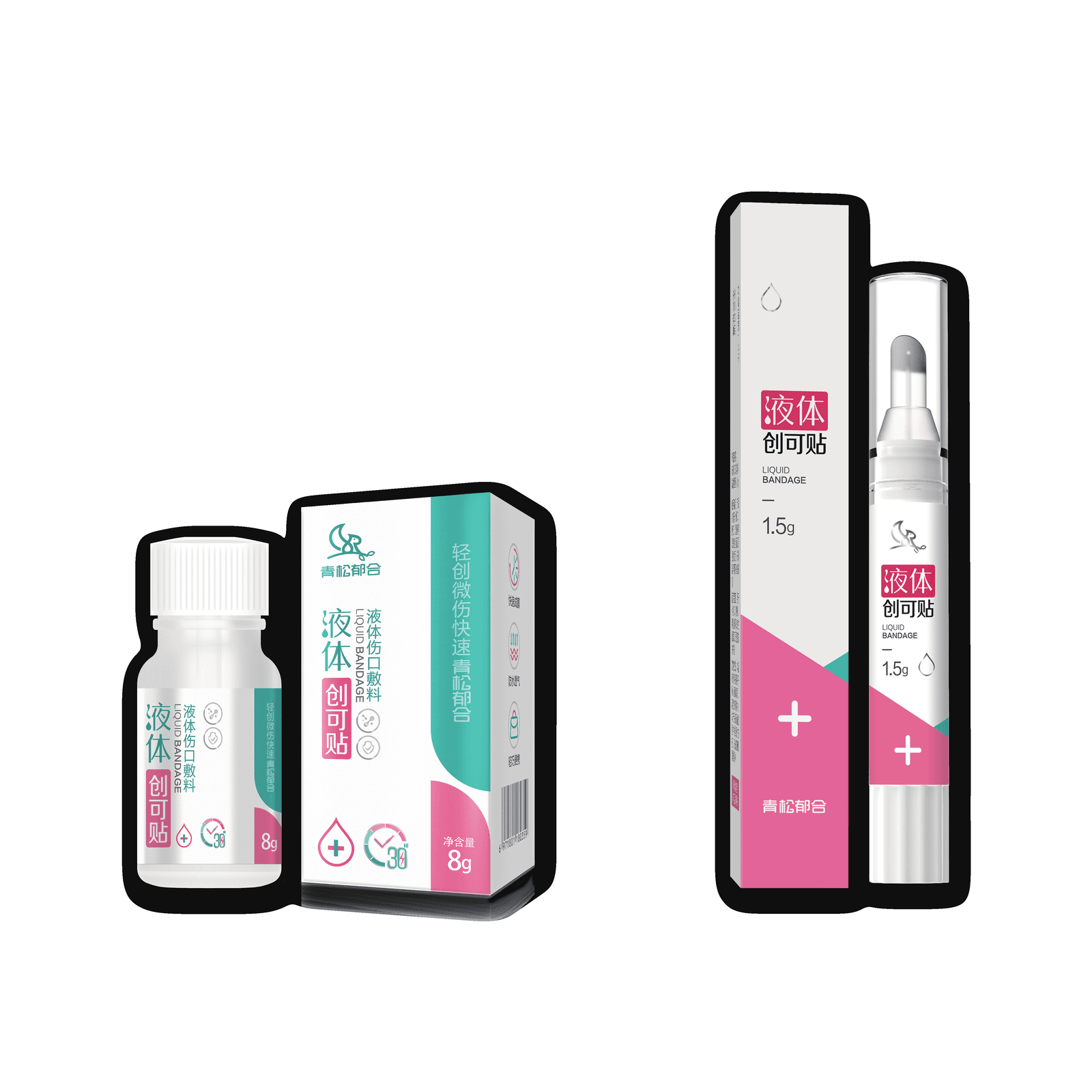
12Wound & Skin · Liquid Bandage
Hyaluronic Liquid Bandage
Liquid wound dressing — sodium-hyaluronate film for minor wounds.
Classification
Class II
NMPA Reg.
Lu Mech Reg. 20180123
A liquid wound dressing that forms a thin protective film on the wound surface, blocking external bacteria and viruses while providing a moist environment for skin tissue healing. Presented under the VEMERIX brand and available for OEM supply.
KEY FEATURES
What makes it work.
- Quickly forms a protective membrane under body temperature
- Physical barrier against external bacteria and viruses
- Re-applicable on thinned areas after one day
- Full peel-and-reapply cycle every 2–3 days
- Online + offline chains, OEM available
APPLICATIONS
Where it's used.
- Care of minor wounds and surrounding skin
- Abrasions and cuts
- Other superficial wounds
CONTRAINDICATIONS
- Non-minor wounds, large abrasions or deep cuts
SPECIFICATIONS
Technical specifications.
Classification
Class II medical device
NMPA registration
Lu Mech Reg. 20180123
Specifications
1.5 g · 8 g
Brand
VEMERIX / OEM
FROM VEMERIX INSIGHTS
Market analysis behind this product
Buyer Guide
What the FDA MAUDE and Recall Record Reveals About Topical Tissue Adhesive Failures: A Post-Market Evidence Map for Procurement and Supplier-Qualification Buyers
An empirical analysis of 1,155 FDA MAUDE device records, 2 recalls, and 36 510(k) clearances for product code MPN, mapping surveillance failure modes to 21 CFR 878.4010 regulatory special controls, Cochrane dehiscence evidence, and buyer tender specifications.
August 12, 2026 · 15 min read
Buyer Guide
Medical Cyanoacrylate Adhesive Supplier Qualification: A Chemistry, Regulatory and Acceptance Guide for Bulk Tissue-Adhesive Buyers
A B2B supplier-qualification framework for bulk medical cyanoacrylate tissue adhesives, covering 2-octyl vs n-butyl chemistry, 2008 FDA Class II reclassification (21 CFR 878.4010, MPN), ISO 10993 biocompatibility, moisture-sensitive aseptic filling, and lot-release acceptance.
August 5, 2026 · 24 min read
Regulatory Guide
Silicone Scar Gel Classification and Claim Substantiation: A US (FDA), EU and China (NMPA) Decision Matrix for Distributors and OEM Buyers
Qualifying a silicone scar gel or sheeting product for international markets requires navigating strict claim-by-claim classification rules across the US (FDA Class I under 21 CFR 878.4025), Europe (EU MDR Class I device vs Cosmetic Regulation boundary), and China (NMPA Class II medical device filing)—where permitted intended-use language, Cochrane evidence certainty, and ISO 10993 biocompatibility requirements set the boundary between compliant commercialization and regulatory rejection.
August 5, 2026 · 14 min read
Regulatory Guide
The Line That Decides the Class: How a Wound Dressing's Claim — Not Its Chemistry — Sets Its Regulatory Class in the US, EU and China
In wound and skin care the label claim, not the material, sets the regulatory class — and because most of the category is 510(k)-exempt in the United States, the public clearance record systematically under-describes who actually supplies it. A primary-source read of 31 FDA product codes, EU MDR Rule 4 and NMPA's 2022 catalogue change.
July 27, 2026 · 27 min read
MORE IN WOUND & SKIN
Related products
Ready to evaluate Hyaluronic Liquid Bandage?
Sample units typically ship under 10 business days for qualified buyers. Distributors — ask about territory exclusivity.