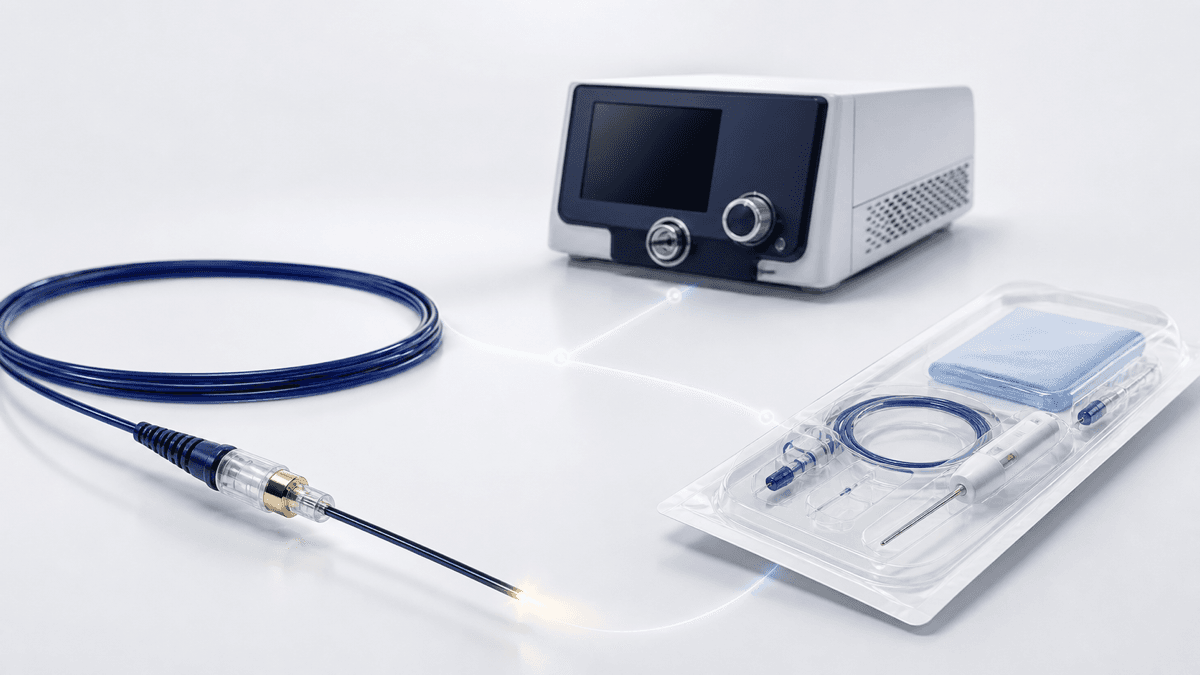
1. The US file names a product code, not a vein
Buyers search endovenous laser fiber 510k and expect a vein-specific class. FDA’s workhorse surgical-laser home is more generic than that.
GEX is a surgical-laser bucket, not an EVLA SKU
The product-classification database in this extract contains 7,084 codes 12. GEX is “Powered Laser Surgical Instrument,” device class 2, regulation 878.4810 1 2. The classification page’s definition is a laser-based device with coherent, collimated, typically monochromatic radiation, typically indicated to cut, destroy, remove or coagulate tissue for general surgical purposes across several specialties. The regulation text itself still identifies a carbon-dioxide laser and an argon laser by name 2. Diode generators used in endovenous work are filed in the same GEX / 878.4810 home. That is a classification fact. It is not a wavelength claim, and it is not a fiber claim.
A radiation-control twin of the same product code sits in FDA’s radiation product-classification view 13. Surgical lasers are dual-tracked: they are medical devices under the Federal Food, Drug, and Cosmetic Act, and they are radiation-emitting electronic products under 21 CFR 1040.10 14. A generator IFU that cites IEC 60601-2-22 (particular requirements for surgical laser equipment) is talking about the source 15. A fiber IFU that cites connector type, core diameter, tip geometry and sterility is talking about the applied part. Those are different evidence packs.
The regulation’s identification paragraph is older than diode EVLA and is worth quoting because buyers treat 878.4810 as if it named their SKU. It identifies (1) a carbon-dioxide laser intended to cut, destroy or remove tissue by light energy emitted by carbon dioxide, and (2) an argon laser intended to destroy or coagulate tissue by light energy emitted by argon; the devices are Class II, with a Class I carve-out for special laser gas mixtures used as a lasing medium 2. GEX’s classification definition is broader than that identification: a coherent, collimated, typically monochromatic source used to cut, destroy, remove or coagulate tissue across general and plastic surgery, dermatology, podiatry, ENT, gynecology, neurosurgery, orthopedics (soft tissue), dental and oral surgery 1. Endovenous diode generators live in that broader GEX practice, not in a dedicated “varicose vein laser” product code. There is no US product code whose name is “1470 nm endovenous fiber.”
GEX is not the only laser code. Gynecologic surgical laser HHR is a separate classification row 16. Adjacent 878.4810 codes in the same 7,084-code file include ONG (powered laser surgical instrument with microbeam/fractional output), NVK (dental soft-tissue laser), OYW (laser for cellulite appearance) and ONO (neurosurgical laser with MR thermography) 12 103 104. Other “laser” codes are ophthalmic, photodynamic-therapy, or non-medical (printers, DVD players, aiming products, tabletop engravers). A compute that greps “laser” without a medical-device filter will count consumer electronics. We filtered to medical laser codes, then split device_name text. That second step is where identity lives.
- Unspecified 'laser'65%(1,872)
- Generator / system28%(792)
- Fiber / consumable7%(190)
- Mentions both0%(14)
View chart data
| Category | Count |
|---|---|
| Unspecified 'laser' | 1872 |
| Generator / system | 792 |
| Fiber / consumable | 190 |
| Mentions both | 14 |
Among 2,868 GEX 510(k) records, the revised device_name heuristic tags 1,872 unspecified, 792 generator/system, 190 fiber/consumable and 14 both. This is a naming split, not EVLA market share.
Source: FDA 510(k) database, export 22 July 2026 — VEMERIX analysis, accessed August 2026
Three counts, one limitation
On 175,559 510(k) records 3 17:
| Slice | n | What it is |
|---|---|---|
| GEX records | 2,868 | The workhorse surgical-laser product code |
| Any medical-laser product code | 3,820 | GEX plus other medical laser codes |
| GEX identity-analysis set | 2,868 | Directly relevant powered-laser surgical-instrument code |
| Unspecified GEX name | 1,872 | Heuristic could not tag fiber or generator |
| Generator or system | 792 | Name contains generator / console / workstation / laser-system / diode-laser language |
| Fiber or consumable | 190 | Name contains fiber / fibres / applicator / radial-tip language |
| Mentions both | 14 | Name contains both families |
The 190 fiber-named GEX records are the commercially interesting minority. They are still a minority of a surgical-laser file that is mostly generator/system names and names too terse to classify. Most of the 1,872 unspecified rows are not mysterious fibers; they are trade names or generic laser names without a reliable object token.
The heuristic under-counts in both directions.
It under-counts fibers that were cleared as accessories inside a system 510(k). If the public device_name is the console, the fiber does not appear in this split even when the submission included delivery fibers.
It can still under-count generators whose trade names omit any source token. K073063 is the public example we use for file identity, not for competitive ranking: device name “15W CERALAS D 1470NM DIODE LASER,” applicant Biolitec, Inc., product code GEX, decision date 2008-02-27 18. The revised rule classifies explicit “diode laser” names such as this as generator/system. That correction is why the generator count increased. String splits are still a map, not a legal opinion: open the named file before deciding what the certificate covers.
A later public file for a related 15 W 1470 nm diode, K082225, uses the device name “15W CERALAS D 1470NM DIODE LASER, MODEL D1470,” same applicant party, still GEX / 878.4810 19. Two public generator-shaped files, one wavelength, no fiber in the title. A distributor who files “1470 nm laser” against those numbers is filing a source, not a disposable applied part.
Named fibers, named kits, named false friends
Public fiber-named examples in the same 510(k) extract are unambiguous about the applied part:
- K921807, “ULTRALINE STERILE DISPOSABLE FIBER,” applicant Heraeus Lasersonics, Inc., GEX, 1992-06-18 20. The regulated object in the title is a sterile disposable fiber.
- K070216, “VARI-LASE BRIGHT TIP FIBER,” applicant Vascular Solutions, Inc., GEX, 2007-03-16 21. The title is a fiber, not a console.
- K124003, “MED-FIBERS SURGICAL LASER FIBER” (and related probes), applicant Med-Fibers, Inc., GEX, 2013-01-17 22. Again a fiber family.
- K060050, “MEGABEAM SIDEFIBER FIBER OPTIC DELIVERY SYSTEM,” applicant Biolitec, Inc. as the public-file party, GEX, 2006-01-23 23. The title is a delivery fiber, not a 15 W generator.
Those four files are identity examples. They are not a league table, and they are not an equivalence claim against any commercial line.
The kit-versus-console contrast is equally public. K112299, device name “ENDOVASCULAR LASER VEIN SYSTEM KIT,” applicant Biolitec Medical Devices, Inc. as the public-file party, GEX, decision 2011-11-03 24. The 510(k) summary names a kit with a radial fiber, access needle, introducer sheath/dilator and guidewire, indicated for endovascular coagulation of the greater saphenous vein in patients with superficial vein reflux. That is a kit file. K073063 is a generator file. Same wavelength family in the public record, two different regulated objects. A tender that asks for “the 1470 laser” without saying kit, fiber or console will be answered with whichever brochure is on the desk.
Generator-named counterparts in the same extract are equally blunt: “BUFFLIGHT CLT SURGICAL LASER SYSTEM” (K000727) 25, “CANDELA SMOOTHBEAM LASER SYSTEM” (K030846) 26, “EQUINOX CO2 LASER SYSTEM” (K100487) 27, “YOULASER CO2 LASER SYSTEM” (K111592) 28, “FOTONA TANDEM LASER SYSTEM” (K022837) 29. The word system in those titles is doing legal work. It is not a synonym for “fiber.”
The heuristic’s false friends belong in the same paragraph as the 190, or the 190 will be over-read.
K833232, “LASER PROTECTIVE EYESHIELD,” product code HQF, 1983-12-30 30. An eyeshield is not an endovenous fiber. K955671, “RITLENG BICAN.LACR.SETS/SELF THREAD. MONOKAS,” product code OKS, 1996-03-06 31. A lacrimal intubation set is not a varicose-vein delivery fiber; “laser” in adjacent classification noise does not make it one. K190685, “Hair Growth System,” product code OAP 32. K223245, “Colibrí,” product code QQV — a laboratory automation name that survived a loose laser-code adjacency 33. K152417, “Adler MicroMed Laser Surgery Fibers” 34, is now correctly tagged fiber because the revised rule includes plurals.
K931776, “DIOMED 25 25W SURGICAL DIODE LASER” 35, is now captured as generator/system by the explicit diode-laser rule. K240816, “MeDioStar,” GEX, 2024-04-23 36, remains a trade name with no fiber/generator token at all. K250431, “Medical Diode Laser Hair Removal System (MNLT-D1),” GEX, 2025-05-12 105, is a hair-removal diode that still sits in GEX. K230228, Iridex 532 / 577 nm ophthalmic lasers, product code HQF 106, is an eye laser, not an EVLA fiber. K844431, “YN CO2 LASER SYSTEM 30W,” HHR, 1985-02-25 107, is a gynecologic CO2 system from a different decade. Unspecified is the honest bucket for trade names. Hair-removal GEX rows are the honest reminder that GEX is not a varicose-vein code.
Read the GEX split as “the public title supplied enough words for this rule.” The 190 fiber, 792 generator/system, 14 both and 1,872 unspecified counts are not US market share for endovenous procedures and are not VEMERIX catalog depth.
Recent decision-year volume in the full 510(k) file is large and mostly not laser: 3,346 records in 2023, 3,129 in 2024, 3,225 in 2025, 1,764 in the partial 2026 extract 3. Applicant-country fill is US-heavy (146,496 of 175,559), with China 5,589 and Germany 2,451 among the next names. Those denominators describe who files 510(k)s, not who sells EVLA fibers. Device class on the full file is mostly Class 2 (136,586) then Class 1 (32,809). GEX’s Class II home is consistent with that majority. It still does not tell a customs broker whether the carton is a console or a pouch of sterile fibers.
PMA silence is not a finding
A first-pass string search of the PMA extract returned zero “laser” hits. That is a likely column miss, not a claim that the United States has no laser PMAs 37. Ophthalmic excimer systems and other Class III laser devices exist in FDA’s PMA database. We did not re-parse PMA indication text for this paper. We therefore do not say there are zero laser PMAs. We say the 510(k) / GEX path is the identity lane we actually computed, and PMA remains an un-scored lane.
GUDID and establishment-registration listing were inspected only as background. They do not replace a 510(k) identity split. Recalls are a thin adjacent lane: 65 laser-regex hits in 58,785 recall rows 38. That is post-market vocabulary, not a clearance-identity table, and it is not a fiber-failure study. Sterile-device recall mechanics live in a separate VEMERIX evidence map 39.
What a US identity check actually answers
A distributor importing a 1470 nm disposable fiber into a US conversation should be able to answer four questions from public files before anyone discusses price:
- Is the US product code GEX (or another named code), and is the regulation 878.4810 1 2?
- Does the 510(k) device name say fiber, kit, generator, or only a trade name 3?
- If the fiber is cleared as an accessory, is it inside a system file or in its own file? The public title will not always say.
- Is the generator a partner’s device? If yes, its 510(k) is not the fiber manufacturer’s 510(k).
VEMERIX, in this line, is the registered single-use-fiber manufacturer. The diode source is partner-supplied 9. A US dossier that blurs those two objects is the same error the foreign registers repeat below, only with a GEX number attached.
2. Eleven public files name three different objects
We keyword-filtered eleven public national files for EVLA / EVLT / endovenous / 1470 / laser fiber / diode laser / varicose-plus-laser. Hits are string matches, not legal sameness, and they are not VEMERIX SKUs.
The denominators matter as much as the hits. A file of 4,740 rows that returns zero laser-regex hits (UAE) is a different statement from a file of 254,292 catalog lines that returns 43 (Ecuador). Grain is the finding.
View chart data
| Category | Laser-regex hits |
|---|---|
| SG HSA | 103 |
| IL AMAR | 88 |
| ID KEMKES | 69 |
| MY MDA | 49 |
| EC ARCSA | 43 |
| CO INVIMA | 29 |
| BR ANVISA | 14 |
| MX COFEPRIS | 8 |
| AR ANMAT | 2 |
| BD DGDA | 2 |
| AE EDE | 0 |
HSA 103, AMAR 88, KEMKES 69, MDA 49, ARCSA 43, INVIMA 29, ANVISA 14, COFEPRIS 8, ANMAT 2, DGDA 2 (RF, not laser), EDE 0. Hits are not VEMERIX SKUs.
Source: National public device registers — VEMERIX analysis, accessed August 2026
| Authority | File grain (rows) | Laser-regex hits | Fiber-named | Generator-named | Unspecified / both | What the hits actually are |
|---|---|---|---|---|---|---|
| Singapore HSA SMDR | 20,860 | 103 | 12 | 43 | 43 / 5 | Strongest split; SMDR is Class B/C/D only |
| Israel AMAR | 29,944 | 88 | 6 | 11 | 70 / 1 | Unspecified-heavy; hair-removal noise |
| Indonesia KEMKES | 82,113 | 69 | 3 | 9 | 57 | Mostly “medical diode laser”; class C common |
| Malaysia MDA | 49,721 | 49 | 4 | 9 | 36 | No class field in this extract |
| Ecuador ARCSA | 254,292 | 43 | 16 | 2 | 20 / 5 | Catalog grain; 16 “fiber” lines can share a certificate |
| Colombia INVIMA | 431,021 sanitary rows | 29 | 15 | 0 | 14 | 15 “fiber” rows are GreenLight catalog lines under one registro |
| Brazil ANVISA | 102,659 | 14 | 2 | 0 | 12 | Includes VenaCure EVLT kit rows |
| Mexico COFEPRIS | 21,654 | 8 | 3 | 1 | 4 | Issuance list; three “SURGICAL OPTICAL FIBER” |
| Argentina ANMAT | 47,325 | 2 | 0 | 0 | 2 | Both “Sistema Láser de diodo 1470nm,” 1107-46 |
| Bangladesh DGDA | 4,422 | 2 | 0 | 0 | 2 | RF ClosureFast, not laser |
| UAE EDE | 4,740 | 0 | — | — | — | No laser-regex hit |
View chart data
| Category | Fiber-named | Generator-named |
|---|---|---|
| SG | 12 | 43 |
| IL | 6 | 11 |
| ID | 3 | 9 |
| MY | 4 | 9 |
| EC | 16 | 2 |
| CO | 15 | 0 |
| BR | 2 | 0 |
| MX | 3 | 1 |
| AR | 0 | 0 |
HSA is the strongest split (fiber 12 / generator 43 / unspecified 43). ANMAT's two hits are the same 1470 nm 'sistema'. ARCSA's 16 'fiber' hits can be catalog lines under one certificate. DGDA's two hits are Medtronic RF catheters.
Source: National public device registers, device-name heuristic — VEMERIX analysis, accessed August 2026
The thesis does not need every row to be an EVLA fiber. It needs the opposite: the same search string lands on different legal objects in different capitals. A distributor who copies a Singapore SMDR number onto an Argentine “sistema” file, or who treats a Bangladeshi RF catheter as laser evidence, is answering the wrong identity question.
Singapore: SMDR is not Infosearch, and Class A is a different database
HSA’s public Infosearch portal points at two medical-device lists that buyers conflate 40 41. The Singapore Medical Device Register (SMDR) is the listing of devices that underwent product registration — Class B, C and D 42 43. Class A devices are exempted from product registration; they are notified and appear in the Class A Medical Device Database, a self-declaration list HSA itself says is unverified and is not an endorsement or a registration 44 45 43. Determine the fiber’s intended use and Singapore risk class before choosing either database; the report’s public files do not establish that class. Ask which database the relevant identity lives in before you put it in a tender.
HSA’s registration overview also distinguishes evaluation routes for Class B/C/D (full, abridged, expedited, immediate) that depend on prior approvals in named reference agencies 43. Those routes change how long a listing takes. They do not change what object is listed. An abridged console registration is still a console. An immediate-route kit listing is still a kit. Do not brief a tender board that “Singapore has 103 lasers” as if route and identity were the same number.
Our 103 hits are SMDR-shaped rows in a 20,860-row extract whose risk-class fill is B 11,968 / C 6,296 / D 2,596 — no Class A, because SMDR does not list Class A as registered products 42. The identity split is the strongest of the eleven files: fiber-named 12, generator-named 43, unspecified 43, both 5.
That split is still a heuristic. Some “fiber” tags are not endovenous delivery fibers. A KARL STORZ “LASER Suction Tube” (Class B) is a suction tube with “laser” in the name. A Merit Mini Access Kit is an access kit. Boston Scientific Flexiva Pulse ID High Power Single-Use Laser Fibers (Class B) is a real fiber listing — urology, not varicose veins, but it is a fiber certificate. AngioDynamics Venacure Endovenous Laser Treatment (EVLT) Procedure Kit (Class B, DE0009109) and the related perforator-vein ablation kit (DE0009108) are kits. AngioDynamics Delta 15/30 Diode Laser (Class C, DE0008660) is a diode. Alma 1470 Surgical Diode Laser System (Class C, DE0018118) is a system. Wuhan Gigaa VELASII-30B Medical Diode Laser System (Class C, DE0501903) is a system. The same authority files the kit, the diode and the “laser system” as different listings. That is the Singapore lesson. It does not require a brand comparison. It requires reading the SMDR line.
Israel: 88 hits, 70 unspecified, and 1470 in the title is still not a fiber
AMAR’s public medical-equipment function sits with the Ministry of Health’s Medical Equipment Division 46. The extract is 29,944 rows. Laser-regex hits: 88. Identity: fiber 6, generator 11, unspecified 70, both 1.
Unspecified is the Israeli grain. Many titles are “Diode Laser Hair Removal System,” “Dermatological Diode Laser Systems,” or a platform trade name. Those are not EVLA fibers. They survived the keyword because “diode laser” is in the regex. Publish that. A 1470 nm string in an Israeli title is still not a fiber certificate: “Velas 30, Galaxy, Galaxy Vein, 1470 nm Diode Laser, Velas II - 30B” and “The Galaxy Vein 1470 nm Laser System” are source-shaped names. Fiber-named rows include “Medilas Laser Fiber Cables” and “Laser Surgery Fiber” — delivery cables, not generators. RF lookalikes are in this file too: ClosureFast Endovenous Radiofrequency Ablation Catheter and ClosureRFS stylet. Endovenous in the title is not laser in the physics.
Israel is useful as a caution against counting hits. Eighty-eight is a large number. Seventy of them do not even claim to be a fiber or a generator in the name.
Indonesia: three fibers in sixty-nine hits, and class C is not Class III
Kemenkes publishes registration at Regalkes and a public e-Info Alkes PKRT search for izin edar 47 48. The extract is 82,113 rows. Laser-regex hits: 69. Fiber-named 3, generator-named 9, unspecified 57.
The three fiber names are the identity signal: MED-FIBERS Surgical Laser Fiber (AKL 21603917519, class c), BIOAER Disposable Medical Laser Fiber (AKL 21603621185, class c), ACCU-TECH Holmium Laser Fiber (AKL 21603325110, class c). The third is a holmium urology fiber. Keyword “laser fiber” does not mean 1470 nm EVLA. Indonesian class c on those rows is Indonesia’s risk class, not China’s NMPA Class III, and not a reason to call a fiber a Class III system.
The rest of the Indonesian 69 is a class-C diode stack with a few class-B outliers. Titles repeat manufacturer families: multiple WIOON / PIOON “Medical Diode Laser” AKL numbers, GIGAALASER / VELAS “Medical Diode Laser Systems,” DIMED BERYLAS and CHERYLAS rows, dental Woodpecker and Lazon rows, hair-removal SANO rows, and 980 nm + 1470 nm aesthetic diode titles. Those 1470 nm strings are still not fiber certificates. A distributor who greps “1470” in Kemenkes and files a fiber against a diode AKL has performed the Argentine error in Bahasa. Public search for izin edar is Info Alkes; the registration workspace is Regalkes 47 48. Use both. Quote the product name on the izin, not the keyword that found it.
Unspecified Indonesian rows are mostly “Medical Diode Laser” / “Medical Diode Laser Systems” listings, plus VENACURE EVLT (AKL 21603520187, class c) as a procedure-name listing, plus CLOSUREFAST Endovenous Radiofrequency Ablation Catheter (AKL 21603718424) as an RF false friend. Generator-named rows include dental diode “systems” and a CURAWAY Endovenous Radiofrequency Generator (AKL 21603420986). The heuristic tagged a radiofrequency generator because the word “generator” matched. Publish that miss next to Bangladesh. Endovenous plus generator is not laser.
Malaysia: forty-nine hits, no class in the extract, four fiber names
The Malaysia Medical Device Register public search is the buyer-facing MMDR 49 50. The extract is 49,721 rows with no risk-class field in this v2 cut. Laser-regex hits: 49. Fiber 4, generator 9, unspecified 36.
Fiber-named titles are terse: “LASER FIBER,” “MEDICAL LASER OPTICAL FIBER,” “ACCUMAX AND ACCUTRAC HOLMIUM LASER FIBER,” and another “LASER FIBER.” Holmium again. Generator-named titles are often “DIODE LASER SYSTEM,” plus “FOX IV DIODE LASER SYSTEM-810NM,” plus “ENDOVENOUS RADIOFREQUENCY GENERATOR AND CATHETER” — RF, not laser, tagged generator because of the word. Unspecified rows include “MEDICAL DIODE LASER SYSTEMS (VELASII-30B),” “GEMINI 810 + 980 DIODE LASER,” “SWING SURGICAL DIODE LASER,” and a stack of dental diode names. Malaysia is a title-only file in this extract. Without a class column, a distributor cannot even quote a Malaysian class from this table. Open MMDR and read the listing. MDA’s public search also covers registered CABs, licensed establishments under the Medical Device Act 2012 (Act 737), and notified devices under the 2016 exemption order 49. Those extra tabs are useful for “who may import.” They still do not turn “DIODE LASER SYSTEM” into a fiber. If the MMDR product name is four words, the dossier’s first sentence should be those four words.
Ecuador: forty-three hits on a catalog, not on forty-three certificates
ARCSA is Ecuador’s sanitary authority 51. The extract is 254,292 rows against 23,198 unique registration numbers. That ratio is the grain. Laser-regex hits: 43. Fiber-named 16, generator-named 2, unspecified 20, both 5.
The 16 fiber tags are not 16 EVLA fibers. They include “Laser Flat Wire Stone Extractor Accepts Optilite Laser Fiber Size 273 Micron,” holmium single-use fibers, coaxial stone extractors “for Rocamed Laser Fiber,” SlimLine SIS (FIBERS), and “Surgical Optical Fiber.” Several share a registration number across catalog lines (DM801013, 11128-DME-0121, 5243-DME-0718, 19600-DME-1025). Count certificates, not SKU lines, or you will brief a tender board that Ecuador has sixteen fiber registrations when it has fewer certificates with many catalog rows.
Generator-named Ecuador rows include “neoV 1470nm Laser System” and “neoV 1470nm Laser System WITH ACCESSORIES” — both under 11549-DME-0421. That is a 1470 nm system certificate with two catalog titles. Unspecified rows include VENACURE EVLT and VENACURE EVLT PROCEDURE KIT, ClosureFast RF catheters (again), dental diode devices, and “OS4 SURGERY SYSTEM … WITH ENDOLASER.” Endolaser in an ophthalmic phaco system is not EVLA.
Ecuador is the catalog-grain lesson. INVIMA is the same lesson with a different language.
Colombia: fifteen “fiber” hits that are one GreenLight registro, plus tattoo-needle noise
INVIMA’s public consulta and dispositivos-médicos pages are the official landings; the compute used the datos.gov.co sanitary-registration snapshot (6 July 2026): 431,021 rows, 33,154 unique registro numbers 52 53 54. Laser-regex hits: 29. Fiber-named 15, generator-named 0, unspecified 14.
The 15 fiber tags are catalog repeats of FIBRAS GREENLIGHT under INVIMA 2019DM-0019379, class IIa, estado Vigente, brand lines AMERICAN MEDICAL SYSTEMS / MOXY / GREENLIGHT HPS. That is a urology GreenLight fiber sanitary registration exploding into fifteen spreadsheet rows. It is not fifteen EVLA 1470 nm fibers. It is not a VEMERIX SKU. Unique-registro thinking would collapse those fifteen hits toward one certificate.
Unspecified INVIMA rows include CONJUNTO PARA PROCEDIMIENTOS VENACURE EVLT (INVIMA 2025DM-0031796, class IIa) — a procedure kit conjunto — plus ENDOLASERENDOLASER VASCULAR in En Estudio with a null registro, plus a run of tattoo-needle rows that matched because the regex is not a clinician. Publish the tattoo miss. A keyword that cannot tell GreenLight urology fibers from tattoo needles cannot be quoted as “Colombia’s EVLA fiber market.”
INVIMA risk-class vocabulary in the full file (I, IIa, IIb, III) is Colombia’s, not NMPA’s. Do not translate IIb on an ENDOLASER row in study status into a Chinese Class III claim on a partner diode.
Brazil: kit rows, two optical-fiber rows, and class is ANVISA’s
ANVISA’s consultas portal and the published list of regularized medical devices are the landings 55 56. The extract is 102,659 rows. Laser-regex hits: 14. Fiber-named 2, generator-named 0, unspecified 12.
The two fiber names are “Single Use Optical Fiber - Quanta System” (reg 81890960017, class iii) and “Reusable Optical Fiber - Quanta System” (81890960018, class iii). Those are optical fibers, and they are ANVISA class III in this file — Brazil’s class, not a reason to call VEMERIX’s NMPA Class II fiber a Class III system.
Unspecified Brazilian rows are the identity lesson the June paper does not own: VenaCure EVLT kit titles (NeverTouch Direct; Spotlight OPS sheath; 400 micrometre fiber kit; NeverTouch-FRS), plus a VenaCure introducer (class ii) and dilatator (class ii), plus GeminiEVO 810+980 Diode Laser (class iii), plus Venclose radiofrequency catheter (class iii), plus ophthalmic endolaser probes. Brazil files the kit, the introducer, the fiber, and the diode as different rows, and it also files RF in the same keyword net. A distributor who registers “EVLT” as one product in Brazil is not reading ANVISA’s own titles.
Mexico: eight hits on an issuance list
COFEPRIS is the Mexican landing 57. The extract is 21,654 rows (issuance list grain). Laser-regex hits: 8. Fiber-named 3, generator-named 1, unspecified 4.
All three fiber hits are titled SURGICAL OPTICAL FIBER, class ii, three different registro strings (2157C2024 SSA, 1017E2017 SSA, 1441E2025 SSA). The generator hit is DENTAL DIODE LASER SYSTEM, class ii. Unspecified includes GEMINI 810 + 980 DIODE LASER, DOCTOR SMILE DIODE LASER, ENDOLASER 120, and MEDTRONIC CLOSURERFS ENDOVENOUS RADIOFREQUENCY STYLET (class iii). Mexico, in this small cut, already separates optical fiber (ii) from RF stylet (iii) from dental diode system (ii). Eight is not a market. It is enough to stop treating “láser” as one class. COFEPRIS issuance lists also move: a 2024 SSA string and a 2017 SSA string for the same generic title “SURGICAL OPTICAL FIBER” are different listings, not one fiber sold twice. Quote the registro, not the English generic name, when the officer asks which certificate covers the shipment 57.
Argentina: two hits, one 1470 nm system, not a fiber
ANMAT is the Argentine landing 4. The extract is 47,325 rows. Laser-regex hits: 2. Both product titles are “Sistema Láser de diodo 1470nm.” Both carry process/reg 1107-46. Fiber-named: 0. Generator-named: 0. The Spanish word is sistema. The wavelength is 1470 nm. The regulated object in the public bulletin line is a system, not a disposable fiber.
If a buyer’s mental model is “1470 nm means the VEMERIX fiber,” Argentina is the counter-example. Wavelength in a register title does not name the applied part. Do not brief an Argentine officer that a Class II fiber certificate from Shandong is the same object as registro 1107-46. Verify the named object. If the local file is a system, the system holder’s IFU and class apply. If the imported line is a single-use fiber, that fiber needs its own identity in the dossier.
Bangladesh: two hits, both RF — publish the miss
DGDA is the Bangladeshi landing 5. The extract is 4,422 rows. Laser-regex hits: 2.
- “Closurefast Endovenous Radiofrequency Ablation Catheter,” Covidien USA, class c, reg 467-6508-019.
- “Closure RFS Endovenous Radiofrequency Stylet,” Precision Concepts Costa Rica SA for Medtronic Inc., class b, reg 467-8430-2022.
Radiofrequency. Not laser. The regex caught “endovenous.” The physics is RF. A careless slide that says “Bangladesh has two laser registrations” is false. The honest sentence is: a laser keyword net in DGDA returned two RF ablation devices. We publish the miss so nobody repeats it.
UAE: zero in 4,740 directory rows is a file fact, not an empty market
Emirates Drug Establishment’s medical-device marketing-authorization service is the official UAE landing; the public registered-product directory is a separate search 58 59 60. The extract is 4,740 directory rows, all status active. Laser-regex hits: 0.
Zero is not “the UAE does not use EVLA.” Zero is “this directory extract did not contain a string our regex would fire on.” Different portals (drug directory versus device MA) mix grain. A distributor who needs a UAE listing must search EDE’s device pathway, not infer absence of procedures from a 4,740-row miss. We still report the miss, because an empty cell that gets quietly dropped is how keyword papers start lying.
EUDAMED and recalls: noisy denominators, not a European class for this fiber
EUDAMED’s public device module is the EU landing 61. The model-level extract is 2,926,029 rows; laser-regex hits: 770. Risk-class fill on the full extract is dominated by Class I and IIa codes in EUDAMED’s refdata vocabulary; that mix is the EU database as a whole, not an EVLA subset. Seven hundred and seventy includes every model whose free text mentioned laser. We do not convert 770 into “EU EVLA fiber registrations.” We do not claim a portfolio-wide CE mark for VEMERIX. Only named CE-marked SKUs in the company’s own materials carry CE language; the laser fiber is not one of them 9 10. Regulation (EU) 2017/745 is the EU device law a European importer would map a fiber into; it is cited here as the destination rulebook, not as a VEMERIX CE claim 112.
FDA recall-database laser-regex hits: 65 of 58,785 38 62. Useful as a reminder that “laser” appears in post-market files. Not a fiber-versus-generator identity table.
What the eleven files jointly prove
They do not prove how many EVLA fibers are sold. They prove that identity is local:
- Argentina names a 1470 nm system.
- Singapore names kits, diodes, systems and some fibers, and keeps Class A in another database.
- Brazil names kits and fibers on separate rows, with introducers on still other rows.
- Colombia’s “fiber” count is GreenLight catalog grain.
- Ecuador’s “fiber” count is urology catalog grain.
- Bangladesh’s “laser” count is RF.
- UAE’s count is zero in this directory.
A distributor’s pack that contains one brochure titled “1470 nm EVLA laser” will match exactly one of those identities by accident. The rest of the time it will not.
3. Trials name procedures and wavelengths
ClinicalTrials.gov is a protocol registry, not a device register 6 63. Sponsors title studies for clinicians. They name the procedure (EVLA, EVLT, endovenous laser ablation), the vein (GSV, SSV, perforator), the comparator (RF, steam, stripping, foam), and sometimes the wavelength (940 nm, 1470 nm, 1920 nm, 1940 nm). They almost never name a fiber SKU or a 510(k) number.
View chart data
| Category | Hits |
|---|---|
| All CT.gov studies scanned | 588016 |
| Loose laser/vein regex (rejected) | 428 |
| Documented EVLA/EVLT/endovenous+laser | 45 |
588,016 ClinicalTrials.gov studies scanned. Loose filter 428 (includes acne 1450 nm, BRVO, glaucoma). The documented endovenous/saphenous/EVLT/EVLA + laser rule yields 45 after coronary-bypass and saphenous-harvesting exclusions.
Source: ClinicalTrials.gov public protocol records — VEMERIX analysis, accessed August 2026
We scanned 588,016 study records. A loose laser-plus-vein regex returned 428. That filter is rejected. It includes:
- NCT00306371, “Comparison of Stacked-Pulses Vs. Double-Pass Treatments of Facial Acne With a 1450 Nm Laser” 64
- NCT00642226, “Combined Vitrectomy and Triamcinolone in Macular Edema Secondary to Branch Retinal Vein Occlusion (BRVO)” 65
- NCT01051583, “Avastin as an Adjunct to Diode Laser in the Treatment of Neovascular Glaucoma” 66
- NCT00443664, external micropulse diode laser trabeculoplasty for glaucoma 67
- NCT00552435, micropulse 810 nm diode for diabetic macular edema 68
- NCT00757536, vitrectomy with endolaser for retinal detachment 69
Acne, BRVO, glaucoma, macular edema, retinal endolaser. The word “vein” or the word “laser” is doing the wrong job. 428 is not the EVLA corpus. Use 45: the documented endovenous / saphenous / EVLT / EVLA-plus-laser cut after excluding coronary-bypass and saphenous-harvesting false positives.
The 45 are still a naming study, not an efficacy meta-analysis. We do not quote occlusion rates or healing rates from them. We quote what the title thinks the device is.
Examples that name wavelength or modality, not SKU:
- NCT01637181 — 940 nm versus 1470 nm laser ablation of the great saphenous vein 70. The title’s objects are wavelengths and a vein.
- NCT01722019 — radiofrequency versus 1470 nm diode laser 71. The objects are two energy modalities.
- NCT02046967 — “Steam Ablation Versus Endovenous Laser Ablation for the Treatment of Great Saphenous Veins” 72. The objects are procedures.
- NCT00841178 — “Endovenous Laser Therapy (EVLT) for Sapheno-Popliteal Incompetence and Short Saphenous Vein (SSV) Reflux: A RCT” 73. The object is EVLT as a procedure on the SSV.
- NCT01972633 — 1470 nm laser versus VNUS Closure Fast for truncal-vein obliteration 74. Wavelength versus an RF trade-method, still not a fiber SKU.
- NCT00509392 — ClosureFAST versus laser ablation for GSV disease 75.
- NCT02236338 — radiofrequency ablation versus laser ablation of the incompetent greater saphenous vein 76.
- NCT02248740 — the same contrast on the small saphenous vein 77.
- NCT02017106 — concomitant or sequential phlebectomy after EVLT 78. The laser is assumed; the question is phlebectomy timing.
- NCT00565604 — endovenous laser ablation for incompetent perforator veins 79.
- NCT02504684 — 1920 nm versus 1470 nm diode for saphenous reflux 80.
- NCT07603570 — EVLA with 1940 nm versus 1470 nm 81.
- NCT06913322 — flush versus standard distance from the saphenofemoral junction in EVLA of the GSV 82. The variables are anatomy and technique.
- NCT05001776 — EVLA in acute thrombophlebitis of the varicose GSV 83.
- NCT00861484 — “Proof of Mechanism in ELT” 84. Even “ELT” is a procedure acronym.
- NCT00621062 — prospective randomized trial of “new endovenous procedures” versus conventional surgery for GSV incompetence 108. The title’s objects are procedure classes, not SKUs.
- NCT00529672 — “Surgery or Noninvasive Therapy for Varicose Veins” 109. Noninvasive is a basket. It does not name a fiber.
- NCT05707169 — compression after EVLA; the protocol text that is public names 1470 nm and a radial fibre as the technique, still not a catalog number 110.
A protocol that compares 940 nm to 1470 nm is not a fiber 510(k). A protocol that compares RF to a 1470 nm diode is not a generator registration in Malaysia. The third identity pattern is: clinical literature names the energy and the vein; registers name the box; Medicare names the CPT. Those three vocabularies only meet if a human maps them.
Society guidelines use the same procedure vocabulary. The 2022 SVS / American Venous Forum / American Vein and Lymphatic Society Part I guidelines recommend endovenous ablation over high ligation and stripping for appropriate axial reflux, and discuss EVLA and radiofrequency as named treatments, not as SKUs 85. Part II (2023) continues the procedure-level recommendations 86. The supporting systematic review is likewise a treatment-comparison review 87. NICE’s endovenous laser guidance (IPG52, now presented as HealthTech guidance HTG26) describes the procedure as placing a catheter, passing a laser fibre through it, and applying diode energy while withdrawing the fiber 88 89. The public procedure chapter is explicit about the two objects: under ultrasound guidance a catheter is placed in the long saphenous vein; a laser fibre is passed through that catheter and positioned below the saphenofemoral junction; tumescent anaesthetic is injected; the fibre is withdrawn while energy from a diode laser is applied 113. The 2004 text names 810 nm or 940 nm as example diode wavelengths. That is historical procedure language, not a claim that 1470 nm is absent from later practice, and not a clearance for any SKU. The identity point is the grammar: fibre is the applied part that is withdrawn; diode laser is the source that emits. NICE CG168 on varicose veins in the legs is a care-pathway document, not a device-register document 90.
None of that is a reason to re-argue the June stripping-to-ablation thesis 11. It is a reason to stop treating a trial title as a registration identity.
4. Medicare pays a CPT, not a SKU
The US paid object for endovenous laser is a destruction code, not a GEX number and not a fiber catalog code.
CMS’s Physician/Supplier Procedure Summary (PSPS) is a calendar-year summary of Medicare Part B carrier and DME fee-for-service claims, organized by carrier, locality, HCPCS code, modifier, specialty, type of service and place of service 7 91 92 93. A public version suppresses small cells. The National (capital N) facility-plus-office totals below are recomputed 2024 National F+O services for the endovenous ablation family. They are services, not unique patients, not Medicare Advantage, not commercial, not global procedure share, and not VEMERIX sales.
CMS HCPCS / CPT descriptors, as used in Medicare contractor vein-ablation instructions, name the energy and the vein treated, not the disposable 8 94 95 96:
| HCPCS | Descriptor (energy + sequence) | 2024 National F+O services |
|---|---|---|
| 36478 | Endovenous ablation therapy of incompetent vein, extremity, inclusive of all imaging guidance and monitoring, percutaneous, laser; first vein treated | 32,107 |
| 36479 | Same, laser; subsequent vein(s) treated in a single extremity, each through separate access sites | 3,777 |
| 36478 + 36479 | Laser family | 35,884 |
| 36475 | Same structure, radiofrequency; first vein treated | 86,009 |
| 36476 | Radiofrequency; subsequent vein(s) | 3,920 |
| 36475 + 36476 | RF family | 89,929 |
| 36482 | Chemical adhesive; first vein treated | 52,024 |
| 36483 | Chemical adhesive; subsequent | 1,681 |
| 36482 + 36483 | Chemical family | 53,705 |
| 36473 | Mechanochemical; first vein treated | 1,327 |
| 36474 | Mechanochemical; subsequent | 100 |
| 36473 + 36474 | MOCA family | 1,427 |
View chart data
| Category | 2024 National services |
|---|---|
| RF 36475+36476 | 89929 |
| Chemical 36482+36483 | 53705 |
| Laser 36478+36479 | 35884 |
| MOCA 36473+36474 | 1427 |
Laser (36478+36479) 35,884 services; RF (36475+36476) 89,929; chemical 53,705; mechanochemical 1,427. This is a CPT destruction code, not a fiber 510(k) number, not unique patients, not global share.
Source: CMS Physician/Supplier Procedure Summary, 2024 National — VEMERIX analysis, accessed August 2026
Laser is real in this file. It is smaller than RF and smaller than chemical adhesive. That ranking is Medicare FFS 2024, not a global share, and it is not a reason to restage the June market-shift charts 11. The identity point is simpler: 36478 does not contain a 510(k) number. A hospital that bills 36478 has attested to a laser ablation service. It has not told CMS whether the fiber was a named GEX accessory, a kit component, or a partner-sourced disposable.
Place-of-service inside the same National cut is office-weighted for laser (facility 3,379 + office 32,505 = 35,884) and even more office-weighted for RF (facility 8,242 + office 81,687 = 89,929) 7. Subsequent-vein add-on codes are small relative to first-vein codes in every family (laser 3,777 subsequent versus 32,107 first). Add-ons are extra veins, not extra patients. Do not divide 35,884 into “35,884 people received EVLA.”
A Medicare administrative contractor’s vein-ablation page lists 36475/36476 next to 36478/36479 next to 36482/36483 as parallel percutaneous ablation families 96. Parallel CPT families are the US reimbursement identity. They are not a register identity. A distributor who ships a fiber into a US outpatient lab still needs the device file from section 1. The CPT file from this section only answers “did Medicare pay for a laser service.”
Three limits belong next to the 35,884, because they are the same limits that make CMS a context lane rather than a market-share headline.
This is fee-for-service. Medicare Advantage, Medicaid, commercial, VA and cash-pay are outside the count. An office-based vein clinic whose book is commercially insured will not look like this National row.
These are professional/carrier services in PSPS, summarized by HCPCS, not DME rental lines for a capital console and not a linked episode file that ties 36478 to a named fiber UDI 91 92. You cannot read 35,884 as “35,884 VEMERIX fibers” or as “35,884 generators.”
National is facility plus office as used in this recompute. Place-of-service mix is a setting fact (laser’s office 32,505 versus facility 3,379). It is not a stocking formula. Subsequent-vein add-ons (36479 = 3,777) are extra access sites on an extremity, not extra people 8.
The Physician & Other Practitioners by Provider and Service public file is a related CMS lane with the same professional-service logic; we cite it so a reader who knows that file does not think we invented a private extract 93 111. The locked totals in the table are the 2024 National F+O HCPCS family sums stated above.
5. What belongs in the distributor’s register and tender pack
The practical question is the one the brief set: an international distributor or hospital procurement lead must tell a registration officer, customs broker or tender board whether the regulated object is a single-use fiber, a diode generator, or a system — and stock the line that matches the certificate.
Name the object in the first sentence of the dossier
Write the object in the same grammar the destination register uses.
If the imported line is VEMERIX’s flagship, the sentence is: Disposable Medical Laser Fiber, NMPA Lu Mech Reg. 20192010517, Class II, 1470 nm, single-use, paired with a partner-supplied diode source 9 97. Verify that number on NMPA’s public inquiry landing; do not attach an invented certificate PDF to an email and call it verified 97 98. Class II is the Chinese class of this fiber. It is not a Class III claim on a laser system. The company holds NMPA registrations across classes; Class III in the portfolio is not this fiber 10.
If the destination file is a generator, the sentence names the generator’s certificate, IEC 60601-2-22 evidence, 21 CFR 1040.10 / GEX file if the US is in scope, and the partner legal manufacturer 15 14 1. Do not paste the fiber’s NMPA number into a generator row.
If the destination file is a kit (Brazil and Singapore both file EVLT kits as kits), the sentence lists every component the kit certificate covers: fiber, sheath, wire, needle. A fiber-only shipment is not that kit.
If the destination file is a sistema (Argentina 1107-46), the sentence says system. A fiber IFU is not a system certificate.
Put four evidence objects in the pack, not one brochure
1. Fiber certificate and IFU. The applied-part identity: generic name, registration number, class, intended use, wavelength the fiber is designed for, sterility, single-use statement, connector family. For VEMERIX that starts with Lu Mech Reg. 20192010517 and the product IFU 9. ISO 13485 is the quality-system envelope, not a substitute for the device certificate 10 99.
2. Source IFU, separately. Partner-supplied diode: wavelength, power, output port, compatible fiber specification, IEC 60601-2-22 particular standard, and that manufacturer’s registration in the destination market if the generator is being placed 15. Compatibility is a specification match, not an equivalence slogan against a named competitor.
3. Classification that matches the object. US: GEX / 878.4810 if that is the file, and a 510(k) whose device name matches fiber or kit or generator 1 2 3. Singapore: SMDR versus Class A Infosearch 40 43. Malaysia: MMDR listing with the actual registered name 49. Brazil: ANVISA class on that row, not a translated Chinese class 55. Do not write “NMPA Class III laser system” on any of these pages.
4. A negative list. What this pack is not: a portfolio-wide CE claim; a healing-rate claim; a CPT as a device registration; a Bangladesh RF catheter as laser evidence; an Ecuador catalog line as a unique certificate; an INVIMA GreenLight fiber as a 1470 nm EVLA fiber.
The single-use consumable thesis is the commercial reason this pack exists: the recurring object is the sterile applied part 100. Contract-manufacturing due diligence still applies to whoever makes that applied part 101. This paper does not replace those two pieces. It tells the registration officer which object those pieces describe.
Copy-ready questions for the RFQ and the register filing
Ask these before the first shipment, in the destination language if the officer will read them:
- What is the exact registered name on the destination certificate — fiber, kit, generator, or sistema?
- What is the registration number, and in which database (SMDR versus Class A; MMDR; ANVISA consultas; INVIMA consulta; NMPA inquiry)?
- What risk class is on that certificate, in that country’s vocabulary?
- Does the certificate cover the sterile single-use fiber being shipped, or only a capital source?
- If a generator is in the same theatre, who is its legal manufacturer, and where is its certificate?
- Are catalog lines under one certificate (Ecuador, INVIMA) being counted as separate registrations?
- Has anyone run the keyword “endovenous” and filed an RF device as laser (Bangladesh, and RF rows in Israel, Indonesia, Malaysia, Mexico, Brazil)?
If the answers are “it is a 1470 laser” four times, the identity has not been specified.
Customs and HS codes will not rescue a bad identity. We did not use UN Comtrade as a lane because there is no honest HS heading that means “endovenous laser fiber” as opposed to optical fiber, surgical instruments or lasers as capital goods. A broker who enters a generator HS on a carton of sterile pouches, or the reverse, is making the same noun error in tariff language. Label copy should repeat the registered generic name and the registration number, not the marketing phrase “EVLA laser.” UDI, where the destination requires it, attaches to the object on the certificate. A fiber UDI on a generator listing is a mismatch; a generator UDI on a fiber shipment is a mismatch.
Singapore adds a dealer-licence layer on top of SMDR: importing and supplying still need the appropriate HSA dealer licence even after the device is listed 41 43. Malaysia’s MMDR public search also exposes establishment licences under Act 737 next to device listings 49. Those are who may import, not what the device is. Put the dealer licence in the operations pack. Do not use it as a substitute for the device identity.
Where VEMERIX fits, tightly
VEMERIX is Weihai Medison’s export brand 102. Its company materials describe the laser-line flagship as a Class II disposable fiber, not a laser-system OEM story 9. Verify the cited number with NMPA before a filing. The June paper is the place to read why endovenous ablation displaced stripping 11. This paper is the place to stop a distributor from registering the box and shipping the fiber.
Do not benchmark this fiber against any named 510(k) holder. K073063 and K112299 are public file-identity examples of how FDA titled a 15 W 1470 nm generator and an endovascular kit. They are not a competitive ranking.
6. Endovenous laser fiber versus generator FAQ
Is VEMERIX’s laser line an NMPA Class III system?
No. VEMERIX’s product page identifies the flagship as a Class II Disposable Medical Laser Fiber, Lu Mech Reg. 20192010517, 1470 nm, with a partner-supplied diode source 9. Verify the registration in NMPA’s inquiry before a filing, and do not pin Class III on the laser system.
Does a 1470 nm hit in a national register mean an EVLA fiber is registered?
No. Argentina’s two hits are a 1470 nm sistema (1107-46), not a fiber 4. Ecuador’s 1470 nm rows include a neoV laser system. Wavelength is not identity.
Why not use 428 ClinicalTrials.gov studies?
Because 428 is the loose laser/vein filter. It includes acne 1450 nm, BRVO and glaucoma diode studies 64 65 66. The documented EVLA set is 45 after explicit exclusions 6.
Are 35,884 Medicare laser services unique patients?
No. They are 2024 National facility-plus-office services for 36478 + 36479 (32,107 + 3,777). Subsequent-vein codes are extra veins. The file is Medicare FFS, not unique people, not global share, not sales 7 8.
Can we register the generator and ship the fiber?
Only if the destination certificate names the object you are shipping. Singapore, Brazil and the US 510(k) file all show kits, fibers and generators as different titles 3 42 55. Shipping an unlisted applied part against a console certificate is the identity error this paper is about.
Does Singapore SMDR include Class A devices?
No. SMDR is Class B/C/D product registration. Class A is a separate notified database on Infosearch, unverified by HSA as a registration 43 45.
Did DGDA list two laser fibers?
No. The two hits are ClosureFast RF catheter and Closure RFS stylet 5.
Does GEX mean the device is a fiber?
No. GEX is powered laser surgical instrument, Class II, 21 CFR 878.4810. Public GEX files include generators (K073063), kits (K112299) and disposable fibers (K921807, K070216, K124003) 1 18 24 20 21 22.
7. Methodology
Computed 22 August 2026. Public databases, not a VEMERIX sales file.
FDA. 510(k) extract 175,559 rows, export 22 July 2026; classification extract 7,084 codes, same date 3 12 17. GEX count = product code GEX. The core identity split is run on all 2,868 GEX records: fiber if the name matched fiber/fibres/applicator/radial-tip language; generator if it matched generator/console/workstation/laser-system/diode-laser language; both if both; else unspecified. The broader 3,843 set is the union of medical-laser product codes and laser-name rules, not a pure name-level set. Limitation: accessories inside system submissions remain under-counted and trade names without tokens land in unspecified. False friends are disclosed in section 1. PMA laser-string = 0 in the first-pass extract is treated as a column miss, not as zero laser PMAs 37. Recalls: 65 / 58,785 laser-regex 38.
National registers. Keyword filter: EVLA/EVLT/endovenous/1470/laser fiber/diode laser/varicose-plus-laser. Eleven files: HSA, AMAR, KEMKES, MDA, ARCSA, INVIMA, ANVISA, COFEPRIS, ANMAT, DGDA, EDE. Hits are string matches. Catalog grain (ARCSA, INVIMA) can multiple-count lines under one certificate. SMDR excludes Class A. Malaysia extract had no class field. DGDA’s two hits are RF; published as a miss. EUDAMED 770 / 2,926,029 is reported as noisy, not as an identity split 61.
ClinicalTrials.gov. 588,016 records. Loose filter 428 rejected. The documented filter produced 45 after excluding coronary-bypass and saphenous-harvesting false positives. Individual NCT pages are cited for naming, not outcomes 6.
CMS. 2024 National facility-plus-office services for 36473–36476 and 36478–36479 and 36482–36483. First-plus-subsequent totals as in the TL;DR: laser 32,107 + 3,777 = 35,884; RF 86,009 + 3,920 = 89,929; chemical 52,024 + 1,681 = 53,705; MOCA 1,327 + 100 = 1,427. PSPS and HCPCS official pages cited 7 8. Descriptors follow CMS / MAC vein-ablation wording: laser versus radiofrequency versus chemical adhesive versus mechanochemical, first vein versus subsequent vein through a separate access site 96. These are services. An empty programmed “national 2024” slot in an intermediate extract was not used; totals were recomputed from the National F+O rows. Place-of-service (facility versus office) is reported as context, not as a stocking ratio.
Client facts. Company profile and live product/quality pages: fiber Lu Mech Reg. 20192010517, Class II, 1470 nm, partner-supplied diode, ISO 13485. No portfolio-wide CE. No named-competitor ranking. No exact patent, SKU or export-country counts. NMPA inquiry is the landing for verifying 20192010517; this article does not attach a certificate PDF we did not retrieve 97 98.
What we did not do. We did not rebuild the June stripping-to-light charts. We did not treat Comtrade HS as “laser fibers.” We did not use USPTO as a fifth identity lane. We did not invent an NMPA certificate PDF.
Conclusion
Registers and buyers do not use the same noun. Buyers say “the laser.” FDA’s GEX file is a surgical-laser bucket that contains generators, kits and a minority of named fibers. Foreign public files file the same 1470 nm idea as a sistema, a kit, a diode, a fiber, or — if the search is careless — an RF catheter. Trials name wavelengths and procedures. Medicare pays 36478.
The distributor’s job is to put the certificate that matches the box in the pack: fiber certificate and IFU for a single-use fiber; source IFU for a partner diode; class in the destination vocabulary; no system-Class-III claim on this line.
VEMERIX belongs in that sentence as a registered single-use-fiber manufacturer for 1470 nm endovenous work, not as a laser-system OEM. If you are building the register pack or the tender language, start from the fiber certificate and the source IFU, and ask the destination officer to name the object 9 102.