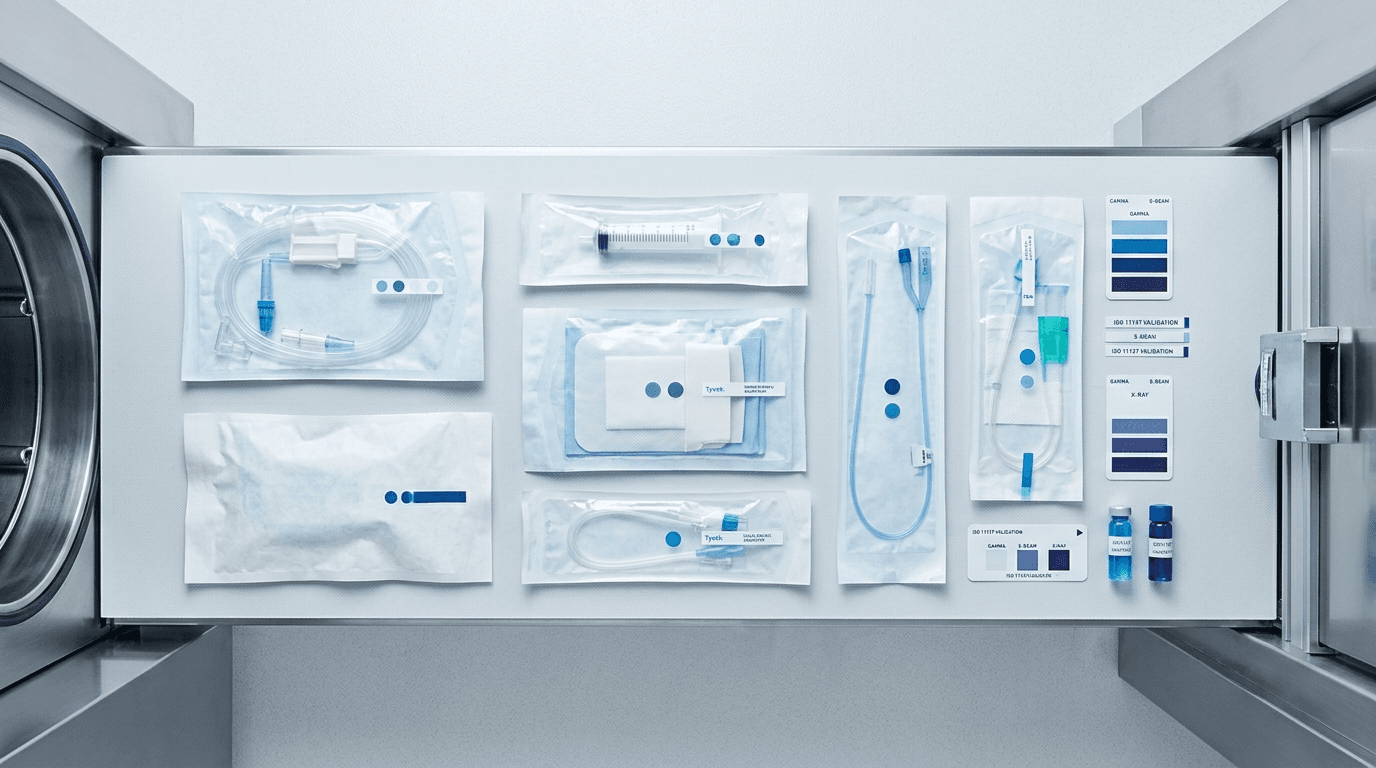
What must an ISO 11137 radiation sterilization validation include, and what minimum evidence should an OEM or private-label buyer require?
When an international medical device distributor, hospital procurement board, or private-label brand owner qualifies an OEM manufacturer producing sterile single-use devices—such as disposable circumcision kits, NPWT drainage dressings, or sterile injection needles—the single most critical quality barrier is the sterilization validation report. Ionizing radiation (gamma rays from Cobalt-60, high-energy electron beams, or accelerator-generated X-rays) acts by disrupting microbial DNA through direct ionization and free-radical generation 1.
The US Food and Drug Administration (FDA) classifies radiation as an established Category A sterilization method 2. Unlike Ethylene Oxide (EO) sterilization under ISO 11135, which leaves chemical gas residuals requiring aeration and toxicological limits under ISO 10993-7, radiation leaves zero chemical residue in the device tissue or polymer matrix. However, because ionizing radiation irreversibly alters polymer molecular chains, validation under ISO 11137 must balance microbial kill against material preservation.
An auditor or procurement officer inspecting an OEM radiation sterilization evidence pack must verify four distinct phases defined in ISO 11137-1 1:
- Product Qualification & Material Compatibility: Demonstration that the device materials, components, barrier packaging, and functional performance remain within specification after exposure to the maximum allowable sterilization dose (Dmax).
- Dose Determination (ISO 11137-2): Experimental substantiation of the minimum sterilization dose (Dmin) required to achieve a Sterility Assurance Level (SAL) of 10-6 based on the product’s baseline bioburden 5.
- Dose Mapping & Installation/Operational Qualification (IQ/OQ): Mapping the radiation dose distribution throughout a fully loaded processing container (tote or pallet) to identify the minimum dose location (Dmin) and maximum dose location (Dmax) and compute the Dose Uniformity Ratio (DUR = Dmax / Dmin).
- Performance Qualification (PQ) & Routine Control: Establishing routine dosimeter placement, load density controls, quarterly/quadrimestral dose-audit schedules, and bioburden monitoring limits.
If an OEM supplier presents only a Certificate of Irradiation (CoI) without an underlying ISO 11137 validation summary report, bioburden baseline history (ISO 11737-1), and dose mapping study, the buyer cannot satisfy US FDA 510(k) premarket requirements or EU MDR Annex IX audit requirements 2.
Gamma vs electron-beam vs X-ray: how does a buyer choose a radiation modality for a single-use device?
A primary technical decision during device design and contract manufacturing selection is determining which radiation modality to deploy. While gamma, electron-beam (E-beam), and X-ray all destroy microorganisms through ionizing energy, their physical delivery mechanisms, penetration depths, processing speeds, and polymer impact differ substantially 8.
The table below details the technical and operational trade-offs across the three radiation modalities:
| Parameter | Gamma Radiation (Co-60) | Electron-Beam (E-Beam) | X-Ray Irradiation |
|---|---|---|---|
| Energy Source | Radioactive isotope (Cobalt-60 photons) | Linear electron accelerator (typically 5–10 MeV) | High-energy electron beam hitting a heavy-metal target (5–7.5 MeV) |
| Penetration Depth | Deep, uniform penetration through high-density pallets/boxes | Shallow to moderate (~40–75 cm at light bulk density 0.1–0.2 g/cm³) | Deep penetration, equivalent to or exceeding Cobalt-60 gamma |
| Dose Rate & Exposure Time | Low dose rate; processing takes hours in a continuous irradiator | Ultra-high dose rate; exposure completes in seconds to minutes | High dose rate; processing takes tens of minutes to ~1 hour (~6x faster than gamma) |
| Dose Uniformity Ratio (DUR) | Moderate DUR (~1.5–1.8 depending on tote geometry) | Density-dependent; requires double-sided exposure for thick boxes | Excellent DUR (typically 1.3–1.5), minimizing Dmax exposure |
| Polymer Impact | Longer exposure increases oxidative degradation risk in sensitive polymers | Short exposure time minimizes free-radical oxidation and polymer breakdown | Low to moderate polymer degradation, lower oxidation rate than gamma |
| Supply Chain & Environmental | Isotope supply constraints (Co-60 decay); regulatory transport controls | On/off electrical machine; zero radioactive source material | On/off electrical machine; zero radioactive source material |
For light, high-volume single-use consumables—such as sterile injection needles, suture packs, or small catheter fixers—Electron-Beam processing is often the most cost-effective and polymer-friendly option because its ultra-high dose rate minimizes oxidative damage while speeding turn-around time 8. Conversely, for dense, multi-layer corrugated master cartons containing complex surgical sets (e.g., disposable circumcision stapler kits or NPWT pump dressing kits), Gamma or X-Ray is required to ensure the minimum sterilizing dose reaches the center of the package.
X-ray sterilization is rapidly gaining market share among contract sterilization providers because it combines the deep photon penetration of Cobalt-60 gamma with the machine-based, high-dose-rate advantages of E-beam, eliminating radioactive source replenishment logistics while reducing polymer oxidative stress 8, 12.
What is the VDmax method (VDmax25 vs VDmax10), and why does it let you validate 25 kGy or 15 kGy on only 10 units?
To claim a medical device is sterile (SAL 10-6), the manufacturer cannot simply assume a dose of 25 kGy is adequate without experimental substantiation. ISO 11137-2 provides multiple dose-setting methods 5:
- Method 1: Bioburden-based dose calculation requiring a minimum sample of 100 product units for verification dosing at SAL 10-2 (a 1-in-100 probability of a non-sterile unit). Suitable for deriving a product-specific dose across a wide bioburden range.
- Method 2: Incremental dose experimentation (Method 2A and 2B) used when establishing a precise, custom minimum dose for devices with low or variable bioburden. Requires extensive product sampling (up to several hundred units).
- VDmax Method (VDmax25 & VDmax10): Verification Dose Maximum method (originally codified in AAMI TIR33 and now integrated into ISO 11137-2 Section 9). Used to substantiate a predetermined sterilization dose of 25 kGy or 15 kGy using a small sample size 5, 6.
The VDmax method is by far the most popular approach for commercial single-use medical devices because it requires only 10 product units for verification testing, drastically reducing sample destruction costs during validation 6.
| Method / Dose Code | Target SAL 10^-6 Dose | Maximum Average Bioburden Cap | Verification Sample Size | Verification Dose SAL |
|---|---|---|---|---|
| VDmax25 | 25 kGy | ≤ 1,000 CFU / device | 10 product units | SAL 10-1 (verification dose read from ISO 11137-2 Table 9; ~4 kGy near 1 CFU, rising to ~8 kGy near the 1,000 CFU cap) |
| VDmax15 | 15 kGy | ≤ 1.5 CFU / device (low-bioburden products; whole device, SIP = 1) | 10 product units | SAL 10-1 (substantiates 15 kGy for radiation-sensitive polymers) |
| Method 1 | Variable (e.g. 14–35 kGy) | 1,000+ CFU / device | 100 product units | SAL 10-2 (fractional verification of 100 units; pass if ≤ 2 positives) |
| Method 2A / 2B | Custom minimum dose | Variable bioburden profiles | 200+ product units | Incremental dosing (determines D10 inactivation value) |
Under VDmax25, the manufacturer measures the average bioburden of the product (typically 10 units from each of three production batches, ISO 11737-1). If the average bioburden is under 1,000 Colony Forming Units (CFU) per device, ISO 11137-2 Table 9 specifies the verification dose to deliver an SAL of 10-1 — a sub-sterilizing dose that rises with bioburden (commonly ~4–8 kGy, from roughly 4 kGy near 1 CFU to ~8 kGy near the 1,000 CFU cap) 5. Ten devices are irradiated at this verification dose and subjected to a 14-day sterility test (ISO 11737-2). If no more than 1 positive unit is observed out of 10, the predetermined dose of 25 kGy is officially substantiated as delivering SAL 10-6 for routine manufacturing.
If a device contains delicate polymers (such as polypropylene components in circumcision rings or polyurethane foams in wound dressings) that degrade at 25 kGy, manufacturers can utilize VDmax15 to substantiate a 15 kGy sterilization dose — but only when the average bioburden is very low (≤ 1.5 CFU per whole device), which makes tight incoming bioburden control a prerequisite 6.
What does the ISO 11137-1:2025 update change — dose-audit interval, energy limits, dosimetry — and what should a buyer update in an RFQ?
In April 2025, the International Organization for Standardization published the 2nd Edition of ISO 11137-1 (ISO 11137-1:2025), superseding the long-standing 2006 edition 1, 10. The US FDA quickly formally recognized this updated consensus standard (Recognized Consensus Standard No. 46252) 3.
Quality assurance teams and procurement managers must understand key differences between the 2006 and 2025 editions to ensure supplier audit checklists and manufacturing quality agreements remain compliant:
| Clause / Element | ISO 11137-1:2006 (Legacy) | ISO 11137-1:2025 (Current Edition) | Buyer / Audit Impact |
|---|---|---|---|
| Dose Audit Frequency | Mandatory every 3 months (quarterly dose audits) | Shifted to every 4 months (quadrimestral; 4 audits per year) | Updates QA audit schedule; allows 4-month interval as long as 4 audits are executed annually |
| Irradiation Energy Limits | Activation assessment triggered above 10 MeV e-beam and 5 MeV X-ray | Thresholds raised to 11 MeV e-beam and 7.5 MeV X-ray before induced-radioactivity assessment | Allows higher-energy e-beam and X-ray processing (deeper penetration, larger loads) below the new activation-assessment threshold |
| Dosimetry & Tech Transfer | Referenced ISO/TS 13004 and older ISO 11137-3 guidance | Integrated ISO/TS 13004 requirements into Part 1 and streamlined technology transfer rules | Simplifies transferring validated products between gamma and X-ray or between facilities |
| Bioburden Spike Handling | Strict rejection if audit bioburden exceeded baseline | Provides structured risk-based pathways for evaluating bioburden spikes during audits | Prevents unnecessary lot holds when a temporary bioburden increase is non-resistant |
The shift from a quarterly (3-month) dose-audit cadence to a quadrimestral (4-month) cadence is a significant operational change 10. Under ISO 11137-1:2025, an OEM manufacturer must complete 4 dose audits within a 12-month period, spaced approximately 4 months apart. When auditing an OEM supplier’s Master Validation Plan, buyers should confirm that quality agreements reflect the 2025 edition standard and that dose-audit SOPs have been updated accordingly.
What radiation-sterilization evidence belongs in a 510(k), and how does the FDA Radiation Sterilization Master File Pilot change supplier or site changes?
When preparing a 510(k) premarket notification or EU MDR Technical Documentation file for a sterile single-use device, the regulatory team must compile specific sterility evidence as mandated by FDA guidance 2. The required submission elements for radiation sterilization include:
- Sterilization Modality Identification: Explicit statement specifying Gamma, Electron-Beam, or X-Ray irradiation.
- Sterilization Facility Details: Name, address, and FDA Establishment Registration Number (FEI) of the contract irradiator facility.
- Dose Specifications: The validated minimum sterilizing dose (Dmin, e.g., 25.0 kGy) and maximum allowable dose (Dmax, e.g., 40.0 kGy).
- Validation Method Reference: Citation of ISO 11137-1 and ISO 11137-2, specifying whether Method 1, Method 2, or VDmax (VDmax25 / VDmax15) was executed.
- Target SAL: Confirmation of a 10-6 Sterility Assurance Level for devices contacting compromised tissue, blood, or mucosal membranes.
- Pyrogenicity / Endotoxin Testing: Description of Limulus Amebocyte Lysate (LAL) bacterial endotoxin testing (USP <85> method; USP <161> device limits: ≤ 20 EU/device for blood/cardiovascular contact, ≤ 2.15 EU/device for intrathecal / cerebrospinal-fluid contact).
Historically, if a 510(k) holder wanted to change their contract sterilization facility or switch from Cobalt-60 gamma to X-ray sterilization, FDA regulations required submitting a new 510(k) or a 510(k) change notification. However, under the FDA CDRH Radiation Sterilization Master File Pilot Program, qualified contract sterilizers submit a Sterilization Master File directly to FDA 4.
Medical device manufacturers participating in the pilot can reference the contract irradiator’s Master File in their 510(k) submissions. This allows switching sterilization locations or transitioning from gamma to X-ray without filing a traditional 510(k) supplement, provided the device’s validated Dmin and Dmax envelope remains unchanged 4. This initiative mirrors FDA’s EtO Innovation Challenges, accelerating supply chain flexibility in response to Cobalt-60 supply constraints.
How do you set a maximum sterilization dose range and audit bioburden so polymer single-use devices are not over-dosed?
While minimum dose (Dmin) guarantees microbicidal efficacy, maximum dose (Dmax) protects the physical integrity and biocompatibility of the medical device. Ionizing radiation causes two competing chemical reactions in polymers: crosslinking (which increases molecular weight and rigidity) and chain scission (which breaks polymer backbones, leading to embrittlement, discoloration, and loss of tensile strength) 9, 12.
Establishing a maximum dose range (e.g., qualifying Dmax at 40 kGy or 50 kGy for a 25 kGy minimum dose process) requires testing devices at 2x or 1.5-2.5x the minimum sterilizing dose per AAMI TIR17 guidance 9, 11.
| Polymer Material | Primary Radiation Reaction | Recommended Max Dose (kGy) | Potential Degradation Risks / Failure Modes | Stabilization & OEM Design Strategy |
|---|---|---|---|---|
| Polyethylene (HDPE / LDPE / LLDPE) | Predominantly crosslinking | 50–100+ kGy (Highly Stable) | Slight loss of flexibility at extreme doses; otherwise excellent radiation resistance | Standard choice for sterile blister packaging trays, catheter tubing, and protective caps. |
| Polypropylene (PP - Unstabilized) | Severe chain scission & post-irradiation oxidation | 25–30 kGy (Sensitive) | Severe embrittlement, yellowing, flaking, crack formation over 3–6 months shelf storage | Must specify radiation-grade PP containing hindered amine light stabilizers (HALS) or phenolic antioxidants. |
| Polycarbonate (PC) | Chain scission & color center formation | 35–45 kGy (Moderate) | Noticeable yellowing / amber tinting; slight reduction in impact strength | Use color-stabilized optical PC grades for luer locks, stapler housings, and clear connectors. |
| Polyurethane (PU / TPU) | Balanced crosslinking / scission | 40–50 kGy (Good) | Minor changes in durometer / elasticity; potential discoloration in light colors | Widely used in NPWT foam dressings and vascular catheter tubes; highly compatible. |
| Polyvinyl Chloride (Plasticized PVC) | Crosslinking & dehydrochlorination | 35–50 kGy (Good) | Yellowing, liberation of micro-hydrochloric acid traces, plasticizer migration | Formulate with calcium-zinc heat stabilizers; avoid lead/barium stabilizers in medical tubing. |
To prevent polymer degradation, the OEM must establish a tight operational dose window defined by the Dose Uniformity Ratio (DUR). For example, if a product load has a DUR of 1.5 and the required Dmin is 25 kGy, the maximum dose delivered to the outer edges of the pallet will reach 37.5 kGy (25 kGy × 1.5). The device and its sterile barrier packaging must be fully qualified and accelerated-aged (ASTM F1980) at 37.5 kGy or higher to ensure 3-to-5-year shelf-life stability 11.
Where VEMERIX fits—and where due diligence still begins
VEMERIX (the international brand of Weihai Medison Medical Equipment Co., Ltd.) operates as a Minimally Invasive Surgery Total Solution Platform serving urology, vascular surgery, and perioperative care. Across VEMERIX’s sterile single-use product portfolio—including disposable circumcision devices and stapler kits, NPWT drainage dressings, sterile injection needles, and catheter fixers—sterilization integrity is backed by comprehensive ISO 11137 and ISO 11135 validation technical packs.
For international distributors, OEM buyers, and hospital procurement engineering teams qualifying a sterile device supplier, VEMERIX provides complete evidence packages containing:
- Full ISO 11137-1/2 validation reports (VDmax25 / VDmax15 dose substantiation studies).
- Quadrimestral (4-month) bioburden trend logs (ISO 11737-1) and dose-audit execution certificates.
- Accelerated and real-time shelf-life aging data (ASTM F1980 / ISO 11607) for sterile barrier packaging subjected to maximum irradiation doses.
- FDA Establishment Registration and NMPA Class II / Class III device registration documentation.
However, sound quality engineering dictates that buyer due diligence begins prior to commercial contract signing. Procurement teams should audit the OEM’s Dose Uniformity Ratio maps, verify polymer raw material resin grade specification sheets (confirming radiation-stabilized resins where applicable), and review change control SOPs for compliance with ISO 13485:2016 and US FDA QMSR. Buyers can request VEMERIX sterilization validation summaries, technical packs, and registration documentation through the enquiry page, or review the VEMERIX quality system before opening a private-label discussion.
Frequently Asked Questions (FAQ)
Q1: Is gamma sterilization equivalent to electron-beam or X-ray for regulatory purposes?
Yes. From a regulatory perspective (US FDA 510(k) and EU MDR Annex I General Safety and Performance Requirements), Gamma, E-beam, and X-ray are all recognized radiation modalities under ISO 11137-1. However, changing modalities requires validating dose equivalence and ensuring material compatibility, as E-beam and X-ray operate at different dose rates.
Q2: How often must a radiation sterilization dose audit be performed under the current standard?
Under the newly published ISO 11137-1:2025 standard, dose audits must be conducted every 4 months (quadrimestral, completing 4 audits per year), provided bioburden history remains stable. This updates the prior 2006 requirement of quarterly (every 3 months) dose audits.
Q3: Can all single-use device polymers be radiation-sterilized, or do some need a maximum-dose cap?
No, not all polymers tolerate radiation equally. Unstabilized polypropylene (PP) undergoes severe chain scission and embrittles rapidly under radiation, requiring specialized radiation-grade resin with antioxidant additives or a reduced maximum dose cap (e.g. Dmax < 30 kGy). Polyethylene (PE) and Polyurethane (PU), by contrast, are highly radiation-stable.
Q4: What is the difference between SAL 10^-6 and a 25 kGy sterilization dose?
SAL 10-6 is the required microbiological performance standard (a 1 in 1,000,000 probability of a surviving microorganism). 25 kGy is a common, historically established radiation dose that delivers SAL 10-6 for typical device bioburden profiles. The 25 kGy dose must still be experimentally substantiated for each specific device via ISO 11137-2 (such as VDmax25).
Q5: Does switching a 510(k)-cleared device from gamma to X-ray sterilization require a new submission?
Not necessarily. Under FDA’s Radiation Sterilization Master File Pilot Program, device manufacturers can transition between contract facilities or modalities (e.g., gamma to X-ray) by referencing the irradiator’s FDA Master File, avoiding a new traditional 510(k) submission provided validated dose ranges remain unchanged.