09NPWT · Disposables
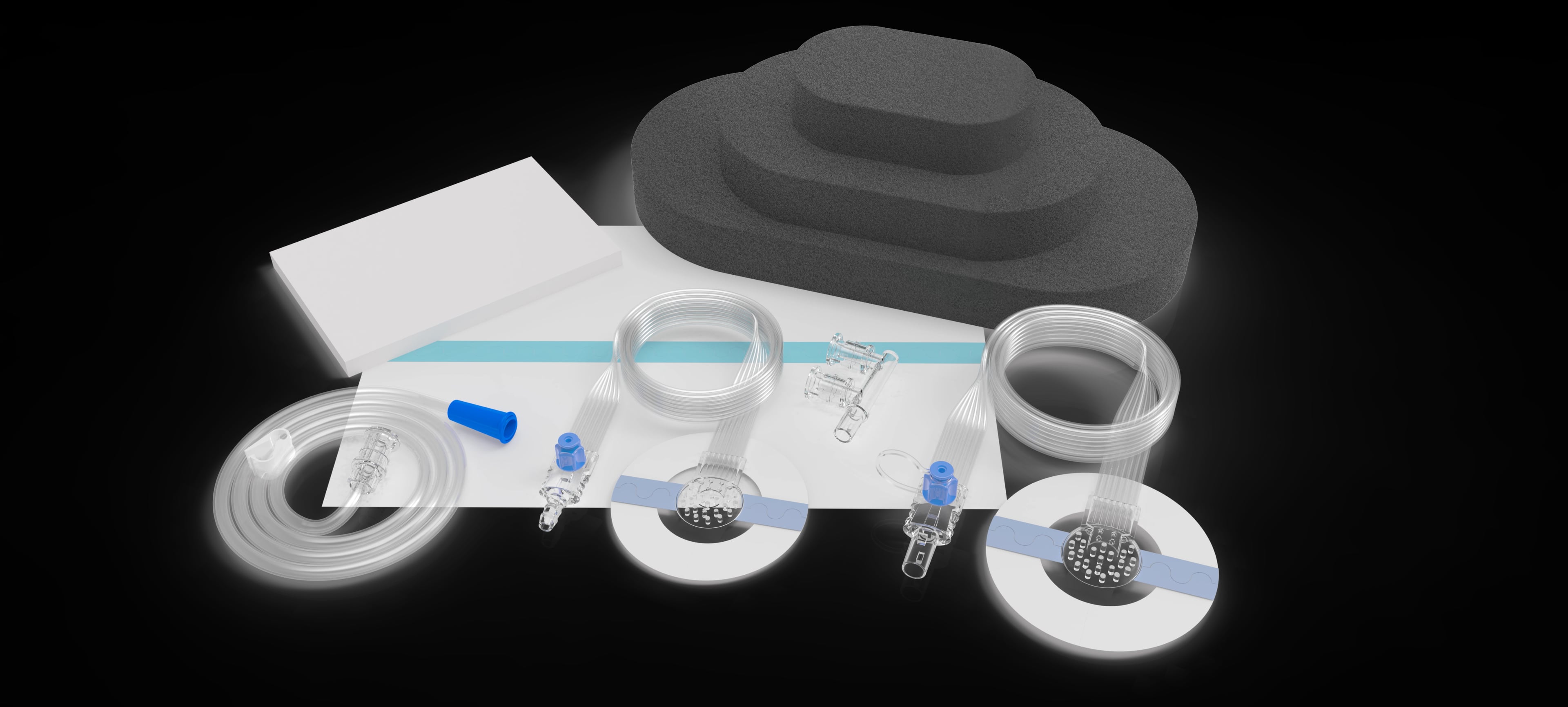
Disposable NPWT Drainage Dressing Kit
Side-suction multi-chamber NPWT dressing kit (S.O.M.T technology).
Classification
Class II
A purpose-built dressing kit pairing VEMERIX’s side-suction multi-chamber drainage cup (S.O.M.T NPWT) with PVA / PU foam, biological semi-permeable membrane and tee connector. Engineered to maximize drainage while minimizing tube blockage and false alarms.
KEY FEATURES
What makes it work.
- Proprietary S.O.M.T side-suction multi-chamber cup
- Independent drainage and injection lines
- PVA / PU sponge in multiple shapes and sizes
- Biological semi-permeable membrane: breathable, moisturizing, bacteria-blocking
- 400–600 µm pore structure for even pressure distribution
- Tee connector + extension tube included
APPLICATIONS
Where it's used.
- Acute wounds
- Chronic and traumatic wounds
- Subacute and split wounds
- Second-degree burn wounds
- Venous ulcers and diabetic ulcers
- Skin grafts and flaps
CONTRAINDICATIONS
- Unclean wounds / wounds with necrotic eschar
- Wounds with tumor tissue
- Sinus tracts connected to organs
- Wounds with large blood vessels or exposed organs
SPECIFICATIONS
Technical specifications.
Classification
Class II medical device
Variants
Type I-PVA · Type II-PVA · Type I-PU · Type II-PU
Pore structure
400 – 600 µm
Patents
ZL 201210207084.7 (invention); ZL 201220294512X (utility)
Patents
ZL 201210207084.7 (invention)
ZL 201220294512X (utility)
FROM VEMERIX INSIGHTS
Market analysis behind this product
Buyer Guide
Medicare DMEPOS NPWT Payment Estimates in 2024–2025: the Evidence Buyers Still Need
Keep payment denominators and uncertainty intact, then verify exact-model coding and the proposed Medicare DME payment pathway.
October 12, 2026 · 15 min read
Regulatory Guide
A Thai Device Importer Registration Is Not Product Authorization
Verify a Thai partner's establishment, product and shipment documents before committing to a sterile-device launch.
October 10, 2026 · 22 min read
Regulatory Guide
Importing Sterile Single-Use Devices Into Vietnam: The 2026 Document File
A staged document checklist for a first commercial shipment: confirm the Vietnamese circulation number, route the CFS and authorization letters, and separate customs labelling from market-release duties.
October 9, 2026 · 20 min read
Buyer Guide
Medicare Home NPWT Fees in October 2026: The ZIP-Code Check Behind an E2402 Benchmark
Unchanged fee cells can still produce a different benchmark when a ZIP changes rural status.
October 5, 2026 · 29 min read
Technical Guide
How Many Units to Inspect on Receipt: AQL Sampling for Sterile Consumables
A five-step receiving inspection protocol for distributor QA leads and hospital procurement engineers navigating ISO 2859-1:2026, destructive sample budgets, defect-class AQLs, and lot CoA reliance.
September 25, 2026 · 18 min read
Market Brief
EU Public Tenders and Chinese-Origin Medical Devices: The €5 Million Rule
A threshold, composition, and tender-file verification guide for EU distributors, wholesalers, and hospital procurement leads navigating Commission Implementing Regulation (EU) 2025/1197 and the autumn 2026 review clock.
September 24, 2026 · 16 min read
Market Brief
What US Tariffs Add to a Chinese Single-Use Medical Device Order
A line-level duty-stack and verification guide for US importers, distributors, and procurement leads navigating the 24 July 2026 forced-labor tariff, de minimis suspension, and Q4 trade clocks.
September 23, 2026 · 16 min read
Buyer Guide
Which Pressure Range Belongs in an NPWT Pump Tender?
How to read CMS A52511's 40–80 mm Hg E2402 capability window against clinical defaults and a factory −50 to −450 mmHg envelope.
September 21, 2026 · 14 min read
Buyer Guide
Medical Consumables Tender Evidence: WHO and UNICEF (2026)
Check specification age, configuration-level evidence and delivery conditions before approving a medical-consumables offer.
September 21, 2026 · 25 min read
Regulatory Guide
Does This China Class II Shipment Need a UDI Yet
An incoming-inspection and regulatory-clock guide for international distributors, OEM/private-label buyers, and hospital procurement leads evaluating Chinese Class II sterile device shipments, Announcement 21 remaining-variety deadlines, the 103 third-batch catalogue, and Announcement 15 exemptions on 18 September 2026.
September 18, 2026 · 16 min read
Buyer Guide
When NPWT Dressing Kits Are Not Interchangeable Across Pumps
Why FDA 510(k) indications for use, CMS integrated-system billing rules and product code OMP dictate companion-pump matching rather than catalog-universal claims.
September 13, 2026 · 14 min read
Technical Guide
How to Review a Supplier's Production and Process-Control File After QMSR: Why 21 CFR 820.70, 820.75 and 820.80 Are Reserved, What ISO 13485 Clause 7.5 and 21 CFR 820.45 Require, What Compliance Program 7382.850 Inspects under Production and Service Provision, and Why a DHR Binder or Contract-Sterilizer Listing Is Not the File
A field-by-field file-review guide for medical device distributors, OEM buyers, and hospital procurement teams evaluating sterile single-use suppliers after 2 February 2026: why 21 CFR 820.70, 820.75, and 820.80 are reserved, what ISO 13485 Clause 7.5 and 21 CFR 820.45 mandate for production, process validation, and labeling inspection, and how FDA Compliance Program 7382.850 audits Production and Service Provision.
September 4, 2026 · 16 min read
Technical Guide
How to Review a Supplier's CAPA and Complaint File After QMSR: Why 21 CFR 820.100 and 820.198 Are Reserved, What ISO 13485 Clauses 8.2.2 / 8.3 / 8.5.2 / 8.5.3 and 21 CFR 820.35 Require, What Compliance Program 7382.850 Inspects, and Why an MDR Report Is Not the Complaint File
An incoming audit guide for medical device distributors, OEMs, and hospital procurement teams: why 21 CFR 820.100 and 820.198 are reserved under QMSR, how ISO 13485 Clauses 8.2.2, 8.3, 8.5.2, and 8.5.3 carry the legal duties, what 21 CFR 820.35 adds on top, what CP 7382.850 inspects under Measurement, Analysis, and Improvement, why an MDR report is not the complaint file, and a 7-point buyer acceptance protocol.
September 2, 2026 · 18 min read
Technical Guide
How to Review a Supplier's Purchasing Controls and Outsourcing File After QMSR: Why 21 CFR 820.50 Is Reserved, What ISO 13485 Clauses 4.1.5 and 7.4 Require, What Compliance Program 7382.850 Inspects, and a Buyer Acceptance Checklist
A practical buyer's audit guide for medical device purchasing and outsourcing files: why 21 CFR 820.50 is reserved under QMSR, how ISO 13485 Clauses 4.1.5 and 7.4 carry the legal duties, what FDA Compliance Program 7382.850 inspects, why supplier-audit reports are no longer exempt, and a 7-point incoming acceptance checklist.
August 31, 2026 · 19 min read
Technical Guide
How to Review a Supplier's ISO 14971 Risk Management File: What QMSR Actually Requires After 2 February 2026, EN ISO 14971:2019+A11:2021 for MDR, China's GB/T 42062-2022, and a Buyer Acceptance Checklist
A practical buyer's audit guide for medical device risk management files: separating ISO 13485 QMSR process mandates from ISO 14971 conformity, verifying EN ISO 14971:2019+A11:2021 for EU MDR, navigating China's GB/T 42062-2022, and executing a 7-point incoming acceptance protocol.
August 27, 2026 · 18 min read
Technical Guide
How to Review a Supplier's ISO 10993 Biocompatibility File: Endpoints by Contact and Duration, the 2025 Edition Transition (FDA Deadline July 2029), and a US/EU/China Acceptance Checklist
A practical buyer's audit guide for medical device biological safety files: matching endpoints to contact category and duration, verifying test-article final form, navigating the ISO 10993-1:2025 transition across FDA, EU MDR and China NMPA, and spotting disqualifying file gaps.
August 22, 2026 · 18 min read
Evidence Review
Wound Debridement Before the Vacuum: What Medicare Data Shows About Where NPWT Actually Sits in Care (2026)
Medicare professional-service data and current wound guidance show why debridement and dressings define the pathway—and why NPWT remains a selective downstream adjunct.
August 17, 2026 · 28 min read
Regulatory Guide
How Sterile Procedure Kits Are Regulated: FDA Convenience-Kit Rules, EU MDR Article 22, and the Evidence Pack an Assembler, Distributor, or OEM Buyer Must Verify
A definitive regulatory pathway, post-market recall analysis, and supplier-qualification checklist for multi-component sterile procedure trays, circumcision kits, puncture sets, and dressing packs.
August 15, 2026 · 18 min read
Buyer Guide
Single-Use vs Reusable NPWT Pump: A Disposable-vs-Powered Procurement Decision Matrix Built on FDA Product Codes, HCPCS Reimbursement and Per-Episode Cost
The FDA itself splits NPWT into reusable powered, non-powered mechanical and disposable powered single-use pumps under three different Class II product codes, and the right buy flows from exudate volume, wound complexity, care setting and reimbursement path rather than a blanket claim that disposable is better.
August 8, 2026 · 16 min read
Buyer Guide
What the FDA 510(k), Recall and MAUDE Record Reveals About Negative Pressure Wound Therapy Pump Failure Modes — and What Procurement Teams Should Specify Against (2015–2025)
An original FDA surveillance analysis of 214 powered NPWT pump clearances, 48 recalls, and 5,775 MAUDE adverse-event reports (2020–2025) translated into tender acceptance criteria and supplier-vigilance questions.
August 6, 2026 · 15 min read
Evidence Review
Incisional vs Open-Wound NPWT: When Closed-Incision Evidence Cannot Be Generalized to Chronic and Open Wounds
A comprehensive clinical evidence review for perioperative, clinical-engineering, and procurement committees establishing why trial outcomes for prophylactic closed-incision NPWT cannot be directly transferred to open or chronic wound care.
August 5, 2026 · 38 min read
Buyer Guide
NPWT Pump Hospital Price and Total Cost of Therapy: A Transparent Pump, Consumables, Reimbursement and Downtime Cost Model (Without Inventing Vendor Prices)
A hospital procurement cost model separating public reimbursement signals, tender price ranges, and consumable consumption rates from editorial cost scenarios, without inventing vendor quotes.
August 5, 2026 · 25 min read
Technical Guide
Radiation (Gamma, Electron-Beam and X-Ray) Sterilization Validation for Single-Use Medical Devices: An ISO 11137, VDmax and FDA Evidence Guide for OEM and Private-Label Buyers
Qualifying a radiation-sterilized single-use device OEM requires verifying an ISO 11137 validation protocol, substantiating the 25 kGy or 15 kGy sterilization dose via VDmax, selecting the optimal modality (gamma vs e-beam vs X-ray), capping polymer maximum doses, and aligning with the 4-month dose-audit interval under ISO 11137-1:2025 and the FDA Radiation Master File Pilot.
August 4, 2026 · 18 min read
Technical Guide
Ethylene Oxide Sterilization Validation for Single-Use Medical Devices: An ISO 11135 Process, ISO 10993-7 Residual and FDA Evidence Guide for OEM and Private-Label Buyers
Qualifying a sterile single-use device OEM demands a validated ISO 11135 process, documented ISO 10993-7 residual dissipation profiles below 4 mg EO / 9 mg ECH for limited contact, clear parametric or BI release protocols, and a regulatory change-control strategy under the FDA Sterilization Master File pilots.
August 3, 2026 · 16 min read
Buyer Guide
Medical Device Contract Manufacturing (2026): A Buyer's Evidence Checklist for Sterile Single-Use Devices
An ISO 13485 certificate is the opening question—not the answer.
August 3, 2026 · 24 min read
Evidence Review
Negative Pressure Wound Therapy Dressing Selection: What the PVA-versus-PU Foam, Pore-Size and Closed-Incision-versus-Open-Wound Evidence Actually Supports
Navigating NPWT dressing selection requires separating material mechanics from clinical healing claims—evaluating open-pore PU black foam (400–600 µm) for high-exudate granulation against hydro-retentive PVA white foam for sensitive wound beds, respecting the 48–72 hour open-wound change boundary, and understanding the FDA regulatory divide between open-wound (OMP) and closed-incision (QFC) devices.
August 3, 2026 · 15 min read
Buyer Guide
How to Specify a Negative Pressure Wound Therapy (NPWT) System: A Lot-by-Lot Tender, RFQ & Acceptance Checklist for Pumps, Dressings and Canisters (2026)
A hospital procurement, health-system category management, or distributor team specifying negative pressure wound therapy (NPWT) should not issue a single bundled RFQ. Structure tenders into platform lots (acute heavy-duty, portable ambulatory, single-use/disposable, consumables, rental), map every pump performance and alarm requirement directly to documented FDA failure modes (leak, occlusion, canister overflow, power thermal cutoff), and demand a 6-part regulatory evidence pack (510(k), UDI, ISO 10993, IEC 60601-1, EO sterilization) before awarding volume.
August 3, 2026 · 18 min read
Technical Guide
Sterile Barrier Packaging and Shelf-Life Validation for Single-Use Medical Devices: An ISO 11607 and Accelerated-Aging Acceptance Guide
Passing ISO 11607 requires more than a cleanroom pouch—it demands a validated forming and sealing process under Part 2, Arrhenius accelerated-aging calculations under ASTM F1980 confirmed by real-time stability, transport simulation under ASTM D4169, and lot-release seal strength and integrity criteria.
August 3, 2026 · 16 min read
Regulatory Guide
Unique Device Identification (UDI) for Private-Label and OEM Single-Use Medical Devices: A US (FDA), EU (MDR/EUDAMED) and China (NMPA) Decision Matrix
Determining who holds the UDI-DI, which issuing agency to use, and when database submission becomes mandatory under 21 CFR 830, EU MDR Article 27, and NMPA UDI Rules.
August 3, 2026 · 22 min read
Market Analysis
From the Pump Cart to the Pocket: The Disposable Shift in Negative-Pressure Wound Therapy
How wound care is repeating the move from a durable capital device to a registered single-use consumable — and why the recurring disposable kit, not the pump, is the strategic prize for device makers and distributors.
July 1, 2026 · 31 min read
MORE IN NPWT
Related products
Ready to evaluate Disposable NPWT Drainage Dressing Kit?
Sample units typically ship under 10 business days for qualified buyers. Distributors — ask about territory exclusivity.