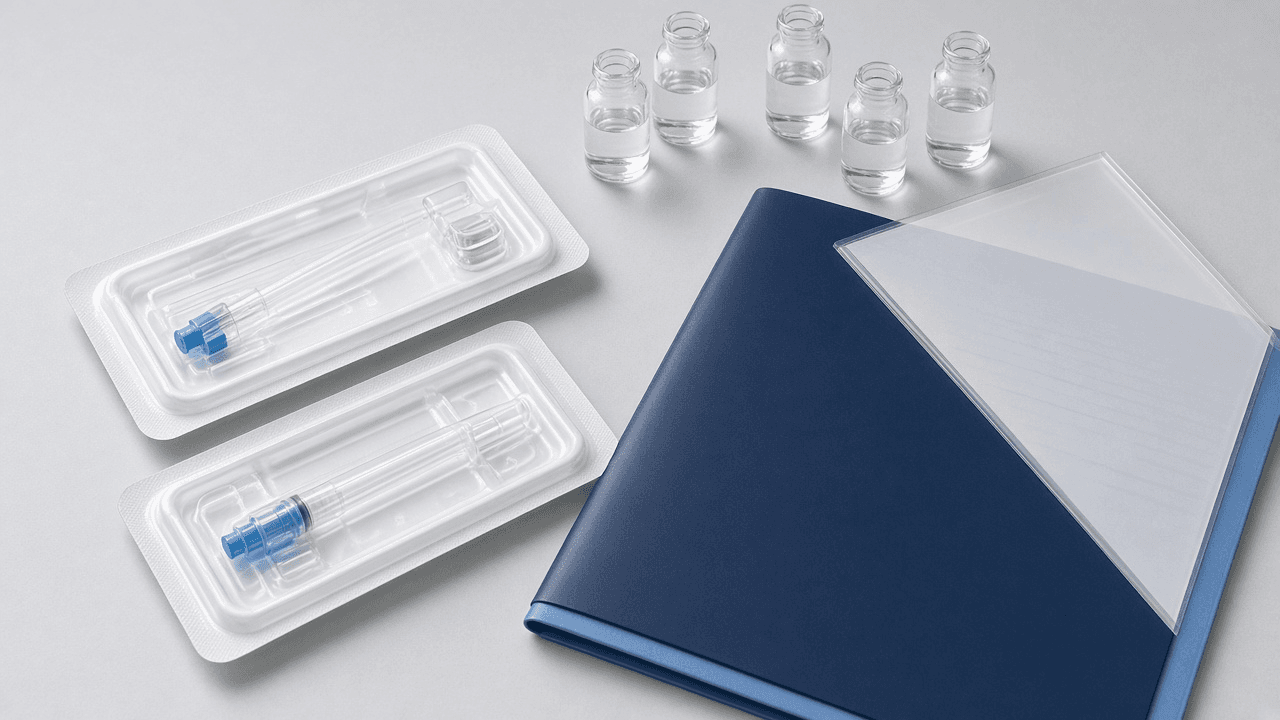
What does the sterility certificate leave open?
Suppose the first commercial shipment arrives with a signed Certificate of Analysis (CoA). It identifies the catalogue number and manufacturing lot, confirms sterilization release, and lists “endotoxin: pass.” The shipping team wants a decision. The useful next question is whether the endotoxin line can be traced to the right specification and supporting test record. Reading the word pass first reverses that review order.
Sterility assurance addresses viable microorganisms. Endotoxins are components of gram-negative bacteria and can remain a concern after microorganisms have been killed. FDA discusses sterilization information and pyrogenicity information separately in its sterile-device submission guidance. Its historical inspection guide explains why reducing viable organisms does not necessarily produce a similar reduction in endotoxin. An EO cycle certificate therefore cannot substitute for the endotoxin evidence applicable to a device.2, 3
A Sterility Assurance Level (SAL) statement describes a probability associated with the validated process, rather than a measured endotoxin concentration. FDA generally recommends SAL 10−6 for sterile-labeled devices in the cited submission context, with a different recommendation for devices contacting intact skin only. Neither value tells the buyer how much endotoxin was extracted from the product.2
| Record | What to verify | What it leaves open |
|---|---|---|
| Sterilization release record | Coverage of the ordered configuration, process and relevant production load | The bacterial endotoxin result and broader pyrogen assessment |
| Bioburden monitoring | The viable-microorganism monitoring program and its relationship to process control | The amount of endotoxin present after manufacturing or sterilization |
| EO residual evaluation, if applicable | Residual chemical evidence applicable to the device and exposure | Endotoxin concentration; this is a separate chemical-safety question |
| Bacterial endotoxin report | Tested sample, extraction, assay validity, acceptance criterion and result | Non-endotoxin pyrogens and untested units |
| Material-mediated pyrogenicity assessment | The evidence addressing pyrogenic substances associated with device materials | Routine manufacturing endotoxin control |
| Supplier CoA | Its scope, approval and traceable supporting records | Any detail not present or accessible in the evidence chain |
Source: Buyer synthesis from FDA sterile-device guidance, section V.A (source 2), FDA Q&A (source 1), and the August 2024 town hall (source 4).
Keep these records connected without treating them as interchangeable. The companion guide on checking an EO CoA against its sterilization cycle file handles process-document identity. This guide concentrates on what the endotoxin report adds.
Which limit applies to the device being purchased?
Ask the legal manufacturer to identify the intended use, patient-contact route, relevant labeling claim, destination market and controlled acceptance specification. Do this for the ordered configuration, including fluid pathways and components that remain in the patient. A marketing category such as “surgical disposable” is too broad to set a limit. Nor should a distributor classify a circumcision device, wound dressing or injection accessory solely from its catalogue photograph.
FDA’s January 2024 guidance recommends pyrogen-limit specifications for implants; devices with direct or indirect cardiovascular, lymphatic or cerebrospinal-fluid contact, including similar systemic exposure; and devices labeled non-pyrogenic. It also distinguishes bacterial endotoxin from material-mediated pyrogens. These recommendations identify questions to resolve in the product file; they do not establish that every sterile external-use product needs identical routine testing.2
| Device/contact scope | Published recommendation | Buyer boundary |
|---|---|---|
| Direct or indirect cardiovascular or lymphatic contact | 20 EU/device under the extraction basis described in FDA Q&A question 111 | Verify the intended use, extraction and any more specific product requirement. |
| Cerebrospinal-fluid contact | 2.15 EU/device in FDA Q&A question 111 | A report evaluated only against the blood-contact example does not answer this scope. |
| Anterior-segment solid intraocular devices within the ophthalmic guidance scope | ≤0.2 EU/device in section V.B of the 2015 guidance6 | This is not a limit for every ophthalmic product. Intraocular fluids have separate recommendations and units. |
| Other sterile consumables | Resolve applicability and the product-specific specification2 | Do not infer either a universal 20 EU/device limit or an automatic exemption. |
Source: FDA Q&A question 11 (source 1), FDA sterile-device guidance section V.A.4 (source 2), and FDA intraocular guidance section V (source 6).
The ophthalmic distinction matters even when the purchase concerns another device: the same number can describe different quantities. FDA’s intraocular guidance recommends ≤0.2 EU/mL for certain intraocular fluids and ≤0.2 EU/device for anterior-segment solid devices within its scope. Copying the number while dropping the denominator changes the specification.6
Also clarify what constitutes one device or one procedure’s exposure. FDA’s March 2026 Q&A says multiple units of the same device from one manufacturer used in the same procedure or surgical site should generally meet the overall limit for a single device, with deviations justified. A kit containing repeated components therefore needs a documented exposure rationale, rather than an assumption that each component independently receives the full allowance.1
What should the supplier report identify?
Use the following matrix to prepare a document request. Information may sit in the signed laboratory report, its referenced protocol, the approved specification or an accessible validation summary. The point is a traceable explanation, not a rule that every field must appear on the first page of every CoA. FDA’s August 2024 town hall specifically discusses sampling plans, extraction parameters, maximum valid dilution, controls, acceptance criteria and results as report content.4
| Check | Evidence to locate | Question if the file is incomplete |
|---|---|---|
| Product and configuration | Model, size or family coverage, and a description of the tested article | Does the tested configuration represent the supplied device, including coatings and fluid pathways? |
| Lot and sample history | Production lot, sample identifiers, manufacturing state and test/report dates | Were finished sterile units tested, or is there a justified pre-sterilization or representative-family basis? |
| Acceptance specification | Limit, units, applicable market and source of the product-specific criterion | Who approved this limit, and does it match the intended contact and labeling? |
| Extraction | Fluid, volume, contacted surfaces, preparation, time and temperature | Was the patient-contact portion recovered appropriately, and are extraction conditions supported? |
| Method and version | Named assay, standard/protocol version and relevant validation | Is this a limit test or a quantitative method, and is it suitable for this device extract? |
| Sensitivity and dilution | Assay sensitivity or reporting range, actual test dilution and maximum valid dilution rationale | Can this diluted sample still reveal endotoxin at the acceptance limit? |
| Validity controls | Evidence of inhibition/enhancement assessment and acceptable run controls | Could the device extract suppress or distort the assay response? |
| Sampling basis | Number of units, selection rationale, individual or pooled extraction, and routine testing frequency | What variability can the plan detect, and how does it represent the production lot? |
| Result and disposition | Result or qualified bound, units, criterion, deviations, approval and linked report identifier | Does pass follow from the stated result and specification? Were unresolved exceptions excluded? |
Source: Editorial purchasing checklist based on FDA Q&A questions 1–6 and 11 (source 1) and the August 2024 town hall, pages 5–6 (source 4).
Configuration matching deserves a separate answer. A report for a plain device may not automatically represent one with a coating or altered fluid path. Conversely, a well-supported family rationale can legitimately cover several catalogue sizes. Ask for the bridge between the tested article and the order instead of demanding destructive testing of every size without considering the validation.
For pre-sterilization results, ask what demonstrates their relationship to the finished sterile product. FDA’s August 2024 discussion describes comparisons of pre- and post-sterilization testing across multiple lots, alongside material, process and historical-data assessment. A label reading “sterile” does not supply that bridge by itself.4
Check validity before interpreting a low result. Device extracts can interfere with the assay, including through anticoagulants, heavy metals or particulates. FDA recommends inhibition/enhancement testing on both the extraction solution and the device extract. Ask the laboratory to explain the method-specific controls, sensitivity and actual dilution. A quantitative spike-recovery percentage is not the reporting format for every valid method; avoid imposing one numerical control format on all assays.1
Which method was used, and what does it establish?
The assay name defines the claim being evaluated. A bacterial endotoxin test addresses endotoxin; a broader pyrogen assessment considers other potential causes of a pyrogenic response. FDA’s sterile-device guidance treats material-mediated pyrogens as part of the biocompatibility assessment. A buyer should locate that assessment when relevant without assuming a routine endotoxin result replaces it.2
| Method/assessment | Useful distinction | Evidence request |
|---|---|---|
| LAL-based bacterial endotoxin test | Gel-clot, turbidimetric and chromogenic approaches provide different result formats; they do not establish absence of every pyrogen. | Identify the exact assay, suitability for the extract, controls and interpretation. |
| Recombinant endotoxin assay | A different reagent platform still needs product-specific suitability and the relevant regulatory basis. | Explain method validation and any transition or equivalence work; do not reject or accept it solely by its name. |
| Rabbit pyrogen test | Assesses a biological response and has limitations; it is not an interchangeable numerical endotoxin concentration. | Identify the purpose and accepted product-specific method, without converting its outcome into EU/device. |
| Monocyte activation method | FDA describes it as an alternative requiring product-specific validation. | Request evidence of interference evaluation and suitability for the material and tested samples. |
| Material-mediated pyrogenicity evaluation | Addresses a different source of pyrogens from bacterial endotoxin. | Locate the applicable biological-evaluation evidence and its device/configuration coverage. |
Source: FDA Q&A questions 5, 6 and 9 (source 1), sterile-device guidance section V.A.4 (source 2), and historical method limitations in source 3.
This is not a method ranking. A more sensitive assay name on a brochure does not show that the device was extracted adequately or that interference was controlled. Likewise, neither a routine LAL result nor a design-stage biological assessment can be read as an unlimited “pyrogen-free” guarantee. FDA recommends wording such as non-pyrogenic or meeting pyrogen-limit specifications rather than pyrogen free unless complete removal can be established.1, 2
What can a pooled result hide?
A laboratory may report an individual result or a value derived from pooled samples. Ask which occurred, how units were selected and how the extraction and calculation were justified. The current FDA Q&A explicitly permits pooling medical-device extracts with attention to rinse/extraction volume and inhibition/enhancement. It treats pooled aqueous drug products separately; their pooling instructions should not be copied into a device purchasing specification.1
FDA’s historical Inspection Technical Guide 40 describes a sterile critical device with an acceptable pooled result but occasional failures when units were tested individually. It does not give a ten-device pool size or the individual EU/device measurements. The example illustrates a sampling limitation; it does not estimate how often any supplier’s devices fail.3
Illustrative arithmetic, not a release protocol: assume complete recovery, nine devices carrying 0.1 EU each and one carrying 45 EU. Total extracted endotoxin is 45.9 EU. In a hypothetical 400 mL composite extract, that is 0.11475 EU/mL, corresponding to an average of 4.59 EU/device across ten devices. That average is below a hypothetical 20 EU/device criterion while one unit exceeds it. These invented values demonstrate averaging only; they are not FDA case data, a recommended extraction volume or an assessment of patient risk.
The implication is to understand the validated sampling design, not to ban every pooled test. The manufacturer’s quality and laboratory teams should explain how the plan addresses variability, process knowledge and relevant standards. FDA recommends scientifically justified sampling and discusses alternatives to batch testing. Neither a buyer’s preferred pool size nor an arbitrary percentage of the limit should replace that rationale.1, 4
Can the reported result support the stated limit?
Before comparing a result with a specification, resolve whether the concentration is measured in the diluted assay solution or has already been corrected back to the original extract. Then establish extraction volume per device, pool size where applicable, and the report’s calculation basis. Ask the laboratory to confirm the conversion so the reviewer does not apply a dilution correction twice.
Unit-check example: for one hypothetical device extracted into 40 mL, an already dilution-corrected result of <0.10 EU/mL corresponds to <4 EU/device. A reporting bound of <1 EU/mL would instead correspond to <40 EU/device. The latter bound cannot establish compliance with a 20 EU/device criterion: the real value might be below that criterion, but the report is not sufficiently resolving. These are arithmetic examples, not measurements or extraction instructions.
Maximum valid dilution (MVD) concerns whether the assay can still detect endotoxin at the relevant limit after dilution. FDA warns that excessive dilution can make a negative result meaningless. Require the laboratory’s calculation with its units and the actual dilution used; do not accept a larger dilution merely because it makes interference disappear. The sensitivity, extraction and applicable limit must remain compatible.1, 3
A gel-clot limit-test report may legitimately state a qualified bound rather than an exact concentration. For procurement review, the question is whether that bound and its controls support the approved criterion. Do not reject an appropriate limit test merely because it has no decimal measurement, and do not interpret a below-detection result as zero endotoxin.
What if the certificate only says pass?
A short CoA can be a legitimate summary backed by controlled records. Start by asking for the referenced specification and report identifier. If the evidence needed for the agreed acceptance decision remains unavailable, route the unresolved issue to the designated quality reviewer and use the organization’s documented status controls. A documentation gap and a confirmed out-of-specification result require different investigations.
- Match: reconcile catalogue number, configuration, shipment lot and report sample identity. Record a discrepancy rather than guessing that similar product names mean equivalent samples.
- Clarify: ask for the limit and units, test method, extraction and dilution basis, validity-control conclusion and sampling plan. Request further data only to resolve the identified question.
- Assess: have qualified quality/regulatory staff compare the evidence with the controlled product specification and relevant market requirements. If an alternative to batch testing is used, review its justification rather than declaring it automatically unlawful.
- Close: document the authorized disposition and any supplier corrective action. Where independent testing is justified, agree the laboratory, representative sampling, method and contractual costs in advance.
Do not use a generic visual-inspection AQL sample size as an endotoxin sampling plan, set an invented response deadline, or assume the supplier pays for every retest. If there is a genuine test failure, preserve it in the investigation. FDA’s Q&A calls for retesting procedures to be specified in advance; repeatedly sampling until a pass appears does not resolve the original result.1
What belongs in the RFQ and quality agreement?
Define the evidence before agreeing price and shipment timing. The following fields are a buyer’s drafting aid, not a universal legal template. The legal manufacturer, laboratory and buyer should resolve the technical choices and commercial responsibilities for the actual device.
- Scope: name device/configurations, intended patient contact, destination market, labeling claims and the party responsible for approving the specification.
- Criterion: identify the justified endotoxin or pyrogen limit, units, relevant standard/protocol version and device-specific regulatory basis. Avoid pasting a generic numerical limit across the catalogue.
- Testing strategy: describe routine frequency, sample selection, pooling if used, relevant validation and any justified alternative to batch testing. Define what evidence accompanies a shipment and what remains available for audit.
- Report access: specify the CoA fields, linked test report and validation summaries, handling of confidential data, review access and how unresolved discrepancies are escalated. A third-party accreditation requirement is an optional qualification term, not a blanket rule established by the cited FDA guidance.
- Changes and failures: agree notification and assessment of material, manufacturing, extraction or assay changes; handling of deviations and out-of-specification results; and authority for release or rejection.
- Commercial arrangements: agree response timing, independent-test costs and contractual remedies expressly. Technical guidance alone does not allocate financial liability.
For example, a buyer can request: “For the listed configurations, provide the approved pyrogen specification and its basis, the routine testing or monitoring plan, and the lot-linked evidence defined in the quality agreement. Identify the extraction, method, result units and validity-control conclusion, or the controlled records containing those details. Refer any unresolved exception to the named quality contact before acceptance.” Fill the technical fields with product-specific information; the sentence does not itself create a valid test plan.
Where do the regulatory and evidence boundaries lie?
United States: the March 2026 Q&A and January 2024 sterile-device document are nonbinding FDA guidance. The latter describes recommended 510(k) submission content, including batch testing or information on an alternative sampling plan and the chosen limit’s rationale. They are valuable evidence-review references, but a distributor should not treat every recommendation as a universally mandated certificate field.1, 2
European Union: MDR Annex II section 6.2(e) requires sterile-device technical documentation to describe relevant methods and include validation reports for packaging, sterilization and maintenance of sterility. It also names bioburden and pyrogen testing and, where applicable, sterilant-residue testing. That manufacturer documentation obligation does not by itself require every raw laboratory record to accompany each distributor shipment or establish one numerical limit for all sterile devices.5
Standards and historical material: USP <85>, USP <161> and AAMI ST72 are referenced in the FDA documents. The complete current normative standards were not used here as an independently accessed test manual. The 1985 inspection guide is used for the process distinction and historical sampling example, not as a current laboratory procedure. Confirm the applicable version and regulatory acceptance with the responsible specialists before finalizing a supply specification.1, 3
This guide evaluates documentary adequacy. It supplies no product test results, contamination prevalence, patient-risk estimate or clinical treatment instruction. A convincing report cannot establish the condition of every untested unit. Conversely, a missing report field does not prove contamination. Recheck this framework when FDA guidance, relevant standards, intended use, labeling, materials, manufacturing or the supplier’s test method changes.
Where VEMERIX fits—and where due diligence begins
VEMERIX is the international brand of Weihai Medison Medical Equipment Co., Ltd., positioned as a Minimally Invasive Surgery Total Solution Platform serving urology, vascular surgery and perioperative care.
The portfolio includes a disposable sterile circumcision device and a sterile single-use injection needle. Those product identities do not establish an endotoxin result, non-pyrogenic claim or a destination-market acceptance limit for a particular SKU. Use the same evidence questions when considering VEMERIX as when reviewing another supplier.
Review the available quality and documentation information, then request a discussion of the required supplier evidence. Send the exact product/configuration, destination market, intended contact, requested claim and proposed acceptance specification. Confirm which documents are available and what further assessment is needed before committing to a shipment.
Frequently asked questions
Does a SAL statement prove endotoxin-free status?
No. It addresses sterility assurance, not an endotoxin measurement. Locate the applicable pyrogen specification and evidence separately. Do not infer a zero endotoxin concentration from either a sterile label or a below-detection test result.1, 2, 3
Is 20 EU/device a universal limit?
No. It is a guidance example for relevant device/contact scopes. FDA gives a lower recommendation for cerebrospinal-fluid contact and separate ophthalmic recommendations. Check the device-specific scope, exposure and denominator before comparing numbers.1, 2, 6
Does non-pyrogenic labeling always mean testing every lot?
FDA typically discusses batch testing but also allows a justified alternative strategy in its submission recommendations. Ask what evidence supports the label, how manufacturing variability is controlled, and how the approved monitoring plan applies to the lot. A sterility certificate alone does not answer those questions.2, 4
What should a distributor request with the first commercial lot?
Request the agreed lot-linked CoA and release evidence, with access to the supporting pyrogen specification, applicable validation summary and routine testing or monitoring plan. Resolve the product, contact, sampling, extraction and units before acceptance. The exact package depends on the product and agreement; it is not a fixed bundle of laboratory reports for every sterile consumable.