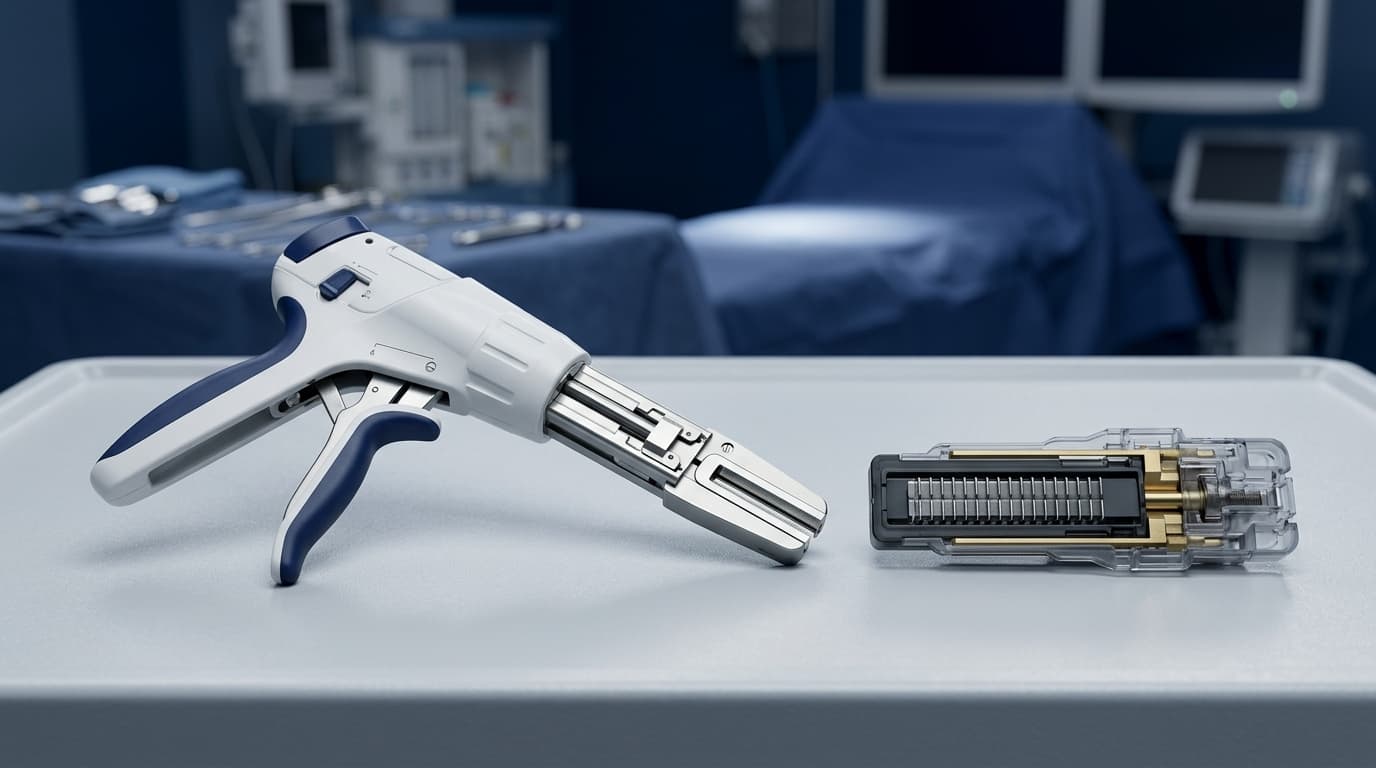
The Procurement Scenario: Why Post-Market Surveillance Matters in Supplier Qualification
Consider a typical high-stakes procurement scenario: A hospital group, regional surgical distributor, or private-label OEM brand is evaluating candidate suppliers for single-use surgical staplers, reload cartridges, or circular anastomosis devices. The vendor supplies slick product catalogs, ISO 13485 certificates, and claims 'zero reported defects.' However, surgical stapling is mechanically demanding: a single device must compress tissue to a precise thickness, drive dozens of microscopic titanium staples into a uniform B-form configuration, and cleanly bisect tissue with an integrated knife blade—all within seconds inside an anatomical cavity.
When mechanical execution fails, consequences range from intra-operative hemorrhage to delayed anastomotic leak, sepsis, and patient death. Hospital clinical-engineering teams and procurement officers cannot rely solely on supplier-provided marketing sheets. Instead, analyzing the FDA's post-market surveillance archive—combining the agency's 2019 aggregate findings, the 2021 Class II reclassification order, openFDA MAUDE adverse-event records, and recall enforcement logs—provides the exact failure-mode map required to author rigorous tender specifications and supplier audit checklists.
This report extends the site's established FDA post-market surveillance series, joining prior evidence maps for circumcision devices, endovenous laser fibers, and NPWT pumps.
What the FDA Post-Market Record Reveals: MAUDE Volume, Outcomes, and Failure Modes
Public awareness of surgical stapler hazards shifted dramatically in March 2019, when the FDA issued a landmark Letter to Healthcare Providers and press announcement summarizing the agency's internal review of surgical staplers and implantable staples for internal use 1. Prior to June 2019, a portion of stapler malfunction reports was submitted under FDA alternative reporting exemptions (such as Alternative Summary Reporting) and was excluded from public MAUDE queries, so the public record under-counted total events 8.
The FDA's 2019 analysis disclosed that between January 1, 2011 and March 31, 2018, the agency received more than 41,000 medical device reports (MDRs) for internal surgical staplers and staples, detailing 366 deaths, over 9,000 serious injuries, and over 32,000 device malfunctions 1. The FDA highlighted that the most frequently reported problems included opening of the staple line or malformation of staples, misfiring, difficulty firing, failure of the stapler to fire, and inadvertent firing.
Reproducible Product-Code Analysis: Product Code GAG (2015–2026)
To provide procurement officers with reproducible, current data, we queried the openFDA device event database for product code GAG (defined under 21 CFR 878.4740 as 'Stapler, Surgical') across receive years 2015 through 2026. Across the full historical MAUDE archive, code GAG contains 26,600 total reports. Within the scoped 2015–2026 window, 3,645 reports were received 8.
Note on passive surveillance: FDA MAUDE data represents passive surveillance. Report counts reflect submissions received by the FDA and do not establish clinical incidence rates, total procedure volume, relative market share, or direct causal proof. They serve as qualitative and quantitative hazard indicators for risk management.
| Surveillance Metric | FDA 2019 Official Aggregate (2011–2018) | openFDA Product Code GAG Dataset (2015–2026) | Procurement & Quality Implication |
|---|---|---|---|
| Total Reports | 41,000+ MDRs (staplers + staples) | 3,645 reports (GAG product code) | High baseline surveillance volume requiring explicit supplier quality screening. |
| Device Malfunctions | 32,000+ reports | 2,977 reports (81.7% of total) | Mechanical lockouts, misfires, and staple malformations dominate. |
| Patient Injuries | 9,000+ serious injuries | 624 reports (17.1% of total) | Direct tissue laceration, bleeding, leakage, and infection. |
| Patient Deaths | 366 deaths | 38 deaths (1.0% of total) | Fatalities linked to catastrophic anastomotic leak or unmanageable arterial hemorrhage. |
| Regulatory Class | Class I (exempt during review period) | Class II (reclassified Oct 2021) | 510(k) clearance and special controls now mandatory for US market access. |
Ranked Patient-Problem Failure Modes in MAUDE Data
Parsing the patient problem coding within the 3,645 GAG MAUDE records (2015–2026) isolates the clinical manifestations of stapler breakdown. Out of 3,645 records, approximately 1,599 malfunction reports involved technical device failures without reported clinical patient harm at the time of filing. Among reports with coded clinical outcomes, the top failure modes rank as follows 8:
- Failure to Anastomose (769 reports): The stapler fails to form a complete fluid-tight tissue closure. Staples fail to penetrate full-thickness tissue or do not clinch into the anvil, leaving unjoined surgical margins.
- Tissue / Staple-Line Breakdown (627 reports): Post-operative disruption or dehiscence of the staple line, leading to GI fluid leakage, peritonitis, or wound failure.
- Hemorrhage / Intra-operative Bleeding (149 reports): Incomplete staple compression or damaged vessel margins causing arterial or venous bleeding along the cut line.
- Tissue Laceration (92 reports): Excessive tissue shearing, blade misalignment, or dull knife action causing tearing beyond the intended cut path.
- Wound Dehiscence (65 reports): Separation of outer tissue layers secondary to poor tissue approximation or staple dislodgement.
- Tissue Damage / Organ Trauma (35 reports): Inadvertent clamping or crushing of adjacent structures due to instrument rigidity or failure to release.
Manufacturer Distribution in GAG MAUDE Records
Analyzing the manufacturer field for GAG MAUDE reports (2015–2026) demonstrates that surveillance reports are concentrated among a small number of major global manufacturers. A key grouping nuance: US Surgical, Covidien, and Medtronic are successive corporate names for the same stapler lineage (US Surgical was acquired by Covidien, now part of Medtronic). Combining these reporting-entity name variants, this single lineage accounts for roughly 80% of GAG reports — a concentration driven by dominant global stapler market share and institutional reporting volume rather than inherent unreliability of a specific brand 8.
| Reporting Manufacturer Lineage | MAUDE Report Count (2015–2026) | Share of GAG Reports | Primary Device Types |
|---|---|---|---|
| Covidien / Medtronic (incl. US Surgical Puerto Rico lineage) | 2,914 | 79.9% | Endo GIA, EEA, Signia, and open linear surgical staplers & reload cartridges. |
| Ethicon Endo-Surgery (Johnson & Johnson) | 286 | 7.8% | ECHELON FLEX, ENDOPATH, and circular surgical stapling systems. |
| CooperSurgical | 139 | 3.8% | Specialty surgical stapling and obstetric/gynecologic resection tools. |
| Teleflex Medical | 97 | 2.7% | Fascial closure, surgical ligation, and specialty stapling devices. |
| Bolder / JustRight Surgical | 79 | 2.2% | Micro-laparoscopic and pediatric surgical stapling devices. |
| Other (B. Braun, Stryker, Medline, and others) | 130 | 3.6% | Miscellaneous specialty and distributed surgical stapling devices. |
Which Firms Drive the Recall Record and What Were the Root Causes?
While MAUDE provides continuous adverse-event signals, FDA Medical Device Recalls reflect formal field correction or removal actions triggered by verified design, manufacturing, or packaging defects. Examining recent high-profile Class I recalls alongside openFDA recall database records isolates the exact engineering failure modes that lead to regulatory enforcement.
Named FDA Class I Recalls: Intuitive SureForm and Ethicon ENDOPATH
FDA Class I recalls are the agency's highest hazard classification, assigned when there is a reasonable probability that device use will cause serious adverse health consequences or death. Two prominent Class I actions highlight critical reload cartridge vulnerabilities 34:
- Intuitive Surgical 8mm SureForm 30 Gray Reloads (Class I Recall): Intuitive Surgical issued a recall for specific lots of 8mm SureForm 30 Gray reloads due to incomplete staple line formation during robotic tissue resection. The FDA classified the action as Class I after reporting indicated 1 patient death and 4 serious injuries linked to anastomotic leakage and bleeding 3.
- Ethicon Endo-Surgery ECHELON FLEX ENDOPATH 60mm Staplers (Class I Recall, October 2019): Ethicon recalled ENDOPATH staplers after identifying an out-of-specification anvil component within the device jaw that could produce malformed staples and compromise staple-line integrity. FDA reporting detailed 1 patient death and 7 serious injuries across 8,256 affected devices distributed in the US 4.
Recall Root Cause Taxonomy from FDA Enforcement Records
Querying openFDA recall logs for product code GAG isolates recurring mechanical and sterility failure categories across manufacturing batches 9:
| Failure Sub-System | Specific Mechanical / Quality Root Cause | Clinical Risk Impact | Tender / Audit Screening Requirement |
|---|---|---|---|
| Staple Formation & Clinch | Unformed, malformed, or asymmetrical 'B-form' staples caused by anvil mis-alignment or staple wire hardness variance. | Incomplete tissue seal, staple line dehiscence, GI fluid leak, peritonitis. | Mandatory B-form clinch height verification and anvil alignment tolerance testing. |
| Tissue Gap Control | Incorrect jaw tissue-gap dimension setting or deflection under clamping pressure. | Tissue crushing/necrosis (if gap too tight) or fluid leakage/bleeding (if gap too loose). | Clamping force vs tissue compression thickness deflection limit certification. |
| Reload & Lockout System | Failure of safety lockout mechanism to prevent firing spent or missing reload cartridges; staple guide disengagement. | Blade cuts tissue without staple placement (catastrophic open cut line). | 100% mechanical lockout interlock validation on spent cartridge insertion. |
| Firing Force & Drive Train | Excessive force-to-fire, driver rod bending, or gear tooth stripping in manual or powered handles. | Incomplete stroke, stuck stapler locked on tissue requiring emergency open conversion. | Maximum force-to-fire ergonomics limit and emergency manual release mechanism. |
| Sterile Packaging Integrity | Pinhole leaks, seal channel voiding, or blister tray cracking during transit/sterilization. | Loss of sterility, surgical site infection, sepsis. | ISO 11607 packaging validation, dye penetration, and bubble emission testing. |
How the 2021 FDA Reclassification Changed What a Buyer Must Request
Understanding regulatory classification is crucial for international procurement and quality compliance. Prior to October 2021, internal surgical staplers were classified as Class I (general controls exempt from premarket notification) under 21 CFR 878.4740. This historical loophole allowed legacy stapler models to enter the US market without formal 510(k) review.
On October 8, 2021, the FDA published its landmark final order in the Federal Register (Document 2021-22041), formally reclassifying surgical staplers for internal use from Class I to Class II (special controls) under 21 CFR 878.4740 2. The order established product code GAG as the designated Class II code for internal staplers, requiring mandatory 510(k) clearances and adherence to special controls performance guidelines 5.
The GAG vs. QQS Classification Pitfall: Internal vs. External Skin Staplers
A frequent regulatory trap encountered by international buyers is confusing internal surgical staplers with external skin staplers. Both device types reference 21 CFR 878.4740, but their regulatory status and product codes differ fundamentally 5:
| Classification Attribute | Product Code GAG ('Stapler, Surgical') | Product Code QQS ('Stapler, Skin') | Procurement Verification Action |
|---|---|---|---|
| Intended Use | Internal tissue resection, transection, and anastomosis (GI, thoracic, gyn). | External cutaneous skin closure only (abdominal, orthopedic, traumatic skin cuts). | Verify device indication matches anatomical target before accepting classification claims. |
| FDA Device Class | Class II (Special Controls) | Class I (General Controls) | Reject vendors offering internal staplers under Class I exempt declarations. |
| 510(k) Premarket Review | Mandatory 510(k) clearance required for US commercial distribution. | Exempt from 510(k) premarket notification. | Demand valid 510(k) K-number for GAG internal stapler offerings. |
| Special Controls Compliance | Mandatory performance testing (burst pressure, staple formation, lockout reliability). | Standard general controls (GMP/QS Regulation, packaging labeling). | Request full special-controls evidence pack for internal staplers. |
Correction Note: In some technical literature, product code QQS has been erroneously cited as the reclassified internal stapler code. Official FDA CDRH databases confirm that GAG is the Class II internal surgical stapler code, while QQS is the Class I external skin stapler code 5.
Tender Specifications & Acceptance Testing to Screen Out Stapler Failure Modes
Translating MAUDE and recall evidence into procurement criteria allows hospital buyers, biomedical engineers, and distributors to erect effective quality gates. Tenders and supplier contracts should incorporate mandatory testing limits mapped directly to the top FDA failure modes:
| Target Failure Mode | FDA MAUDE / Recall Basis | Mandatory Acceptance Test & Technical Specification | Supplier Verification Document |
|---|---|---|---|
| Failure to Anastomose & Staple Line Leakage | 769 MAUDE reports; Class I SureForm recall (incomplete lines). | Staple Line Burst Pressure Testing: Sealed tissue margins must withstand >50 mmHg fluid pressure without burst or leakage. 100% visual 'B-form' clinch verification under optical comparator. | ISO 13485 bench test report; burst pressure test protocol per ASTM/FDA guidance. |
| Inadvertent Misfire / Spent Cartridge Firing | Class I Ethicon ENDOPATH correction; lockout mechanism failures. | Safety Lockout Interlock Test: 100% force interlock testing ensuring handle cannot be actuated when reload cartridge is missing, spent, or improperly seated. | Risk analysis (FMEA) showing lockout failure severity = Catastrophic; 100% line inspection protocol. |
| Tissue Gap Deflection & Crushing | Covidien gap height recalls; tissue breakdown (627 MAUDE reports). | Jaw Stiffness & Tissue Gap Tolerance: Jaws must maintain gap height tolerance within ±0.05 mm under maximum clamping load without structural deflection. | Finite element analysis (FEA) and physical jaw deflection load test curves. |
| Excessive Firing Force / Handle Jamming | Driver rod bending; locked stapler on tissue requiring conversion. | Force-to-Fire Limits & Emergency Release: Firing actuation force must not exceed 40 N manually; manual override release mechanism must function within <5 seconds. | Ergonomic force-to-fire profile curves; emergency tissue release validation. |
| Packaging Sterility Void | Ethicon & Cardinal Health sterile barrier recalls. | ISO 11607 Packaging Integrity: Dye penetration (ASTM F1929) and bubble emission (ASTM F2096) after accelerated aging & transit simulation. | Sterilization validation report (EO residual ISO 10993-7) and packaging shelf-life report. |
Where Does the Circumcision Stapler Fit? Addressing the QQR Evidence Gap
A critical product line within the VEMERIX urology portfolio is the single-use circular circumcision stapler and circumcision anastomat kit. These specialized surgical instruments perform circumferential prepuce resection and staple anastomosis in a single rapid pass.
When searching the US FDA database for circular circumcision staplers under product code QQR (defined as 'Circumcision Device With Stapler' under 21 CFR 884.4530), surveillance queries return zero MAUDE reports and zero US 510(k) clearances all-time. As established in our circumcision stapler mechanism guide, this zero count does not mean circular circumcision staplers possess zero clinical risk.
Rather, the zero US database footprint reflects a commercial registration pattern: most single-pass circular circumcision staplers manufactured globally are distributed in Asia, Europe, Latin America, and the Middle East under CE mark or NMPA Class II registrations (such as Medison's NMPA registration Lu Mech Reg. 20192020192), or listed under generic surgical tool filings. Because US clinical adoption of circular circumcision staplers remains minimal compared to traditional clamps (code HFX), passive US MAUDE reporting for code QQR remains unpopulated.
Consequently, when international buyers qualify disposable circumcision staplers or anastomat kits, they cannot look to a QQR-specific MAUDE record for guidance. The rigorous, defensible quality approach is to treat the GAG surgical stapler post-market failure map as the proxy specification baseline. Circular circumcision staplers utilize the exact same mechanical principles—anvil alignment, titanium staple formation, tissue compression gap control, and circular knife cutting—as GI circular staplers. Requesting GAG-equivalent staple formation, burst pressure, and lockout evidence ensures comprehensive quality screening for circumcision stapler programs.
Where VEMERIX Fits — and Where Due Diligence Still Begins
VEMERIX, the international brand of Weihai Medison Medical Equipment Co., Ltd., operates as a Minimally Invasive Surgery Total Solution Platform serving urology, vascular surgery, and perioperative care. Within the urology portfolio, Medison manufactures NMPA-registered single-use circumcision staplers and anastomat kits engineered for outpatient surgical centers and hospital operating rooms.
VEMERIX does not manufacture or supply internal gastrointestinal or thoracic surgical staplers (code GAG). However, for urology distributors and hospital procurement teams evaluating circular anastomosis technology, Medison's manufacturing and quality systems reflect the exact engineering standards emphasized in this post-market report:
- Precision Anvil & Staple Alignment: Manufactured under NMPA Class II registration (Lu Mech Reg. 20192020192 for circumcision staplers; Lu Mech Reg. 20162020372 for anastomat kits), utilizing automated assembly to ensure consistent B-form staple clinch across all size codes.
- 100% EO Sterilization & Packaging Control: Processed under ISO 11135 validated ethylene oxide sterilization with ISO 11607 compliant sterile barrier packaging, eliminating packaging pinhole and residual toxicity risks.
- Complete Qualification Packs: VEMERIX provides distributors and procurement officers with comprehensive technical files, including dimensional tolerances, staple formation test logs, EO sterilization validation, and regulatory documentation.
- Cross-Portfolio Synergies: For complete outpatient urology workflows, VEMERIX pairs circumcision staplers with post-operative protective garments (catheter fixers and Circum-CARE post-op pants) and topical wound care solutions (medical adhesive and HOCl disinfectant).
Due diligence begins with inspecting objective test data. Procurement committees and OEM partners are encouraged to request VEMERIX's technical packs, sample lots, and registration dossiers to verify compliance against international quality standards.
Frequently Asked Questions (FAQ)
How many surgical stapler adverse events are in the FDA MAUDE database, and what do the counts actually mean?
In 2019, the FDA disclosed an internal aggregate of more than 41,000 medical device reports for internal surgical staplers and staples received between January 2011 and March 2018 (including 366 deaths and >9,000 serious injuries). Our scoped openFDA search for product code GAG ('Stapler, Surgical') received between 2015 and 2026 identified 3,645 reports (2,977 malfunctions, 624 injuries, and 38 deaths). MAUDE data represents passive surveillance; these counts reflect reported events rather than total clinical incidence, but they highlight the high surveillance volume of this device category.
Are surgical staplers Class I or Class II devices — and what changed in the 2021 FDA reclassification?
Prior to October 2021, internal surgical staplers were Class I (exempt from 510(k) premarket review). On October 8, 2021, the FDA published a final order in the Federal Register reclassifying surgical staplers for internal use to Class II (special controls) under 21 CFR 878.4740 (product code GAG). Internal staplers now require mandatory 510(k) clearance and special-controls performance evidence. External skin staplers (product code QQS) remain Class I and 510(k)-exempt.
What are the most common surgical stapler failure modes in the FDA record?
The top coded patient-problem failure modes in MAUDE for product code GAG are failure-to-anastomose (769 reports), tissue/staple-line breakdown (627 reports), intra-operative hemorrhage/bleeding (149 reports), tissue laceration (92 reports), and wound dehiscence (65 reports). Mechanical root causes include staple malformation, anvil mis-alignment, improper jaw tissue gap, safety lockout failure, and excessive force-to-fire.
Which surgical stapler recalls were classified FDA Class I, and what caused them?
Prominent FDA Class I recalls include Intuitive Surgical's recall of 8mm SureForm 30 Gray Reloads (incomplete staple lines linked to 1 death and 4 injuries) and Ethicon Endo-Surgery's correction for ENDOPATH cartridges (inadvertent lockout and malformed staples linked to 1 death and 7 injuries). Class I recalls represent the highest regulatory risk tier, where device failure carries a reasonable probability of serious injury or death.
If our circumcision or anastomosis stapler has no MAUDE reports, does that mean it is safe?
No. Product code QQR ('Circumcision Device With Stapler') shows zero MAUDE reports and zero 510(k) clearances in the US database because circular circumcision staplers are primarily marketed internationally under CE mark or NMPA approvals, or listed under general codes. Passive surveillance zero counts indicate low US reporting volume rather than zero clinical risk. Procurement teams should apply internal surgical stapler (GAG) performance specifications as a proxy baseline.
What acceptance tests and specifications should a procurement team write against surgical stapler failure modes?
Procurement specifications should mandate: (1) Staple line burst pressure testing (>50 mmHg) and 100% B-form clinch height optical inspection; (2) 100% mechanical lockout interlock verification on missing/spent cartridges; (3) Jaw deflection limits (±0.05 mm tolerance under load); (4) Maximum force-to-fire limits (<40 N) and emergency manual release validation; and (5) ISO 11607 sterile barrier packaging integrity testing.