08NPWT · Wound Therapy
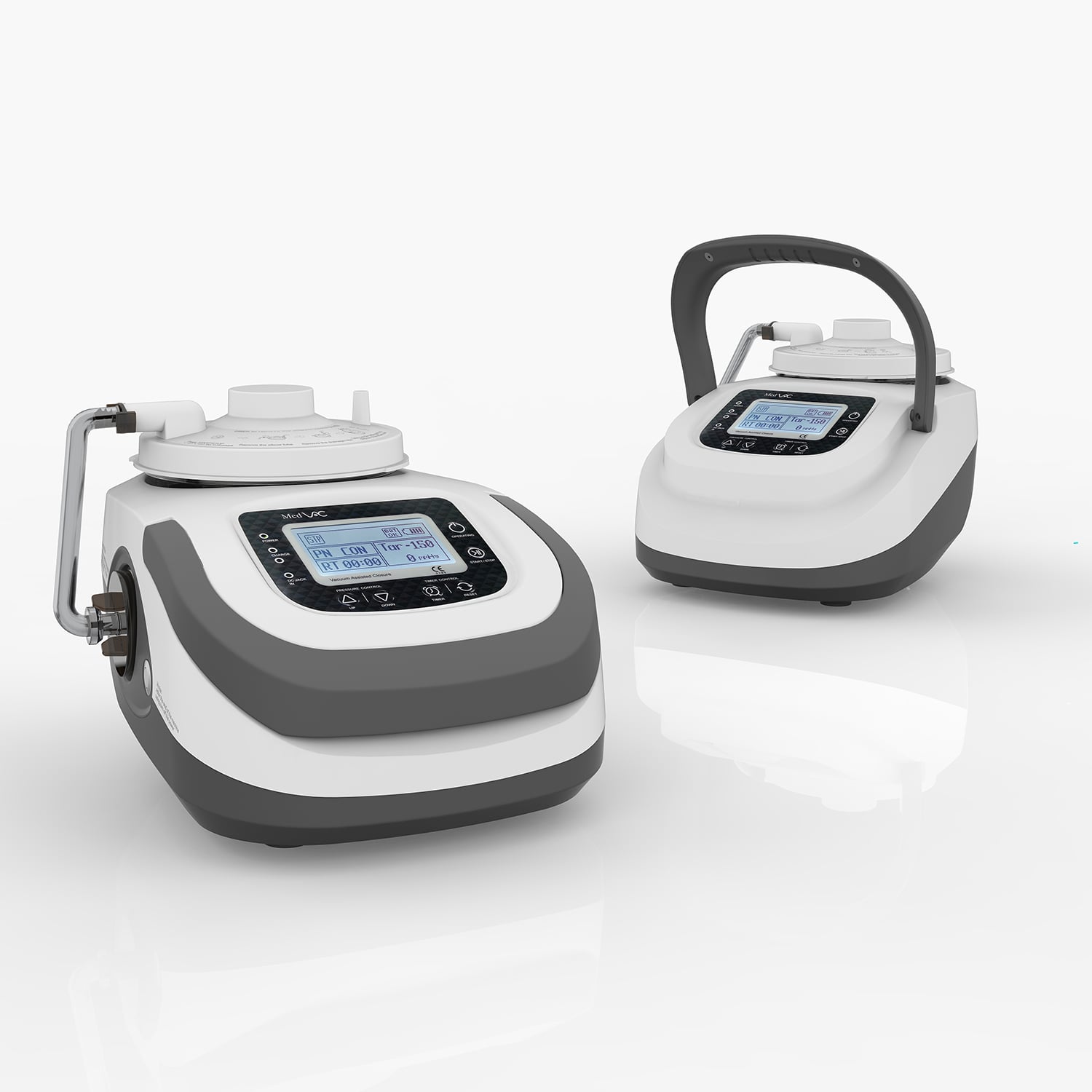
NPWT Pump for Negative Pressure Wound Therapy
Microcomputer-controlled Medical Vacuum NPWT Pump.
Classification
Class II
NMPA Reg.
Lu Mech Reg. 20182140303
Microcomputer-controlled Medical Vacuum NPWT Pump with ultra-low pressure range, intelligent memory and multiple safety protections. Designed for chronic, acute and post-surgical wound drainage in inpatient and ambulatory settings.
KEY FEATURES
What makes it work.
- Continuously adjustable pressure: −50 to −450 mmHg, 10 mmHg steps
- Continuous and intermittent operating modes
- Quiet operation: < 45 dB
- AC/DC + spare battery (4 h continuous, 8 h intermittent) + 12 V vehicle DC option
- Auto memory of last setup, gas-leak alarm, overflow alarm, overheat protection
- Suction flow 1.5 – 8.0 L/min, ±0.2% pressure display error
APPLICATIONS
Where it's used.
- Acute wounds
- Chronic and diabetic wounds
- Wound drainage of high-exudate post-surgical wounds
CONTRAINDICATIONS
- Wounds with necrotic eschar or unfinished debridement
- Wounds with tumor tissue
- Sinus connected with organs
- Wounds with great vessels or organs exposed
SPECIFICATIONS
Technical specifications.
Classification
Class II medical device
NMPA registration
Lu Mech Reg. 20182140303
Pressure range
−50 mmHg ⇄ −450 mmHg, ±0.2% display error
Adjustment step
10 mmHg
Suction flow
1.5 – 8.0 L/min
Operation modes
Continuous · Intermittent
Noise
< 45 dB
Lifetime
> 10,000 hours continuous
Power
AC/DC + spare battery + optional 12 V 5A vehicle DC
Patent
ZL 2011 30150021.9 (utility); 20150379238.4 (invention)
Patents
Utility ZL 2011 30150021.9
Appearance ZL 201430202321.0
Invention 20150379238.4
FROM VEMERIX INSIGHTS
Market analysis behind this product
Buyer Guide
Medicare DMEPOS NPWT Payment Estimates in 2024–2025: the Evidence Buyers Still Need
Keep payment denominators and uncertainty intact, then verify exact-model coding and the proposed Medicare DME payment pathway.
October 12, 2026 · 15 min read
Buyer Guide
Medicare Home NPWT Fees in October 2026: The ZIP-Code Check Behind an E2402 Benchmark
Unchanged fee cells can still produce a different benchmark when a ZIP changes rural status.
October 5, 2026 · 29 min read
Buyer Guide
Which Pressure Range Belongs in an NPWT Pump Tender?
How to read CMS A52511's 40–80 mm Hg E2402 capability window against clinical defaults and a factory −50 to −450 mmHg envelope.
September 21, 2026 · 14 min read
Buyer Guide
When a GB 9706.1 CoA Is Not IEC 60601-1 Edition 3.2
An incoming-inspection and supplier-qualification guide for international medical-device distributors, hospital procurement teams, and OEM buyers evaluating Chinese electrical-safety certificates, GB 9706.1-2020 transition rules, and FDA or EU regulatory overlays on 16 September 2026.
September 16, 2026 · 16 min read
Technical Guide
How to Review a Supplier's Design and Development File After QMSR
An incoming audit guide for medical device distributors, OEMs, and private-label partners: why 21 CFR 820.30 is reserved under QMSR, how ISO 13485:2016 Clause 7.3 carries the legal duties, what CP 7382.850 inspects under Design and Development, how EN ISO 13485 and GB/T 42061-2022 overlay the file, the DHF-to-medical-device-file pivot, and an 8-point buyer acceptance protocol.
September 15, 2026 · 16 min read
Buyer Guide
When NPWT Dressing Kits Are Not Interchangeable Across Pumps
Why FDA 510(k) indications for use, CMS integrated-system billing rules and product code OMP dictate companion-pump matching rather than catalog-universal claims.
September 13, 2026 · 14 min read
Evidence Review
Wound Debridement Before the Vacuum: What Medicare Data Shows About Where NPWT Actually Sits in Care (2026)
Medicare professional-service data and current wound guidance show why debridement and dressings define the pathway—and why NPWT remains a selective downstream adjunct.
August 17, 2026 · 28 min read
Buyer Guide
Single-Use vs Reusable NPWT Pump: A Disposable-vs-Powered Procurement Decision Matrix Built on FDA Product Codes, HCPCS Reimbursement and Per-Episode Cost
The FDA itself splits NPWT into reusable powered, non-powered mechanical and disposable powered single-use pumps under three different Class II product codes, and the right buy flows from exudate volume, wound complexity, care setting and reimbursement path rather than a blanket claim that disposable is better.
August 8, 2026 · 16 min read
Buyer Guide
What the FDA 510(k), Recall and MAUDE Record Reveals About Negative Pressure Wound Therapy Pump Failure Modes — and What Procurement Teams Should Specify Against (2015–2025)
An original FDA surveillance analysis of 214 powered NPWT pump clearances, 48 recalls, and 5,775 MAUDE adverse-event reports (2020–2025) translated into tender acceptance criteria and supplier-vigilance questions.
August 6, 2026 · 15 min read
Evidence Review
Incisional vs Open-Wound NPWT: When Closed-Incision Evidence Cannot Be Generalized to Chronic and Open Wounds
A comprehensive clinical evidence review for perioperative, clinical-engineering, and procurement committees establishing why trial outcomes for prophylactic closed-incision NPWT cannot be directly transferred to open or chronic wound care.
August 5, 2026 · 38 min read
Buyer Guide
NPWT Pump Hospital Price and Total Cost of Therapy: A Transparent Pump, Consumables, Reimbursement and Downtime Cost Model (Without Inventing Vendor Prices)
A hospital procurement cost model separating public reimbursement signals, tender price ranges, and consumable consumption rates from editorial cost scenarios, without inventing vendor quotes.
August 5, 2026 · 25 min read
Evidence Review
Negative Pressure Wound Therapy Dressing Selection: What the PVA-versus-PU Foam, Pore-Size and Closed-Incision-versus-Open-Wound Evidence Actually Supports
Navigating NPWT dressing selection requires separating material mechanics from clinical healing claims—evaluating open-pore PU black foam (400–600 µm) for high-exudate granulation against hydro-retentive PVA white foam for sensitive wound beds, respecting the 48–72 hour open-wound change boundary, and understanding the FDA regulatory divide between open-wound (OMP) and closed-incision (QFC) devices.
August 3, 2026 · 15 min read
Buyer Guide
How to Specify a Negative Pressure Wound Therapy (NPWT) System: A Lot-by-Lot Tender, RFQ & Acceptance Checklist for Pumps, Dressings and Canisters (2026)
A hospital procurement, health-system category management, or distributor team specifying negative pressure wound therapy (NPWT) should not issue a single bundled RFQ. Structure tenders into platform lots (acute heavy-duty, portable ambulatory, single-use/disposable, consumables, rental), map every pump performance and alarm requirement directly to documented FDA failure modes (leak, occlusion, canister overflow, power thermal cutoff), and demand a 6-part regulatory evidence pack (510(k), UDI, ISO 10993, IEC 60601-1, EO sterilization) before awarding volume.
August 3, 2026 · 18 min read
Market Analysis
From the Pump Cart to the Pocket: The Disposable Shift in Negative-Pressure Wound Therapy
How wound care is repeating the move from a durable capital device to a registered single-use consumable — and why the recurring disposable kit, not the pump, is the strategic prize for device makers and distributors.
July 1, 2026 · 31 min read
MORE IN NPWT
Related products
Ready to evaluate NPWT Pump?
Sample units typically ship under 10 business days for qualified buyers. Distributors — ask about territory exclusivity.