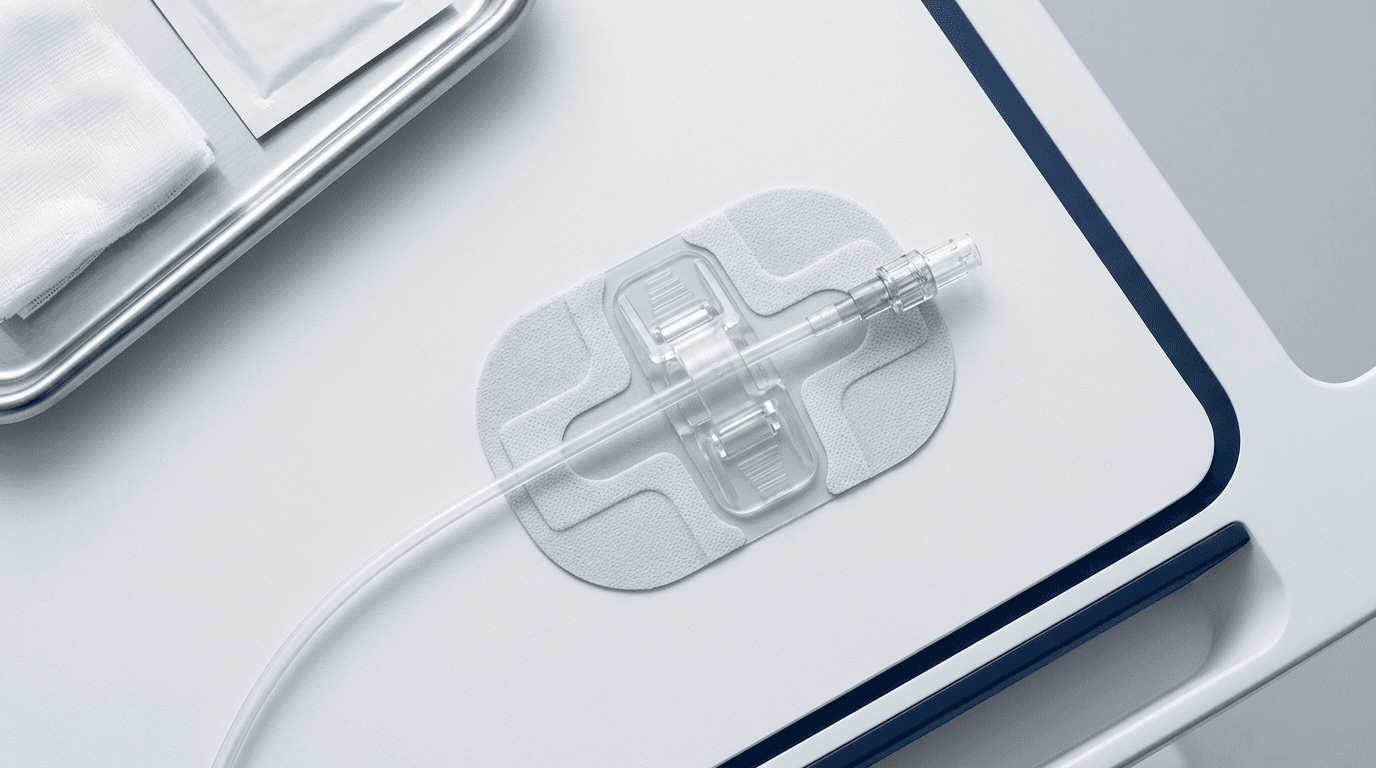
The Procurement Scenario: Why Does Post-Market Surveillance Matter in Securement Supplier Qualification?
Consider a standard hospital value-analysis committee or medical-device distributor evaluating candidate suppliers for single-use catheter stabilization devices, integrated-securement dressings, or tube holders across vascular access, urology, and critical care units. The candidate supplier presents ISO 13485 certification, an FDA establishment registration listing, and glossy marketing brochures promising 'superior holding force' and 'universal catheter compatibility.'
In clinical reality, catheter securement is an exacting mechanical and bio-interfacial challenge. An effective securement device must maintain uninterrupted adhesion to fragile, perspiring skin for 72 to 168 hours; resist multi-directional axial tugs and rotational forces; prevent catheter micro-pistoning (which introduces intraluminal pathogens and triggers mechanical phlebitis); and release cleanly without inducing Medical Adhesive-Related Skin Injuries (MARSI) or epidermal stripping 79.
Because standard intravascular securement devices enter the market under an FDA 510(k)-exempt pathway, regulatory authorities perform no independent benchtop testing or premarket review of the device's mechanical retention, adhesive chemistry, or sizing accuracy. If hospital buyers rely merely on marketing claims, clinical teams quickly face dislodged lines, skin tears, or retainer clips that crush or fail to grip specific catheter hub geometries.
To establish an evidence-based procurement filter, clinical-engineering teams must examine the post-market empirical record. By synthesizing data from the FDA Manufacturer and User Facility Device Experience (MAUDE) database, openFDA device recall enforcement reports, and peer-reviewed randomized controlled trials, buyers can construct a comprehensive map of how securement devices fail in real-world clinical use and build acceptance criteria that prevent those failures before issuing a tender.
This post-market analysis extends the site's dedicated surveillance series, complementing previous failure-mode maps for surgical staplers, topical tissue adhesives, negative pressure wound therapy pumps, circumcision devices, and endovenous laser fibers.
FDA Regulatory Classification Architecture: Why Does 510(k) Exemption Shift the Quality Burden to the Buyer?
A foundational step in qualifying any medical consumable is understanding its exact regulatory classification, product code, and premarket review requirements. Within the FDA classification architecture, securement and fixation devices fall into distinct product codes with fundamentally different regulatory oversight levels 16.
| Product Code | Regulation | Device Generic Name | FDA Class | Submission Type | Premarket Review Burden | Representative Technology |
|---|---|---|---|---|---|---|
| KMK | 21 CFR 880.5210 | Device, Intravascular Catheter Securement | Class I | 510(K) Exempt | General Controls; GMP/QSR compliance; Establishment Registration & Listing; No 510(k) clearance required | Adhesive stabilization pads, mechanical retainer clips (StatLock-style), catheter fixation dressings |
| CBH | 21 CFR 868.5770 | Device, Fixation, Tracheal Tube | Class I | 510(K) Exempt | General Controls; GMP/QSR compliance; Establishment Registration & Listing; No 510(k) clearance required | Endotracheal tube holders, adhesive faceplates, bite-block track assemblies (AnchorFast-style) |
| OKC | 21 CFR 880.5970 | Implanted Subcutaneous Securement Catheter | Class II | 510(K) Required | Special Controls; Mandatory 510(k) premarket clearance; Biocompatibility & mechanical anchor bench testing | Subcutaneous engineered anchor mechanisms with deployable metal/polymer feet (SecurAcath) |
| Adjacent Novel (2024) | 21 CFR 880.5215 | Intravenous Catheter Force-Activated Separation Device | Class II | 510(K) / De Novo | Class II Special Controls (89 FR 66558); Separation force validation; Fluid path integrity testing | Breakaway inline valve connectors designed to decouple under excessive axial tension |
Source: FDA Product Classification Database, 21 CFR Regulations, and Federal Register Notices (Accessed 2026-08-14)
As detailed in Table 1, the vast majority of intravascular securement devices utilized across global hospitals fall under product code KMK (21 CFR 880.5210) 1. The FDA classifies KMK devices as Class I and exempts them from premarket notification under Section 510(k) of the Food, Drug, and Cosmetic Act. While 64 historical KMK 510(k) clearances exist in the FDA database from the pre-exemption era (prior to regulatory streamlining), new market entrants today can commercialize a KMK device simply by completing an establishment registration and device listing.
However, exemption from 510(k) premarket notification does not mean exemption from Current Good Manufacturing Practice (CGMP) / Quality System Regulation (QSR / 21 CFR Part 820) or ISO 13485 requirements. Furthermore, under 21 CFR 880.9 (Limitations of Exemptions), a device loses its exempt status if it introduces a different fundamental scientific technology (e.g., active antimicrobial drug eluting coatings) or an intended use outside standard external mechanical stabilization 6. A clear example of regulatory bifurcation occurred on August 16, 2024, when the FDA published a final classification order (89 FR 66558) placing intravenous catheter force-activated separation devices into Class II under 21 CFR 880.5215 with strict special controls 11.
Because 510(k)-exempt Class I status removes FDA premarket technical scrutiny, the burden of verifying design safety, peel-force holding strength, retainer clip tolerances, and biocompatibility shifts entirely onto the healthcare procurement organization.— VEMERIX Quality & Regulatory Engineering Working Group
FDA MAUDE Adverse-Event Evidence (2015–2026): What Do Real-World Failure Volumes and Trends Reveal?
To quantify the real-world operational challenges of catheter securement, we executed a structured analysis of the FDA MAUDE database across reports received between January 1, 2015, and August 14, 2026, targeting product codes KMK, CBH, and OKC 23.
| Product Code | Generic Description | Malfunctions | Injuries | Deaths | Other / Blank | Total 2015–2026 | All-Time Archive |
|---|---|---|---|---|---|---|---|
| KMK | Intravascular Catheter Securement | 612 | 54 | 1 | 3 | 670 | 750 |
| CBH | Tracheal Tube Fixation Device | 232 | 202 | 8 | 0 | 442 | 823 |
| OKC | Implanted Subcutaneous Securement | 11 | 2 | 0 | 0 | 13 | 18 |
| Combined Total | All Securement & Fixation Families | 855 | 258 | 9 | 3 | 1,125 | 1,591 |
Source: FDA MAUDE Database / openFDA Event Partition Analysis (Data Analyzed 2026-08-14)
Across the 2015–2026 reporting window, the FDA captured 1,125 total adverse event reports across the three securement product codes, with KMK accounting for 670 reports and CBH accounting for 442 reports 2. Examining the annual reporting trajectory for product code KMK reveals a pronounced surge in report volume over the past four years.
| Receive Year | 2015 | 2016 | 2017 | 2018 | 2019 | 2020 | 2021 | 2022 | 2023 | 2024 | 2025 | 2026 (YTD) |
|---|---|---|---|---|---|---|---|---|---|---|---|---|
| KMK Reports | 41 | 20 | 45 | 40 | 10 | 14 | 33 | 107 | 140 | 105 | 75 | 40 |
Source: FDA openFDA Annual Partition Aggregates (2026 Partial-Year Through August 14, 2026)
As shown in Table 3, KMK adverse event submissions rose from an average of ~25–40 reports annually between 2015 and 2021 to a peak of 140 reports in 2023 and 105 reports in 2024. This volume expansion reflects increased post-market surveillance vigilance under hospital electronic reporting integrations and broader adoption of sutureless securement protocols recommended by international vascular access guidelines 9.
| Product Code | Lead Manufacturer / Entity | Report Count | Share of Code | Dominant Brand Families Reported |
|---|---|---|---|---|
| KMK | C.R. Bard / Bard Access Systems / BD | 460 | 68.7% | StatLock PICC Plus Crescent Sliding Post (80), StatLock generic entries (58), StatLock PICC Plus Sliding Post Crescent (49), StatLock Sliding Post Tricot Crescent Pad (43), Bard StatLock (36) |
| KMK | TIDI Products LLC | 50 | 7.5% | Grip-Lok Universal Catheter Securement, Grip-Lok PICC/CVC |
| KMK | Convatec / Unomedical | 37 | 5.5% | Easi-V Securement Dressing (33), AnchorPlus |
| KMK | 3M Health Care | 23 | 3.4% | 3M Tegaderm PICC/CVC Securement Device & Dressing System |
| KMK | All Other Manufacturers Combined | 100 | 14.9% | Centurion, Merit Medical, Dale Medical, Various Hospital System Own-Brand SKUs |
| CBH | Hollister Incorporated | 273 | 61.8% | AnchorFast Oral Endotracheal Tube Fastener family (268 across brand-name variants) |
| CBH | Teleflex Medical / Hudson RCI | 59 | 13.3% | Hudson RCI ET Tube Holder (51), Teleflex Endotracheal Tube Holder |
| CBH | NeoTech Products LLC | 17 | 3.8% | NeoBar / EZ-Hold Neonatal/Pediatric Endotracheal Tube Fastener |
| CBH | Dale Medical Products | 12 | 2.7% | Dale Tracheostomy Tube Holder, Dale Stabilock Tube Fastener |
| OKC | Interrad Medical Inc. | 13 | 100.0% | SecurAcath Subcutaneous Engineered Stabilization Device |
Source: FDA MAUDE Database Manufacturer & Brand Field Aggregation (Analyzed 2026-08-14)
Table 4 illustrates the heavy commercial concentration present within FDA post-market records. For intravascular catheter securement (KMK), Bard entities account for 68.7% (460 reports) of all submissions, led by the pervasive StatLock product line. For tracheal-tube holders (CBH), Hollister accounts for 61.8% (273 reports), centered on the AnchorFast device. In the subcutaneous anchor category (OKC), Interrad Medical represents 100% of all 13 reports.
Crucial Surveillance Limitation & Methodological Notice: The FDA MAUDE repository represents a passive surveillance system. An elevated report count for a market-leading brand like StatLock or AnchorFast is primarily an artifact of vast commercial market share, widespread clinical familiarity, and automated corporate complaint filing systems. Report volume does not establish product defect rates, clinical incidence, or relative safety rankings. Conversely, the minimal volume for OKC (13 reports) reflects a niche procedural footprint rather than proof of zero failure risk. Post-market records must be evaluated to identify what failure modes occur, not to construct unadjusted vendor league tables.
Two Divergent Severity Profiles: Why Do Vascular Catheter Malfunctions Differ From Tracheal Tube Harm?
When analyzing post-market records, clinical-engineering evaluators must distinguish between failure consequences across anatomical applications. Comparing intravascular catheter securement (KMK) against tracheal-tube fixation (CBH) reveals two entirely different severity profiles from the same mechanical category 2.
| Coded Patient Problem | Intravascular Securement (KMK, n=670) | Share of 670 | Tracheal Tube Fixation (CBH, n=442) | Share of 442 |
|---|---|---|---|---|
| No Clinical Signs, Symptoms or Conditions | 444 | 66.3% | 68 | 15.4% |
| No Known Impact or Consequence to Patient | 70 | 10.4% | 48 | 10.9% |
| Insufficient Information to Determine Impact | 18 | 2.7% | 56 | 12.7% |
| Pressure Sore/Ulcer, Pressure Sores or Tissue Breakdown | 6 | 0.9% | 83 | 18.8% |
| Accidental Extubation | 0 | 0.0% | 18 | 4.1% |
| Hypoventilation | 0 | 0.0% | 15 | 3.4% |
| Skin Tears, Erosion, Inflammation or Rash (MARSI-type) | 23 | 3.4% | 17 | 3.8% |
| Hypersensitivity / Allergic Reaction | 11 | 1.6% | 0 | 0.0% |
| Hemorrhage / Bleeding | 9 | 1.3% | 1 | 0.2% |
| Unspecified Tissue Injury | 0 | 0.0% | 15 | 3.4% |
Source: FDA MAUDE Patient Problem Coded Fields (2015–2026 Partitions, Analyzed 2026-08-14)
As detailed in Table 5, intravascular catheter securement (KMK) is characterized by an overwhelmingly benign direct clinical profile: 91.3% of reports (612/670) are coded as device malfunctions — adhesive lifting, a retainer clip that will not snap onto the catheter hub, or wing-post fracture identified at setup or replacement — rather than as patient injury, and 444 of the 670 reports (66.3%) carry the explicit code 'No Clinical Signs, Symptoms or Conditions' 2.
In stark contrast, tracheal-tube holders (CBH) carry severe patient risk: 47.5% of all reports (210/442) involve documented patient injury (202) or death (8). Because endotracheal tube securement devices rest against facial bones in sedated, critically ill ICU patients, inadequate foam cushioning or excessive strap tension causes rapid ischemic pressure necrosis (83 reports — 18.8% of all CBH reports — carry a pressure-sore, pressure-ulcer or tissue-breakdown code). When adhesive faceplates release due to oral secretions, sudden accidental extubation and subsequent acute hypoventilation occur (33 reports mention accidental extubation, hypoventilation or both).
In vascular access, the primary risk is not acute skin necrosis but line failure and bloodstream infection 10. In a 281-patient randomized controlled trial published by Ferraz-Torres et al. in the Journal of Infusion Nursing (2024), peripheral intravenous catheters secured with fully reinforced stabilization dressings achieved statistically significant reductions in both infectious phlebitis (P = 0.043) and accidental dislodgement (P = 0.03) compared to standard bordered transparent dressings, with an average dwell time of ~2.7 days 7. This clinical trial evidence confirms that mechanical stability directly governs vascular access longevity, corroborating Cochrane meta-analyses by Marsh et al. 8 and Infusion Nurses Society (INS) standards 9.
The FDA Recall Record: What Are the Root Causes Behind the Four Major Failure Classes?
While MAUDE captures spontaneous clinical complaints, the FDA Medical Device Recalls database documents instances where manufacturers and regulatory authorities initiated formal market withdrawals or field corrections due to validated engineering and manufacturing flaws 35.
| Recall Year / Res # | Device Brand / Model | Code | Manufacturer | Quantity Affected | Root Cause / Reason for Recall | FDA Status |
|---|---|---|---|---|---|---|
| 2024 (Initiated Dec) / Z-1178 to Z-1181-2025 | AnchorFast Oral Endotracheal Tube Fastener family (REFs 9700, 9787, 9799, 9800) | CBH | Hollister Incorporated | 36,228 boxes (434,736 eaches) across 4 actions | Decreased skin-barrier wear time; premature adhesive release could allow tube migration / extubation | Open / Active |
| 2024 (Initiated Nov) / Z-0695 to Z-0698-2025 | HUDSON RCI mBrace ET Tube Holder (2- and 4-point strap, with/without bite block) | CBH | Medline Industries LP | 3,924 units across 4 actions | Adhesive-element defects plus rigid frame pressure on cheekbones / upper lip risking dermal injury | Open / Active |
| 2022 / Z-1611-2022 | Centurion IV Securement Kit (Model IVSSTK3; coded OKC in the FDA recall record) | OKC | McKesson Medical-Surgical (distributor action) | 3 cases | Facility temperature excursions (Jun–Aug 2021) prior to delivery may have impacted product effectiveness | Open / Active |
| 2017 / Z-2120-2017 | StatLock IV Premium Catheter Stabilization Device | KMK | Bard Access Systems | 4,500 units (Lot JUAQF675) | Incorrectly sized retainer clip may not grip the target IV catheter hub correctly | Terminated |
| 2017 / Z-1927 & Z-1928-2017 | Dale Stabilock Endotracheal Tube Holder (#270) + Adhesive Base (#273) | CBH | Dale Medical Products Inc. | 34,770 units | Adhesive faceplate may lose adhesion when exposed to patient moisture, risking tube movement | Terminated |
| 2016 (Initiated Dec) / Z-0981 & Z-0982-2017 | StatLock PICC Plus / CV Plus single-unit pouches | KMK | Bard Access Systems | 44,500 units across 2 actions | Single-unit pouches released without unique product identifiers (product code, lot number, expiration date) — lot-traceability defect | Terminated |
| 2013 / Z-1618-2013 | StatLock CV Plus Stabilization Device (w/ Pigtail) | KMK | Bard Access Systems | 3,875 units (Lot JUWJF283) | Incorrect pad assembly during manufacture (hydrocolloid strip and directional arrow missing) | Terminated |
| 2008 / Z-0446 & Z-0447-2008 | Dale 240 / 242 Tracheostomy Tube Holders | CBH | Dale Medical Products | Undisclosed | Instructions for use failed to prohibit trimming fastener hook tabs; trimmed tabs could disengage at the tracheostomy plate | Terminated |
| 2007 / Z-0627 to Z-0629-2007 | StayFix (percutaneous, small & large) and EpiFix (epidural) fixation devices | KMK | Merit Medical Systems (Unomedical) | Undisclosed | Sterility may be compromised by damaged single-unit packaging | Terminated |
Source: FDA Medical Device Recalls Database & openFDA Recall API (Statuses and Quantities Verified Live 2026-08-14)
Auditing the 20 historical and active recall actions across securement codes reveals that failures cluster into four primary engineering classes 45:
- 1. Adhesive & Skin-Barrier Degradation: Moisture-induced adhesive failure remains the leading cause of field corrections. As exemplified by the still-open December 2024 Hollister AnchorFast actions (434,736 eaches across four recalls) and the 34,770-unit Dale recall, formulation shifts or poor moisture-vapor transmission rate (MVTR) substrates lead to premature edge lift and pad detachment well before the labeled wear period in high-humidity or diaphoretic patient settings.
- 2. Component Sizing, Retainer Fit & Assembly Mismatches: In April 2017, Bard Access Systems recalled 4,500 StatLock IV Premium devices (Recall Z-2120-2017) because an incorrectly sized plastic retainer clip had been assembled onto the device 4. The mismatched clip could not provide reliable mechanical retention around the target IV catheter hub, allowing the catheter to slip free. Similarly, Bard recalled 3,875 StatLock CV Plus units in 2013 after incorrect pad assembly during manufacture left some pads without their hydrocolloid strip and directional application arrow.
- 3. Sterile-Barrier Compromise & Packaging Defects: Merit Medical's 2007 StayFix and EpiFix recalls were initiated because damaged single-unit packaging could compromise unit sterility. A sterile catheter fixer delivered in a breached pouch introduces environmental bioburden directly adjacent to an open vascular puncture site.
- 4. Labeling Gaps, User-Interface Flaws & Traceability Defects: Dale Medical's 2008 actions stemmed from instructions for use that failed to prohibit trimming the fastener hook tabs — trimmed tabs could disengage at the tracheostomy plate. In a parallel lot-traceability failure, Bard's 2016 StatLock field actions (44,500 units) involved single-unit pouches released without unique product identifiers, defeating lot-level recall and expiry control.
Sourcing & Specification Translation: What Acceptance Tests and RFQ Specifications Screen Out Failure Modes?
To prevent these documented post-market failure modes from compromising hospital care, procurement committees must translate every empirical failure class into an enforceable tender specification and incoming quality acceptance gate 16.
| Failure Mode Class | Observed Post-Market Risk | Mandatory Tender Specification / RFQ Requirement | Verification Standard / Test Method | Incoming Acceptance Inspection Gate |
|---|---|---|---|---|
| Pillar 1: Adhesive & Skin Interface | Premature edge lifting, skin stripping, MARSI, adhesive breakdown from sweat/skin prep | Medical-grade hypoallergenic acrylic or silicone adhesive; Breathable non-woven or hydrocolloid backing; MVTR > 1,500 g/m²/24h; Documented 7-day wear substantiation | ISO 10993-5 (Cytotoxicity), ISO 10993-10 (Irritation/Sensitization), ASTM D3330 (180° Peel Adhesion), PSTC-101 | Incoming peel-adhesion testing; Release-liner easy-peel verification; Zero adhesive residue on simulated substrate |
| Pillar 2: Mechanical Retention & Sizing | Retainer clip popping open, catheter slipping through clip, crushing soft catheter lumen | Engineered mechanical retainer clip with positive audible snap-latch; Minimum axial pull-force retention ≥ 15 N (3.37 lbf); Exact dimensional compatibility matrix | BS EN ISO 10555-1 (Catheter Tensile/Securement Force), ISO 80369 Luer/Hub Fitment, In-house pull-to-failure bench test | Go/No-Go plug gauge test on retainer jaws; Snap-latch cycle testing (minimum 5 open/close cycles without hinge fatigue) |
| Pillar 3: Sterile-Barrier System | Packaging pinholes, weak pouch seals, compromised shelf life during transit | Medical-grade Tyvek/PET-PE or paper/film sterile pouch; Validated 3-year or 5-year sterile shelf life; Residual EO ≤ 4 mg/device | ISO 11607-1/2, ASTM F88 (Seal Strength ≥ 1.5 N/15mm), ASTM F2096 (Bubble Leak), ASTM F1929 (Dye Penetration), ISO 11135 | Visual seal inspection (100% seal integrity, no channel leaks); Dye penetration test on representative lot sample |
| Pillar 4: Human Factors & Usability | Clinician misapplication, incorrect wing orientation, inadvertent tab trimming | Intuitive numbered application liners (Step 1, Step 2); High-contrast catheter placement markers; Sizing printed on retainer clip | IEC 62366-1 (Medical Device Usability Engineering), Formative clinical handling evaluations | Incoming packaging labeling verification (correct French/gauge sizing, expiration date, UDI-compliant barcode) |
| Pillar 5: Quality System & Traceability | Undetected tooling wear, unannounced supplier material changes, zero CAPA disclosure | ISO 13485:2016 certified QMS; Fully traceable lot serialization; Mandatory written notification of raw material changes | FDA 21 CFR Part 820 / ISO 13485 QMS audit, Certificate of Analysis (CoA) per lot, Historical recall disclosure | Review of lot-specific Certificate of Conformance (CoC), biocompatibility file audit, supplier CAPA verification |
Source: VEMERIX Quality Assurance & Biomedical Procurement Engineering Framework
When drafting request-for-proposal (RFP) documentation, procurement officers should demand that prospective vendors submit verified test reports covering all five pillars. For detailed guidance on validating sterile packaging integrity and shelf-life stability, see our companion guide on sterile barrier packaging validation. For comprehensive procurement criteria across non-vascular and vascular securement lines, reference our catheter securement device selection and sourcing buyer guide.
Where Does VEMERIX Fit — And Where Does Due Diligence Still Begin?
Within the VEMERIX minimally invasive surgical and perioperative consumable portfolio, securement and puncture solutions are manufactured to address these exact clinical and quality demands 1.
The VEMERIX Disposable Catheter Fixer (Set) is engineered as a dedicated single-use sterile securement system. It incorporates a breathable, hypoallergenic non-woven adhesive base pad coated with medical-grade pressure-sensitive acrylic adhesive, paired with an injection-molded precision retainer clip. The system provides positive mechanical retention across standard vascular lines, drainage catheters, and puncture cannulas, preventing axial migration and micro-pistoning without constricting the internal fluid lumen.
When deployed alongside the VEMERIX Ultrasound-Guided Puncture Kit, the catheter fixer completes an integrated vascular access workflow—from echogenic needle visualization and wire placement through to final sterile stabilization. For technical specifications on needle guidance and puncture trays, review our ultrasound-guided puncture kit selection guide.
Where Due Diligence Begins: VEMERIX does not ask procurement committees or international distributors to accept marketing assertions of quality. Every hospital procurement group and OEM partner is urged to execute rigorous due diligence: request our full technical documentation pack, review third-party ISO 10993 biocompatibility test files, inspect our ISO 13485 quality system certificates on our Quality & Regulatory page, and evaluate physical production samples on your own clinical benches. To initiate sample requests or discuss OEM/private-label contract manufacturing, contact our team through our commercial contact portal.
Frequently Asked Questions (FAQ): What Else Must Buyers and Biomedical Engineers Know?
Q1: Are intravascular catheter securement devices FDA Class II?
No. Under 21 CFR 880.5210 (product code KMK), intravascular catheter securement devices are classified as FDA Class I (510(k) Exempt) 1. They do not require a 510(k) premarket clearance application. However, subcutaneous implanted anchors (product code OKC, 21 CFR 880.5970) and novel force-activated separation devices (21 CFR 880.5215) are classified as Class II and require formal 510(k) clearance 11.
Q2: Has the market-leading StatLock securement device ever been recalled?
Yes. The FDA recall database documents multiple field corrections for StatLock devices, including a 4,500-unit field correction initiated in April 2017 (Recall Z-2120-2017) due to an incorrectly sized retainer clip, and a 3,875-unit recall in 2013 (Recall Z-1618-2013) due to incorrect pad assembly during manufacture 45. Both actions were successfully terminated following corrective manufacturing controls.
Q3: Do MAUDE adverse event report counts prove that one securement brand is less safe than another?
No. The FDA MAUDE database is a passive reporting system subject to significant reporting bias. Market-leading brands with massive commercial distribution (such as Bard StatLock or Hollister AnchorFast) generate higher absolute report numbers primarily due to sheer unit volume, broad clinical exposure, and rigorous corporate vigilance systems 2. MAUDE counts cannot be used to calculate adverse event incidence rates or prove comparative product inferiority.
Q4: What is the most common patient harm associated with securement and fixation devices in post-market records?
For intravascular catheter securement (KMK), direct patient harm is rarely reported (over 91% are caught as mechanical malfunctions before clinical injury) 2. When harm does occur, it manifests primarily as skin irritation or Medical Adhesive-Related Skin Injury (MARSI). For tracheal-tube holders (CBH), the dominant reported patient harm is device-related pressure ulceration and tissue necrosis (18.8% of reports carry a pressure-injury code), caused by rigid plastic frames resting against facial bones in prolonged ICU admissions.
Q5: What critical technical requirements should an RFQ mandate that a 510(k)-exempt supplier will not automatically possess?
Because 510(k) exemption bypasses FDA technical review, an RFQ must explicitly demand: (1) independent ISO 10993 biocompatibility certification for skin contact; (2) multi-day adhesive peel-force retention data under perspiration/humidity challenge; (3) mechanical pull-force verification (≥15 N) across specific catheter hub outer diameters; (4) ISO 11607 sterile-barrier packaging and shelf-life validation reports; and (5) documented lot-level traceability and CAPA history.