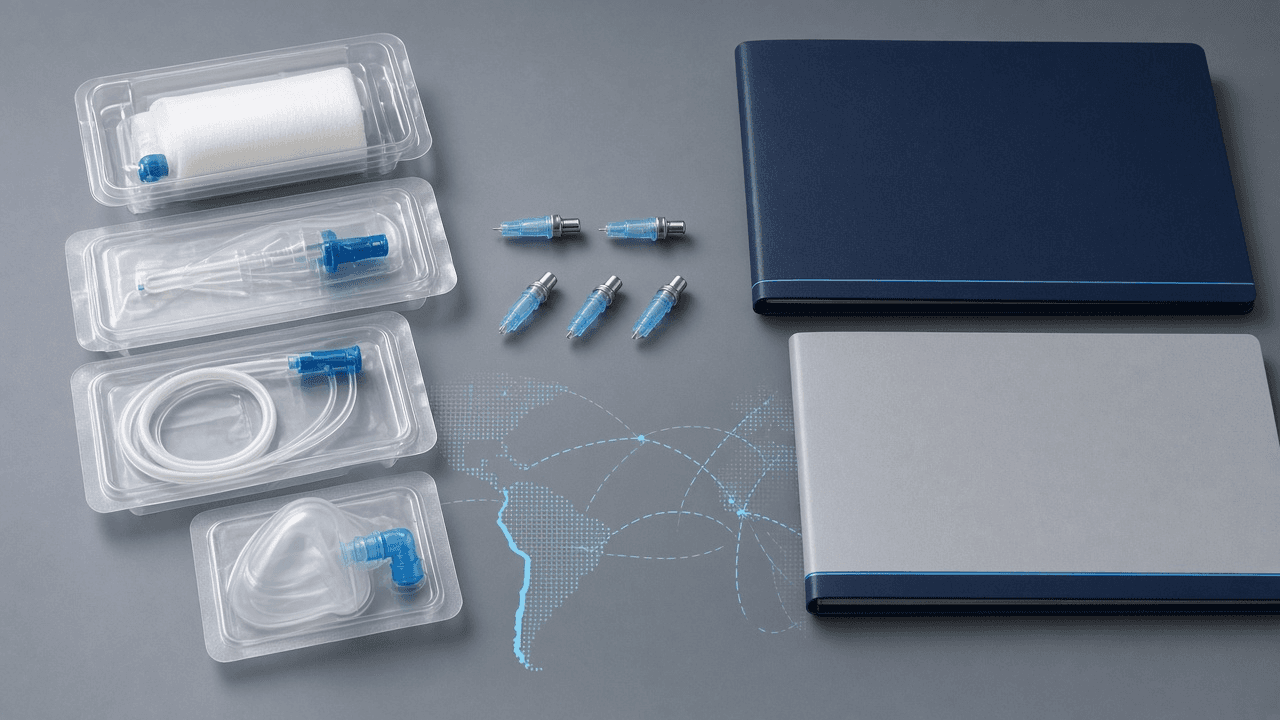
The decision: which checks apply to this shipment?
Start a first-order discussion with the product’s intended use, model or family, legal manufacturer and proposed Chilean importer. A description such as “sterile consumable” is insufficient to assign a registration route. Two products on the same invoice can require different evidence: an ordinary hypodermic needle can belong to an established controlled category while a different consumable may not be subject to mandatory registration.1, 3
The practical distinction is between product status, shipment destination and lot conformity. The registro sanitario records product authorization where required. The CDA identifies where the import is going. The conformity certificate and UyD address the applicable controls before commercial use or distribution of controlled devices. The importer should maintain these as separate records, linked by product identity and imported lot.1, 9
This also separates responsibilities. A manufacturer can supply product and batch evidence, but its export documents cannot establish the Chilean importer’s filing status. Conversely, an importer’s CDA cannot establish that a supplier’s test report covers the model delivered. The workflow below is designed to make those handoffs explicit before freight is booked.
Which categories already require registration?
Use ISP’s registration page together with its regulatory index, rather than treating an old category count as a complete current list. The import page describes established controlled categories, while the registration page also identifies additional IVD decrees and the future expansion. A decree’s publication and the date its requirements apply can be different.3, 7
The following lookup highlights categories relevant to the document split. It is not a ruling on a particular catalogue item, and the IVD rows should not be read as sharing the needle or glove testing procedure.3, 7
| Category | Instrument or current check | Consequence for the shipment |
|---|---|---|
| Surgical and examination rubber gloves | Decreto 342/2004; confirm the exact material and use covered | Registration and the applicable authorized-body conformity route. |
| Male latex, synthetic male and female condoms | Decreto 93/2018 and its amendments; earlier controls also appear in Decreto 342/2004 | Check the applicable category and current standard; do not infer one test regime from another. |
| Sterile single-use hypodermic needles | Decreto 47/2025; NCh2503:2021 | Current conformity evidence must address the updated Chilean standard. |
| Sterile single-use hypodermic syringes | Decreto 47/2025; NCh2504/1:2021 | Current conformity evidence must address the updated Chilean standard. |
| Portable automated external defibrillators (AEDs) | Decreto 42/2021 | ISP performs conformity verification; do not apply a generic third-party lot-testing workflow. |
| HIV self-tests and professional HIV IVDs | Decreto 41/2022 and amendments 96/2022 and 15/2024 | Use the specific IVD procedure and registration requirements. |
| Immunohematological reagents and blood-donation microbiological IVDs | Separate decrees 5/2025 and 31/2026 listed by ISP | Check the applicable scope and effective date separately from Decreto 25/2026. |
Source: ISP category pages and regulatory index; Decreto 47/2025. See sources 1, 3, 7 and 11.
Needle and syringe update: Decreto 47/2025 replaces Decreto 1887/2007 and updates conformity verification to NCh2503:2021 and NCh2504/1:2021. LeyChile identifies its effective version from 10 October 2026. Its transitional article permits continued sale and distribution of products verified under the earlier decree before entry into force, while subsequent conformity verification must use the updated standards. Record which situation applies instead of assuming all older stock is invalid or that an old registration settles a new verification.11
For a product outside mandatory registration, document the reason for that conclusion and retain the exact specification used in the assessment. A classification decision for a simple dressing should not silently be extended to a kit, powered system or product with different claims. ISP’s no-UyD answer for non-mandatory devices is useful only after that scope decision is sound.8
If the category remains uncertain, the Chilean partner can seek ISP’s Declaración de situación regulatoria de dispositivos médicos, service 9200005. The service determines whether a device is under sanitary control under the current rules and requests product information such as instructions or a technical file, label images and promotional material where available. A documented determination is more useful than assuming that the absence of a familiar catalogue name establishes an exemption.5
What does the CDA establish?
ISP’s general device-import page requires a CDA for devices and IVDs and says it must identify the destination establishment. The non-registration CDA page records that this requirement was extended to devices without mandatory registration from 2 July 2018. “No mandatory product registration” therefore does not mean “no sanitary import paperwork.”9, 2
For devices requiring mandatory registration, ISP says the CDA must name an authorized bodega or droguería and separately lists conformity verification and UyD for commercialization. Use the CDA to check the destination, and the applicable authorization and conformity records to check whether the stock can enter distribution. Do not use a customs movement document as the release decision.1
The official CDA page directs importers to GICONA and its importer-user and submission instructions. The general import page notes a manual procedure for free zones. Confirm the current route for the actual entry point and product; a platform used for another ISP service is not evidence that every CDA has migrated to that platform.2, 9
A storage destination entered in a form and an authorization covering that establishment are different facts. For controlled devices, obtain the applicable storage authorization and check that the name and address match the destination declared in the CDA. For other devices, establish what the current procedure requires for that destination rather than assuming one warehouse rule applies to every sanitary product.1, 2
The scale of the non-registration route illustrates why filing modality and lot identity must stay separate. ISP’s historical bulletin records 309,234 completed CDA requests for devices without mandatory registration from July 2018 to December 2023: 234,637 single-load, 66,590 bulk-load and 8,007 mixed requests. The chart divides each count by the same 309,234-request denominator and rounds to one decimal place.4
View chart data
| Category | Share of completed CDA requests (%) |
|---|---|
| Single-load | 75.9 |
| Bulk-load | 21.5 |
| Mixed | 2.6 |
July 2018–December 2023; 309,234 completed requests for devices without mandatory registration.
- Caveat: Request counts are not device units, unique manufacturers or market shares. These historical data do not describe registered-category imports or current annual demand.
Source: ISP, Boletín de Vigilancia Vol. 14 N° 6 (2024), results, Figure 2; source 4.
A bulk request may cover a group of devices; the number of CDAs is therefore not a substitute for a lot register. The buyer’s useful control is a product-and-lot schedule tied to the relevant shipment, not a forecast derived from historical filing volume. The bulletin figures are published administrative aggregates; no underlying GICONA microdata was analyzed.4
When does lot conformity repeat?
ISP’s registered-device import guidance requires a conformity-verification certificate for each imported lot in subsequent imports of mandatory-registration devices whose conformity is verified by a certification body. Its document set also identifies the CDA and UyD. A supplier’s Certificate of Analysis can support the file, but it is not the authorized body’s Chilean conformity certificate.1
This is a scope-specific rule. The same guidance says ISP itself performs AED conformity verification. The newer IVD categories have their own procedures. There is no basis to instruct every registered-device importer to arrange identical physical sampling, laboratory tests or an AED engineer’s inspection for every lot.1, 3
Keep the legal release conditions separate from the order in which applications are lodged. ISP’s UyD FAQ says to request UyD before requesting conformity verification from a certification body; the import page also describes limited sample authorization and modification of UyD during first registration. The safe operating instruction is to follow the current category procedure and the conditions of the actual resolution, while withholding commercial distribution until the applicable requirements are satisfied.13, 1
- Repeat import with registration: Check the registration against the model/family, arrange the CDA and the applicable UyD, and obtain the authorized-body conformity certificate for each imported lot where that rule applies. Preserve the certificate-to-lot link in the receiving record.1
- First import requiring authorized-body verification: ISP describes automatic rejection of UyD where registration is absent, followed by an appeal for limited samples needed for testing and registration. Once registration is obtained, a modification of UyD can authorize commercialization of the imported balance. Resolve this route before treating a first shipment as saleable stock.1
- AEDs without registration: ISP describes a different rejection/appeal route, in which the registration must be obtained before authorization to commercialize. The sample procedure above is not a blanket exception for every device.1
Ask the importer and certification body to specify the current standard, sample quantity, lot coverage and documents needed for this category. Put the expected completion point in the supply plan as a dependency, rather than promising a fixed clearance or testing duration without an agreed basis. Neither a CE mark nor a foreign-market authorization replaces the Chilean documents identified in the applicable procedure.1, 12
What changes under Decreto 25/2026?
Decreto Exento 25/2026 was published on 19 March 2026. Article 1 lists 39 device and IVD categories. Counting the rows of its first transitional article gives 13 categories with a 24-month phase-in and 26 with a 36-month phase-in: 19 March 2028 and 19 March 2029 respectively. These are future dates as of this review, not a statement that all 39 categories already require registration.6
For these newly listed products, article 2 describes ISP conformity verification through review of supporting documents. Article 7 says the relevant conformity verification corresponds to an ISP sanitary registration. Do not turn that into an unsupported forecast that every future import will require the same third-party lot testing used for existing needle or glove categories.6
The table translates the decree’s category names for planning. It does not expand the scope of a named category: for example, its oncology software entries do not mean all software, and its cardiovascular catheter entry does not mean every catheter. The Spanish legal text and the exact intended use remain the basis for a product assessment.6
| Category name | Device type | Risk class | Mandatory enforcement deadline |
|---|---|---|---|
| Implantable cardiac defibrillators / cardioverter pacemakers | Medical Device (DM) | Class IV | 19 March 2028 |
| Implantable defibrillators / pacemakers / cardioverters for resynchronization | Medical Device (DM) | Class IV | 19 March 2028 |
| Cardiac stents and implantation systems | Medical Device (DM) | Class IV | 19 March 2028 |
| Cardiovascular catheters | Medical Device (DM) | Class IV | 19 March 2028 |
| Heart valves | Medical Device (DM) | Class IV | 19 March 2028 |
| Cochlear implants | Medical Device (DM) | Class IV | 19 March 2028 |
| Hip endoprostheses and accessories | Medical Device (DM) | Class IV | 19 March 2028 |
| Breast implants and expanders | Medical Device (DM) | Class IV | 19 March 2028 |
| Implantable surgical meshes | Medical Device (DM) | Class IV | 19 March 2028 |
| Implantable hyaluronic-acid dermal fillers | Medical Device (DM) | Class IV | 19 March 2028 |
| Copper-containing contraceptive intrauterine devices | Medical Device (DM) | Class IV | 19 March 2028 |
| Insulin infusion pumps and accessories | Medical Device (DM) | Class III / IV | 19 March 2028 |
| Blood bags | Medical Device (DM) | Class III / IV | 19 March 2028 |
| Manual defibrillator monitors | Medical Device (DM) | Class III | 19 March 2029 |
| Conventional X-ray equipment | Medical Device (DM) | Class III | 19 March 2029 |
| Brachytherapy equipment | Medical Device (DM) | Class III | 19 March 2029 |
| External radiotherapy equipment, including linear accelerators | Medical Device (DM) | Class III | 19 March 2029 |
| Mammography equipment | Medical Device (DM) | Class III | 19 March 2029 |
| Computed tomography equipment | Medical Device (DM) | Class III | 19 March 2029 |
| Nuclear medicine equipment, including PET and SPECT | Medical Device (DM) | Class III | 19 March 2029 |
| Hemodialysis concentrates (acid–base) | Medical Device (DM) | Class III | 19 March 2029 |
| Hemodialysis equipment and accessories | Medical Device (DM) | Class III | 19 March 2029 |
| Hemodialysis catheters | Medical Device (DM) | Class III | 19 March 2029 |
| Hemodialysis filters | Medical Device (DM) | Class III | 19 March 2029 |
| Intraocular lenses | Medical Device (DM) | Class III | 19 March 2029 |
| Mechanical ventilators (fixed and transport) | Medical Device (DM) | Class III | 19 March 2029 |
| Extracorporeal circulation equipment | Medical Device (DM) | Class III | 19 March 2029 |
| Electrosurgical equipment (electrobisturí) | Medical Device (DM) | Class III | 19 March 2029 |
| Software for processing and analysis of oncology images | SaMD | Class III | 19 March 2029 |
| Software for planning treatment of oncology images | SaMD | Class III | 19 March 2029 |
| Continuous glucose monitoring systems | Medical Device (DM) | Class II | 19 March 2029 |
| Automatic sphygmomanometers | Medical Device (DM) | Class II | 19 March 2029 |
| CPAP/BPAP | Medical Device (DM) | Class II | 19 March 2029 |
| Steam or ethylene-oxide sterilization equipment | Medical Device (DM) | Class II | 19 March 2029 |
| IVDs for detection of Helicobacter pylori | IVD Diagnostic (DMDIV) | Class C | 19 March 2029 |
| Tests for detection of human papillomavirus | IVD Diagnostic (DMDIV) | Class C | 19 March 2029 |
| Tests for detection of the listed respiratory viruses | IVD Diagnostic (DMDIV) | Class C / B | 19 March 2029 |
| Glucose monitoring system, including meter, strip, lancet / puncture device / control solution | IVD / DM System | Class C | 19 March 2029 |
| hCG detection tests (pregnancy and/or tumor marker) | IVD Diagnostic (DMDIV) | Class C / B | 19 March 2029 |
Source: Ministerio de Salud, Decreto 25/2026, article 1 and first transitional article; source 6. English translations, reordered by deadline.
Source for category names, risk classes and dates: Decreto 25/2026, article 1 and first transitional article. The grouping above preserves the decree’s 13/26 split.6
- Technical implementation: The transitional articles require the technical instruction and specified resolutions within 12 months of publication, giving a deadline of 19 March 2027. The decree permits voluntary early registration once the instruction is issued; this is a conditional route, not a promise that every portal service is already available.6
- Registration scope: Article 5 permits a single product, family, group or system according to ISP criteria. Confirm the proposed grouping; do not assume every variant in a catalogue can share a registration.6
- Changes after registration: Article 6 requires notification of relevant changes and a new registration for significant modifications. The procurement implication is to connect supplier change notification to the Chilean holder’s assessment.6
Article 7 restricts manufacture, import, sale and distribution of the listed products from the applicable dates to products with the corresponding ISP registration. Plan product status, incoming orders and remaining stock against those dates; the article does not establish a sell-through exemption or an unlimited right to import until a particular vessel sails. The importer must check any later implementation instructions before committing a transition shipment.6
What should the supplier and importer reconcile?
Prepare one controlled product-and-lot schedule and use it to reconcile the shipping documents, labels and sanitary filings. The checklist below is a recommended commercial handoff, not a claim that every field is a universal CDA attachment. The exact submission requirements depend on the procedure and product.1, 2
For controlled devices, ISP’s registration service lists documents according to device type, including conformity evidence, an export/free-sale certificate, manufacturer recognition of the applicant, a quality-system certificate, labels and instructions, and sterility evidence where applicable. It allows ISO 13485, ISO 9001 or an equivalent quality system in the stated requirement; it does not establish that ISO 13485 plus a free-sale certificate is the sole sufficient evidence for every CDA.12
| SKU status | Product-level record | Shipment-level CDA | Conformity and UyD | Owner and evidence handoff |
|---|---|---|---|---|
| Outside mandatory registration, after exact-scope check | No mandatory registro for the assessed product | Non-registration CDA route | ISP says no UyD is required for this group; do not assign the controlled-product lot rule | Importer records scope and filing; supplier provides matching product/lot information. |
| Existing mandatory category assessed by an authorized certification body | Registration covering the product; first-import sample procedure where applicable | CDA naming the authorized storage destination | Each imported lot needs the applicable conformity certificate after registration; follow the category procedure and UyD conditions | Importer/applicant handles local permissions; authorized body issues conformity evidence; supplier supports the file. |
| AED or an IVD with its own ISP procedure | Applicable registration and category-specific evidence | Applicable CDA procedure | Use the specific ISP procedure; do not import the needle/glove sampling sequence by analogy | Local applicant and ISP; confirm who evaluates the product and which evidence is required. |
| Decreto 25/2026: 13 categories, 19 March 2028 | Plan registration under the decree; voluntary early route once the instruction is issued | CDA remains a separate import control | Decree describes ISP document-review conformity corresponding to registration; check implementation instructions | Local applicant prepares the file with manufacturer evidence and checks future shipment conditions. |
| Decreto 25/2026: 26 categories, 19 March 2029 | Same planning task, with the later mandatory date | CDA remains a separate import control | Same need to verify implementation; no assumed blanket future third-party per-lot test | Local applicant confirms the exact listed category and registration grouping. |
Source: Editorial status-by-check matrix, based on ISP guidance and Decreto 25/2026; sources 1, 2, 3, 6 and 8.
| Record | Supplier contribution | Chilean importer decision |
|---|---|---|
| Product identity and scope | Legal manufacturer, model/SKU, intended use, sterile status, configuration, label and IFU revision | Record the exact mandatory category or the basis for the non-registration route. |
| Registration and conformity | Applicable technical and quality documents; evidence covering the configuration supplied | Confirm registration scope and current conformity route; identify who obtains each certificate. |
| Destination | Delivery and storage conditions, carton configuration | Confirm the destination establishment and any required authorization; reconcile the CDA destination. |
| Lots and quantities | Lot identifier exactly as labeled, units per lot, manufacture and expiry dates where applicable | Link each lot to the shipment, applicable conformity certificate and UyD conditions. |
| Transport and receipt | Invoice/packing details, handling limits and package identification | Arrange the correct filing; check seals, labels and transport conditions on receipt. |
| Release and traceability | Batch evidence agreed for the product; change/complaint contact | Record the release decision and distribution traceability; keep unresolved stock out of distribution. |
Source: Editorial checklist based on ISP import/registration requirements and storage/traceability guidance; sources 1, 2, 12 and 14.
ISP’s storage guide calls for checking packaging integrity, labeling, conservation conditions and distribution traceability, including lot, manufacture/expiry dates and quantities. If the dates on a pouch and the shipment schedule disagree, isolate the discrepancy and ask the responsible parties to resolve it against controlled records before release. Do not invent a corrected label or presume a specific customs penalty follows automatically.14
Separate costs in the commercial agreement: the current official filing fee, certification/testing charges where applicable, and logistics or storage charges. Obtain dated quotes from the responsible parties. This guide offers no verified current fee or approval-time estimate, and a consultant’s service price should not be presented as an ISP fee.
A mixed order needs a product-by-product decision
Consider a hypothetical order containing ordinary sterile hypodermic needles, circumcision staplers and NPWT dressings. The order is useful precisely because its lines cannot be assigned one blanket “sterile device” authorization. These examples are not determinations of the Chilean status of any VEMERIX SKU.
- Needle line: If the exact product falls within Chile’s sterile single-use hypodermic needle category, check registration, the current Decreto 47/2025 conformity requirements, the CDA, the applicable imported-lot certificate and UyD. A foreign quality certificate alone does not complete those gates.1, 11
- Other lines: Assess the exact stapler or dressing configuration against the current mandatory scope and future lists. If it is outside mandatory registration, ISP’s published FAQ says the non-registration CDA route does not require UyD. That conclusion belongs to the assessed product; it is not a blanket clearance for every kit, accessory or powered system sold under the same brand.3, 6, 8
- Shared shipment: Keep the commercial invoice connected to separate status and release records for each line and lot. Completing the CDA does not resolve a missing controlled-product certificate; nor should a valid needle registration be treated as covering unrelated consumables.1, 9
For a needle RFQ, ask for the dimensions, intended use and exact product identity needed to confirm the category match. Our needle specification and acceptance guide supports that technical discussion; the Chilean decree and current local procedure control the Chilean regulatory assessment.11
Five checks before dispatch and release
- Wrong route: Do not use the non-registration CDA service for a product that requires the controlled-device procedure. Retain the category assessment and the version/date checked.2
- Wrong destination: Match the CDA destination to the intended receiving establishment. For controlled devices, check the authorized bodega or droguería rather than relying on an unrelated office address.1, 9
- Wrong lot coverage: Map every imported lot to the required conformity evidence. The certificate for a previous lot does not establish that the current lot was verified under the rule for subsequent imports.1
- Premature commercial release: Confirm the applicable UyD conditions, registration and conformity evidence before moving controlled stock into distribution. A limited sample authorization must remain a limited sample authorization.1, 13
- Uncontrolled documents or damaged packaging: Investigate inconsistent identifiers, label revisions, seals or expiry information through the supplier/importer quality process. Maintain a receiving and distribution record that supports a later lot trace.14
Build these dependencies into the shipment plan before booking freight, but do not confuse that recommendation with a universal legal requirement to obtain the CDA before departure from the exporting country. The sources establish the import and destination controls; they do not substantiate a fixed demurrage outcome, automatic rejection for a leading-zero mismatch, or a standard penalty for every documentation discrepancy.
Frequently asked questions
Does CE marking or FDA clearance replace the Chilean file?
No. The applicable Chilean procedure identifies its own registration and conformity documents. Foreign-market and manufacturer evidence can support the submission where requested, but does not establish that the Chilean registration, CDA or imported-lot requirements have been completed.1, 12
Does a CDA alone let us sell the goods?
For controlled devices, ISP lists conformity verification and UyD separately from the CDA. For devices outside mandatory registration, its FAQ states that UyD is not required and the relevant CDA is required. Apply that distinction to the exact product and comply with the applicable storage, labeling and traceability requirements.1, 8, 14
Can the supplier use its existing foreign registration holder?
Do not assume a foreign authorization determines the Chilean applicant. ISP requests manufacturer recognition of the applicant as its authorized representative or distributor for imported products. Agree who holds and maintains the local file, with what product scope and access to supporting evidence.12
Should we use GICONA or SAFIS?
The official non-registration CDA page directs applicants to GICONA. Check the current service instructions for the procedure you actually need; the availability of SAFIS for a different product or filing does not prove the CDA service moved. ISP also describes manual CDA processing for free zones.2, 9
Are the 2028 and 2029 dates already mandatory?
They are the prospective dates calculated from Decreto 25/2026’s 24- and 36-month periods after its 19 March 2026 publication. The early voluntary route is conditional on the technical instruction. Check for subsequent instructions, amended scope and new decrees before a filing or shipment.6
Where VEMERIX fits—and where due diligence begins
VEMERIX’s public portfolio includes a sterile single-use injection needle for aesthetic workflows. That establishes a relevant supplier discussion, not a determination that the exact configuration is a Chilean hypodermic needle or that it holds Chilean registration. Confirm the intended use, model and local category before applying the worked example.10
For an enquiry, provide the target SKU/configuration, intended use, quantity and proposed Chilean applicant. Ask which current quality, technical, label and batch documents are available for that product. Review the manufacturer quality information and request a product-specific documentation discussion; the Chilean partner remains responsible for establishing the applicable local route and permissions.
Review boundary and update triggers: This is a public-document planning guide reviewed on 6 November 2026. It is not an authenticated registration search for a named applicant, a portal submission or a product-specific legal opinion. Recheck at the next order and whenever ISP publishes implementation instructions, changes the CDA service, updates a category decree or approaches a phase-in date. The historical chart describes administrative filings only; it cannot support a claim about clinical safety, supplier superiority or current market share.