INSIGHTS

Research and practical buying guidance.

Browse practical buyer, technical, regulatory and evidence-led guidance across the VEMERIX knowledge library.

LATEST ARTICLES

Practical guidance from the VEMERIX team.

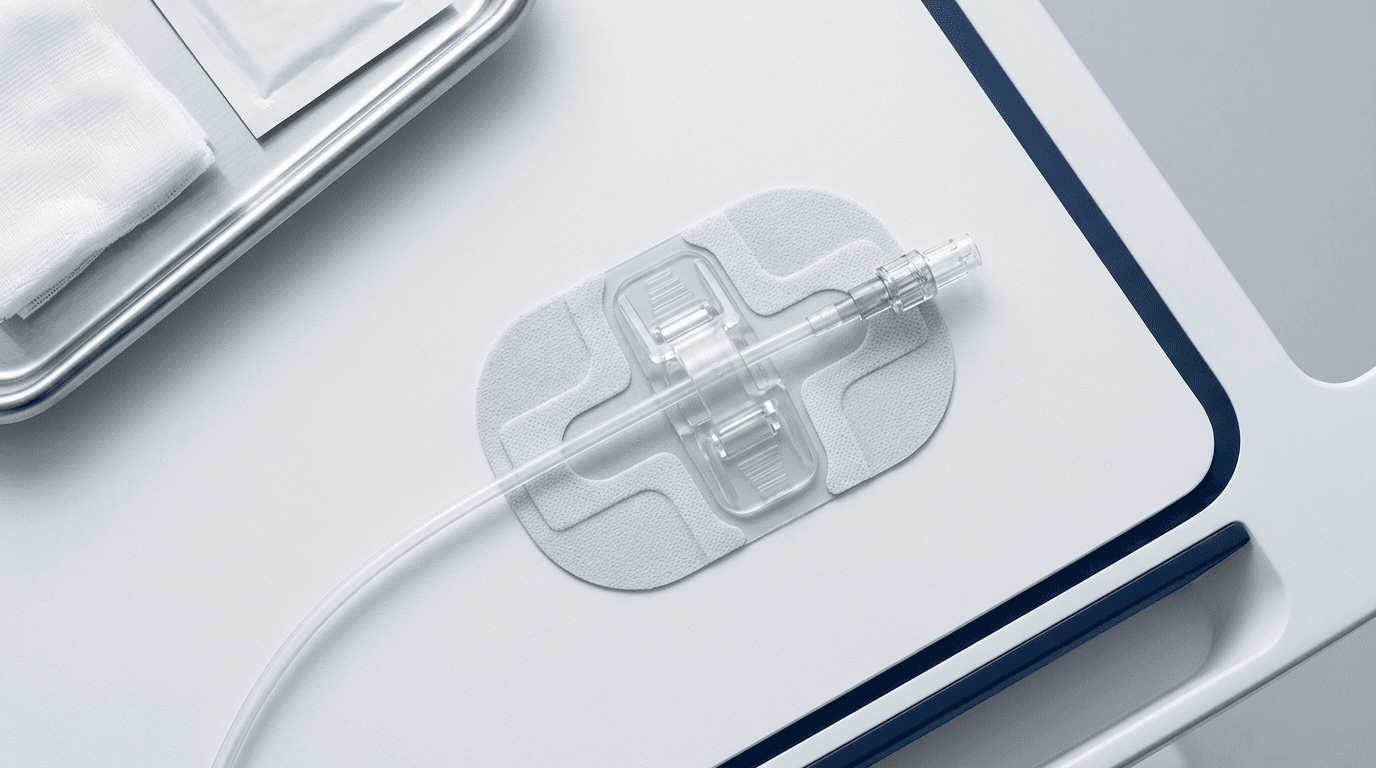
Sterile single-use medical catheter securement device with hypoallergenic adhesive pad and mechanical retainer clip securing an intravenous catheter on a clinical workstation.
What the FDA MAUDE and Recall Record Reveals About Catheter and Tube Securement Device Failures: A Post-Market Evidence Map for Securement Procurement and Supplier Screening (2015–2026)An original FDA post-market surveillance analysis of 1,125 MAUDE medical device reports, a 20-action recall record, and the 510(k)-exempt Class I regulatory baseline (21 CFR 880.5210, product codes KMK, CBH, OKC) translated into tender specifications, acceptance testing, and supplier-screening criteria for vascular-access and catheter-fixation procurement.August 14, 2026 · 16 min read
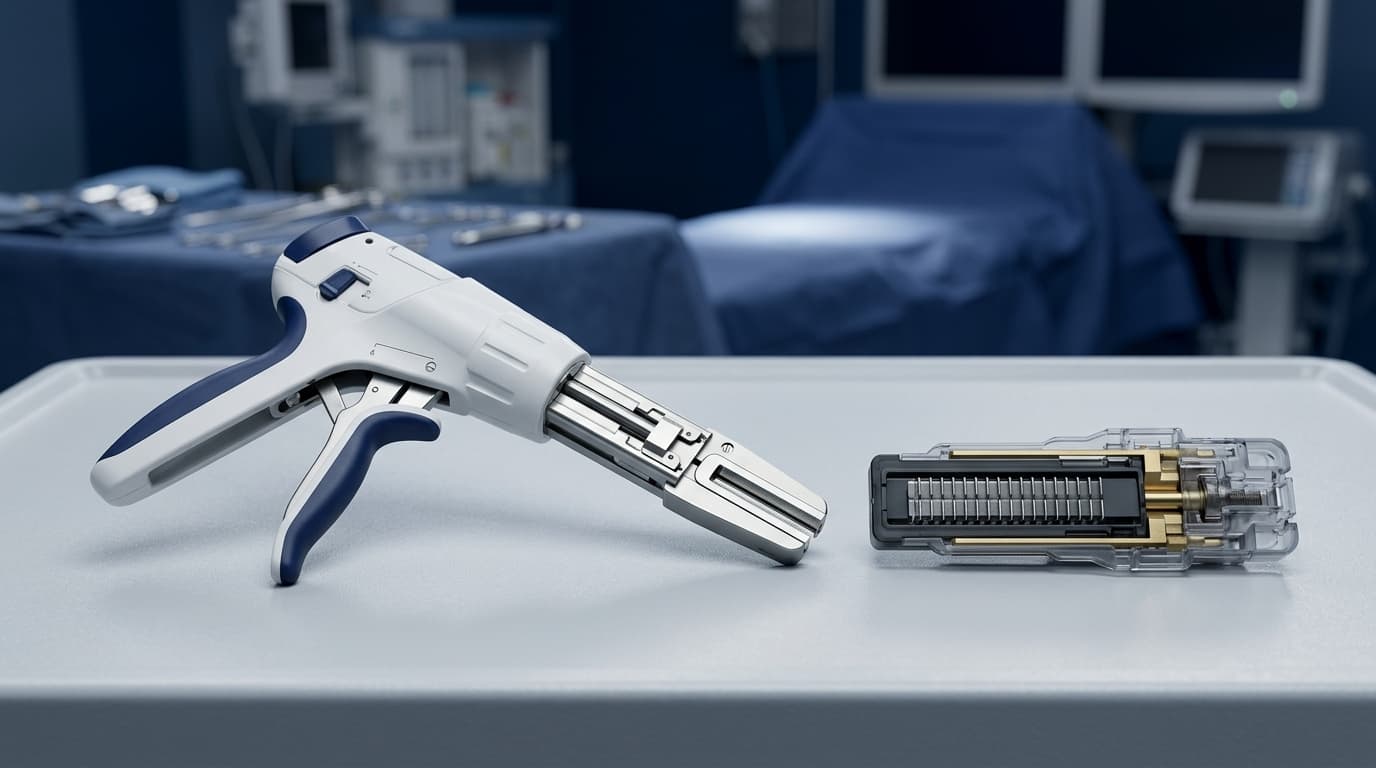
Sterile disposable surgical stapler and cartridge reload laid out on a clinical workstation surface.
What the FDA MAUDE and Recall Record Reveals About Surgical Stapler Failures: A Post-Market Evidence Map for Surgical Stapler Procurement and Supplier Screening (2015–2026)An original FDA post-market surveillance analysis of 3,645 MAUDE medical device reports, Class I/II recalls, and the 2021 Class II reclassification order (21 CFR 878.4740, product code GAG) translated into tender specifications, acceptance testing, and supplier-screening criteria for disposable surgical and circumcision stapler procurement.August 13, 2026 · 16 min read
FDA surveillance analysis diagram showing circumcision device 510(k) classification structure, HFX vs QQR MAUDE report distribution, and recall failure modes.
What the FDA MAUDE and Recall Record Reveals About Circumcision Device Failures: A Post-Market Evidence Map for Circumcision Procurement and Supplier Screening (2015–2026)An original FDA surveillance analysis of 31 circumcision device 510(k) clearances, 34 recalls, and 942 MAUDE adverse-event reports (all-time; 592 in the 2015–2026 window) translated into tender acceptance criteria and supplier-vigilance questions for disposable circumcision stapler, ring, and clamp devices.August 11, 2026 · 16 min read
Component mechanics, sterile kit components, and lot-acceptance testing framework for disposable circumcision anastomat and stapler devices.
Disposable Circumcision Anastomat and Stapler: Device Mechanics, Sterile-Kit Components and Lot-Acceptance Tests for Procurement and Biomedical EngineeringA component-level technical guide to the single-use circumcision anastomat and stapler: the bell-and-staple firing mechanism, what belongs in the sterile convenience kit, the staple-formation and sterile-barrier lot-acceptance tests, and the US, EU and China classification — including why no US 510(k) predicate and no WHO prequalification exist for the stapler.August 9, 2026 · 18 min read
Single-Use vs Reusable NPWT Pump Procurement Decision Matrix comparing FDA Class II product codes OMP, OKO, QPX, and QFC
Single-Use vs Reusable NPWT Pump: A Disposable-vs-Powered Procurement Decision Matrix Built on FDA Product Codes, HCPCS Reimbursement and Per-Episode CostThe FDA itself splits NPWT into reusable powered, non-powered mechanical and disposable powered single-use pumps under three different Class II product codes, and the right buy flows from exudate volume, wound complexity, care setting and reimbursement path rather than a blanket claim that disposable is better.August 8, 2026 · 16 min read
VEMERIX report cover showing thermal vs non-thermal varicose vein ablation regulatory ladder and supplier qualification framework.
Thermal vs Non-Thermal Varicose Vein Ablation: A Vascular Service-Line and Distributor Technology-Selection and Supplier-Qualification Guide (EVLA Laser Fiber vs RFA vs MOCA vs Cyanoacrylate Closure)Thermal (EVLA, RFA) and non-thermal (MOCA, cyanoacrylate closure) varicose-vein ablation platforms sit on different regulatory rungs. EVLA laser fibers (FDA GEX, Class II 510(k)) and RFA/MOCA catheters (GEI/KRA, Class II 510(k)) clear by substantial equivalence, while cyanoacrylate vein closure (VenaSeal, PJQ, Class III PMA) is a single-manufacturer PMA device with zero 510(k) predicates. Evaluate regulatory fit, supplier evidence packs, and consumable workflow economics alongside clinical closure data before committing portfolio or RFQ volume.August 7, 2026 · 16 min read
VEMERIX regulatory guide cover showing a sterile tube of silicone scar gel, silicone sheeting segment, and US EU China regulatory decision documentation.
Silicone Scar Gel Classification and Claim Substantiation: A US (FDA), EU and China (NMPA) Decision Matrix for Distributors and OEM BuyersQualifying a silicone scar gel or sheeting product for international markets requires navigating strict claim-by-claim classification rules across the US (FDA Class I under 21 CFR 878.4025), Europe (EU MDR Class I device vs Cosmetic Regulation boundary), and China (NMPA Class II medical device filing)—where permitted intended-use language, Cochrane evidence certainty, and ISO 10993 biocompatibility requirements set the boundary between compliant commercialization and regulatory rejection.August 5, 2026 · 14 min read
VEMERIX technical guide cover showing an ISO 11137 radiation sterilization validation framework, VDmax decision table, and modality comparison.
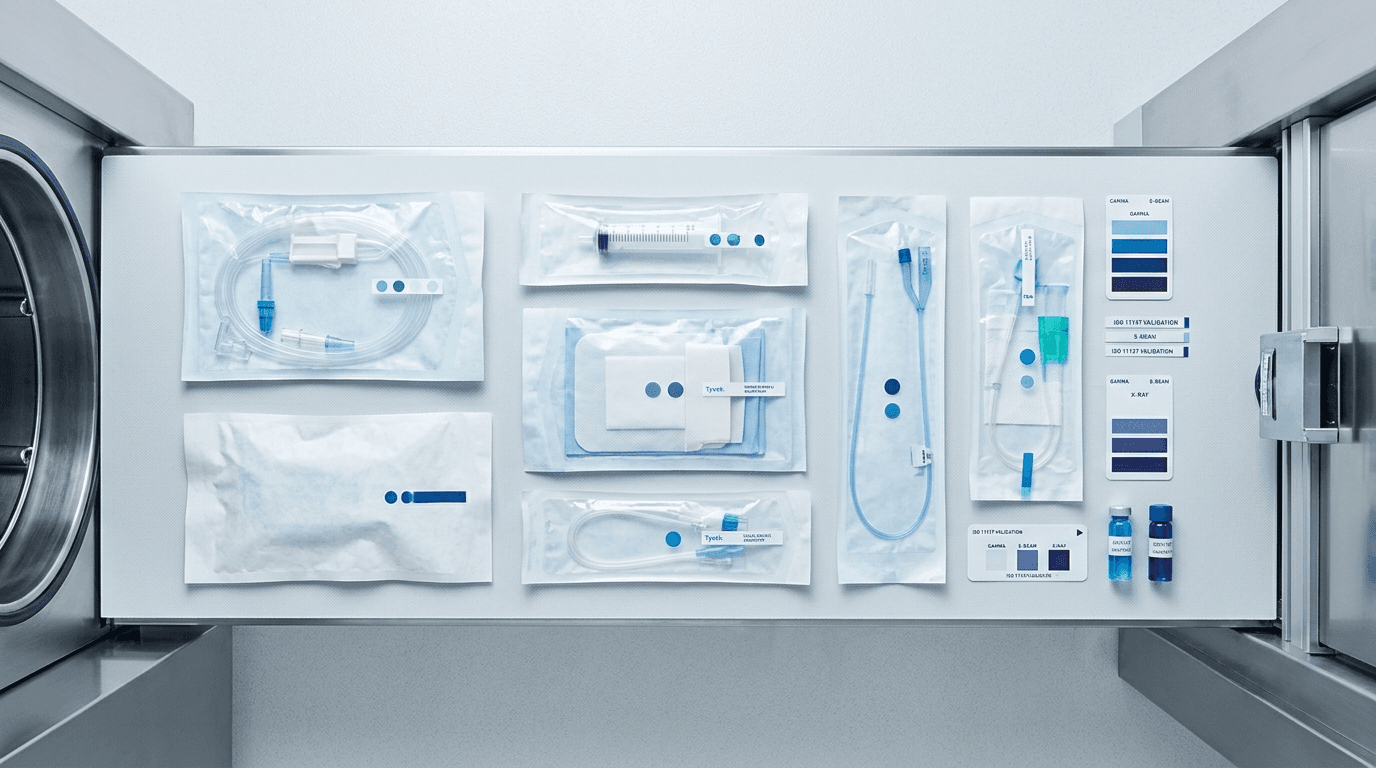
Radiation (Gamma, Electron-Beam and X-Ray) Sterilization Validation for Single-Use Medical Devices: An ISO 11137, VDmax and FDA Evidence Guide for OEM and Private-Label BuyersQualifying a radiation-sterilized single-use device OEM requires verifying an ISO 11137 validation protocol, substantiating the 25 kGy or 15 kGy sterilization dose via VDmax, selecting the optimal modality (gamma vs e-beam vs X-ray), capping polymer maximum doses, and aligning with the 4-month dose-audit interval under ISO 11137-1:2025 and the FDA Radiation Master File Pilot.August 4, 2026 · 18 min read
VEMERIX report cover showing a 1470 nm endovenous laser fiber specification and optical compatibility framework.
Endovenous Laser Fiber Specifications & Compatibility: A Buyer's Specification and RFQ Guide for 1470 nm Radial FibersA 1470 nm single-use endovenous laser fiber must be matched to the console on wavelength, connector standard (SMA905), core diameter, numerical aperture, tip geometry (radial 360° vs bare-tip), introducer French size, and regulator-cleared status (FDA GEX / 21 CFR 878.4810 Class II 510(k); NMPA Class II; EU MDR IIb). Verify console compatibility and clearance before committing volume.August 3, 2026 · 14 min read
VEMERIX technical guide cover showing an ISO 11135 EO sterilization validation acceptance framework and ISO 10993-7 residual limits.
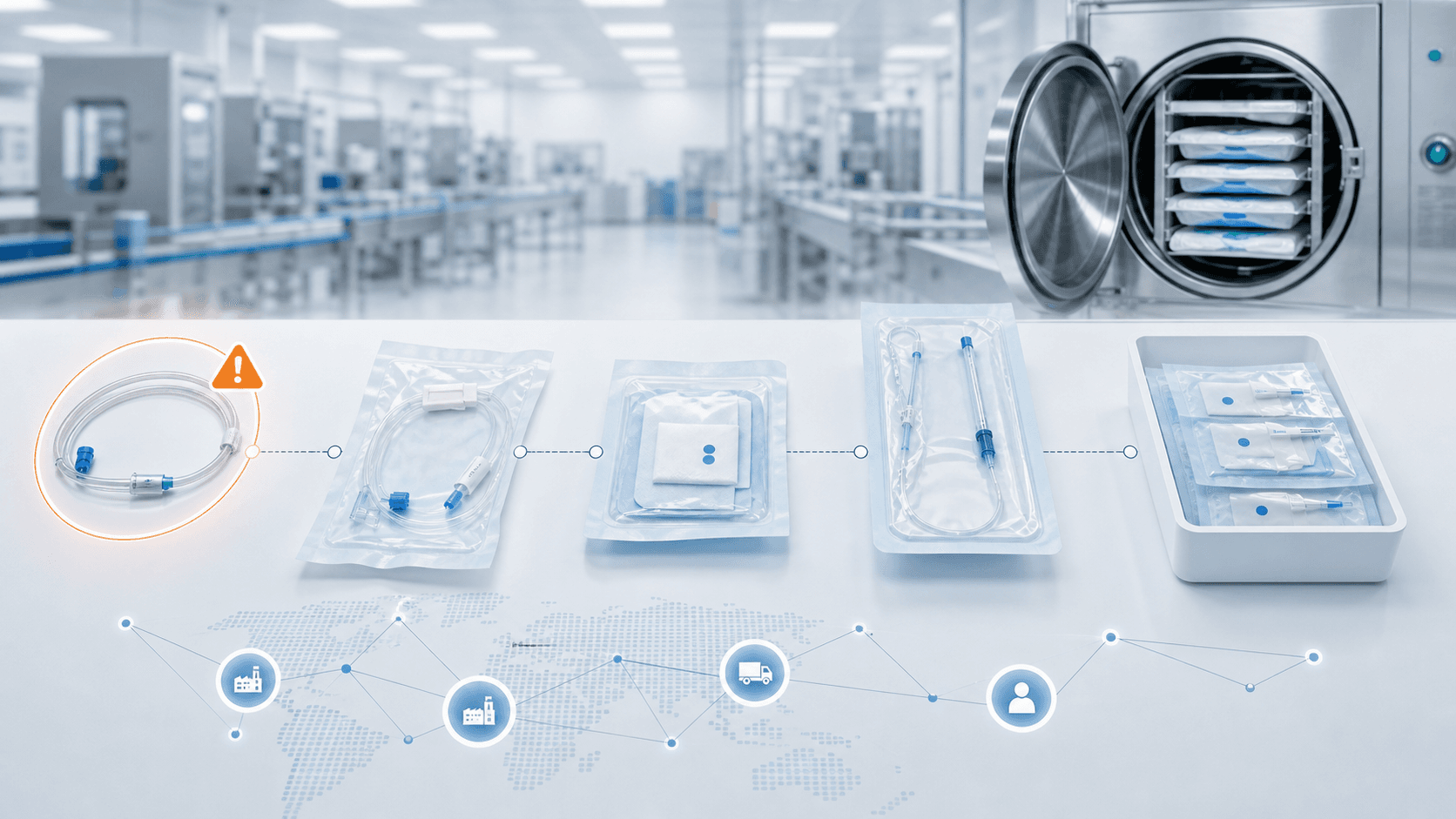
Ethylene Oxide Sterilization Validation for Single-Use Medical Devices: An ISO 11135 Process, ISO 10993-7 Residual and FDA Evidence Guide for OEM and Private-Label BuyersQualifying a sterile single-use device OEM demands a validated ISO 11135 process, documented ISO 10993-7 residual dissipation profiles below 4 mg EO / 9 mg ECH for limited contact, clear parametric or BI release protocols, and a regulatory change-control strategy under the FDA Sterilization Master File pilots.August 3, 2026 · 16 min read
VEMERIX regulatory guide cover showing a US, EU and China regulatory decision matrix for hypochlorous acid (HOCl) disinfectants.
Hypochlorous Acid (HOCl) Disinfectant Classification: A US, EU and China Regulatory Decision Matrix for Medical-Device and Hygiene-Product BuyersProcuring hypochlorous acid (HOCl) disinfectants internationally requires recognizing that regulatory classification is governed by intended-use claims, concentration, and application site rather than chemical identity—navigating the US EPA pesticide vs FDA liquid sterilant split under PRN 98-2, ECHA Biocidal Products Regulation (BPR) active substance rules in Europe, and China's weixiaozheng hygiene licensing system.August 3, 2026 · 15 min read